
The Sunday Of the Orthodoxy
The first Sunday in Lent is kept in memory: primarily, of the final triumph of the Church over the Iconoclasts in 842; and, incidentally, of her victory over all other heresies. It has a kind of commination appropriate to itself alone
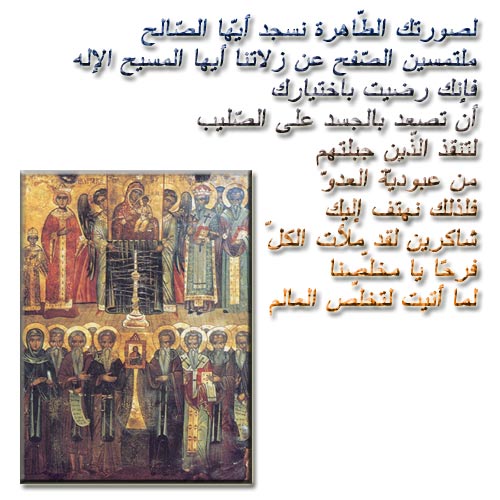
We worship your most pure icon, loving Lord, as we ask pardon of our offences, Christ God. For by your own choice you were well-pleased to ascend the Cross in the flesh, to deliver from the slavery of the enemy those whom you had fashioned; therefore with thanksgiving we cry to you: You have filled all things with joy, our Saviour, by coming to save the world
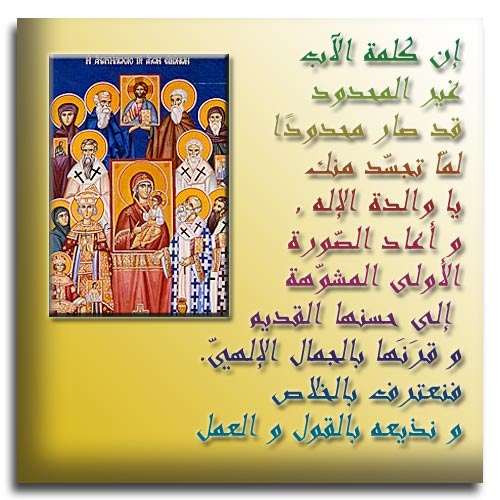
First Sunday of Lent: The Sunday of Orthodoxy
http://www.goarch.org/en/ourfaith/articles/article8127.asp
Lent was in origin the time of final preparation for candidates for baptism at the Easter Vigil, and this is reflected in the readings at the Liturgy, today and on all the Sundays of Lent. But that basic theme came to be subordinated to later themes, which dominated the hymnography of each Sunday. The dominant theme of this Sunday since 843 has been that of the victory of the icons. In that year the iconoclastic controversy, which had raged on and off since 726, was finally laid to rest, and icons and their veneration were restored on the first Sunday in Lent. Ever since, that Sunday been commemorated as the "triumph of Orthodoxy."
Orthodox teaching about icons was defined at the Seventh Ecumenical Council of 787, which brought to an end the first phase of the attempt to suppress icons. That teaching was finally re-established in 843, and it is embodied in the texts sung on this Sunday.
"Inspired by your Spirit, Lord, the prophets foretold your birth as a child incarnate of the Virgin. Nothing can contain or hold you; before the morning star you shone forth eternally from the spiritual womb of the Father. Yet you were to become like us and be seen by those on earth. At the prayers of those your prophets in your mercy reckon us fit to see your light,
"for we praise your resurrection, holy and beyond speech. Infinite, Lord, as divine, in the last times you willed to become incarnate and so finite; for when you took on flesh you made all its properties your own. So we depict the form of your outward appearance and pay it relative respect, and so are moved to love you; and through it we receive the grace of healing, following the divine traditions of the apostles.
"The grace of truth has shone out, the things once foreshadowed now are revealed in perfection. See, the Church is decked with the embodied image of Christ, as with beauty not of this world, fulfilling the tent of witness, holding fast the Orthodox faith. For if we cling to the icon of him whom we worship, we shall not go astray. May those who do not so believe be covered with shame. For the image of him who became human is our glory: we venerate it, but do not worship it as God. Kissing it, we who believe cry out: O God, save your people, and bless your heritage.
"We have moved forward from unbelief to true faith, and have been enlightened by the light of knowledge. Let us then clap our hands like the psalmist, and offer praise and thanksgiving to God. And let us honor and venerate the holy icons of Christ, of his most pure Mother, and of all the saints, depicted on walls, panels and sacred vessels, setting aside the unbelievers' ungodly teaching. For the veneration given to the icon passes over, as Basil says, to its prototype. At the intercession of your spotless Mother, O Christ, and of all the saints, we pray you to grant us your great mercy. We venerate your icon, good Lord, asking forgiveness of our sins, O Christ our God. For you freely willed in the flesh to ascend the cross, to rescue from slavery to the enemy those whom you had formed. So we cry to you with thanksgiving: You have filled all things with joy, our Savior, by coming to save the world.
The name of this Sunday reflects the great significance which icons possess for the Orthodox Church. They are not optional devotional extras, but an integral part of Orthodox faith and devotion. They are held to be a necessary consequence of Christian faith in the incarnation of the Word of God, the Second Person of the Trinity, in Jesus Christ. They have a sacramental character, making present to the believer the person or event depicted on them. So the interior of Orthodox churches is often covered with icons painted on walls and domed roofs, and there is always an icon screen, or iconostasis, separating the sanctuary from the nave, often with several rows of icons. No Orthodox home is complete without an icon corner, where the family prays.
Icons are venerated by burning lamps and candles in front of them, by the use of incense and by kissing. But there is a clear doctrinal distinction between the veneration paid to icons and the worship due to God. The former is not only relative, it is in fact paid to the person represented by the icon. This distinction safeguards the veneration of icons from any charge of idolatry.
Although the theme of the victory of the icons is a secondary one on this Sunday, by its emphasis on the incarnation it points us to the basic Christian truth that the one whose death and resurrection we celebrate at Easter was none other than the Word of God who became human in Jesus Christ.
On This day we also remember the Famous Icon defender : St John Of Damascus ( Al Mansour )
http://elvis.rowan.edu/~kilroy/JEK/12/04.html
John of Damascus, hymn-writer, defender of icons
4 December 750
John is generally accounted "the last of the Fathers". He was the son of a Christian official at the court of the moslem khalif Abdul Malek, and succeeded to his father's office.
In his time there was a dispute among Christians between the Iconoclasts (image-breakers) and the Iconodules (image-venerators or image-respectors). The Emperor, Leo III, was a vigorous upholder of the Iconoclast position. John wrote in favor of the Iconodules with great effectiveness. Ironically, he was able to do this chiefly because he had the protection of the moslem khalif (ironic because the moslems have a strong prohibition against the religious use of pictures or images).
John is also known as a hymn-writer. Two of his hymns are sung in English at Easter ("Come ye faithful, raise the strain" and "The Day of Resurrection! Earth, tell it out abroad!"). Many more are sung in the Eastern Church.
His major writing is The Fount of Knowledge, of which the third part, The Orthodox Faith, is a summary of Christian doctrine as expounded by the Greek Fathers.
The dispute about icons was not a dispute between East and West as such. Both the Greek and the Latin churches accepted the final decision.
The Iconoclasts maintained that the use of religious images was a violation of the Second Commandment ("Thou shalt not make a graven image... thou shalt not bow down to them").
The Iconodules replied that the coming of Christ had radically changed the situation, and that the commandment must now be understood in a new way, just as the commandment to "Remember the Sabbath Day" must be understood in a new way since the Resurrection of Jesus on the first day of the week.
Before the Incarnation, it had indeed been improper to portray the invisible God in visible form; but God, by taking fleshly form in the person of Jesus Christ, had blessed the whole realm of matter and made it a fit instrument for manifesting the Divine Splendor. He had reclaimed everything in heaven and earth for His service, and had made water and oil, bread and wine, means of conveying His grace to men. He had made painting and sculpture and music and the spoken word, and indeed all our daily tasks and pleasures, the common round of everyday life, a means whereby man might glorify God and be made aware of Him. (Note: I always use "man" in the gender-inclusive sense unless the context plainly indicates otherwise.)
Obviously, the use of images and pictures in a religious context is open to abuse, and in the sixteenth century abuses had become so prevalent that some (not all) of the early Protestants reacted by denouncing the use of images altogether. Many years ago, I heard a sermon in my home parish (All Saints' Church, East Lansing, Michigan) on the Commandment, "Thou shalt not make a graven image, nor the likeness of anything in the heavens above, nor in the earth beneath, nor in the waters under the earth -- thou shalt not bow down to them, nor worship them." (Exodus 20:4-5 and Deuteronomy 5:8-9) The preacher (Gordon Jones) pointed out that, even if we refrain completely from the use of statues and paintings in representing God, we will certainly use mental or verbal images, will think of God in terms of concepts that the human mind can grasp, since the alternative is not to think of Him at all. (Here I digress to note that, if we reject the images offered in Holy Scripture of God as Father, Shepherd, King, Judge, on the grounds that they are not literally accurate, we will end up substituting other images -- an endless, silent sea, a dome of white radiance, an infinitely attenuated ether permeating all space, an electromagnetic force field, or whatever, which is no more literally true than the image it replaces, and which leaves out the truths that the Scriptural images convey. (One of the best books I know on this subject is Edwyn Bevan's Symbolism and Belief, Beacon Press, originally a Gifford Lectures series.) C S Lewis repeats what a woman of his acquaintance told him: that as a child she was taught to think of God as an infinite "perfect substance," with the result that for years she envisioned Him as a kind of enormous tapioca pudding. To make matters worse, she disliked tapioca. Back to the sermon.) The sin of idolatry consists of giving to the image the devotion that properly belongs to God. No educated man today is in danger of confusing God with a painting or statue, but we may give to a particular concept of God the unconditional allegiance that properly belongs to God Himself. This does not, of course, mean that one concept of God is as good as another, or that it may not be our duty to reject something said about God as simply false. Images, concepts, of God matter, because it matters how we think about God. The danger is one of intellectual pride, of forgetting that the Good News is, not that we know God, but that He knows us (1 Corinthians 8:3), not that we love Him, but that He loves us (1 John 4:10).
(Incidentally, it was customary in my parish in those days for the preacher to preach a short "Children's Sermon," after which the children were dismissed for Sunday School, and the regular sermon and the rest of the service followed. What I have described above was the Children's Sermon. I remained for the regular sermon, but found it a bit over my head -- a salutary correction to my intellectual snobbery.)
In the East Orthodox tradition, three-dimensional representations are seldom used. The standard icon is a painting, highly stylized, and thought of as a window through which the worshipper is looking into Heaven. (Hence, the background of the picture is almost always gold leaf.) In an Eastern church, an iconostasis (icon screen) flanks the altar on each side, with images of angels and saints (including Old Testament persons) as a sign that the whole church in Heaven and earth is one body in Christ, and unites in one voice of praise and thanksgiving in the Holy Liturgy. At one point in the service, the minister takes a censer and goes to each icon in turn, bows and swings the censer at the icon. He then does the same thing to the congregation -- ideally, if time permits, to each worshipper separately, as a sign that every Christian is an icon, made in the image and likeness of God, an organ in the body of Christ, a window through whom the splendor of Heaven shines forth.
Prayer (traditional language)
Confirm our minds, O Lord, in the mysteries of the true faith, set forth with power by thy servant John of Damscus; that we, with him, confessing Jesus to be true God and true Man, and singing the praises of the risen Lord, may, by the power of the resurrection, attain to eternal joy; through Jesus Christ our Lord, who liveth and reigneth with thee and the Holy Spirit, one God, for evermore.
Prayer (contemporary language)
Confirm our minds, O Lord, in the mysteries of the true faith, set forth with power by your servant John of Damscus; that we, with him, confessing Jesus to be true God and true Man, and singing the praises of the risen Lord, may, by the power of the resurrection, attain to eternal joy; through Jesus Christ our Lord, who lives and reigns with you and the Holy Spirit, one God, for evermore.
Psalm 118:14-21 or 16:5-11
1 Corinthians 15:12-20
John 5:24-27 (Eas)
http://www.stjohn1.homestead.com/
Also known as : Doctor of Christian Art; Jean Damascene;
Johannes Damascenus; John Chrysorrhoas ("golden-stream"); John of Damascus
Memorial : 27 March (Latin Church); 4 December (Greek Church)
Profile : Son of Mansur, representative of the Christians to the court of
the Muslim caliph. Apparently thrived as a Christian in a Saracen land, becoming
the chief financial officer for caliph Abdul Malek. Tutored in his youth by a
captured Italian monk named Cosmas. Between the Christian learning of the monk,
and that of the Muslim schools, John became highly educated in the classical
fields (geometry, literature, logic, rhetoric, etc.).
Defended the use of icons and images in churches through a series of letters
opposing the anti-icon decrees of Germanus, Patriarch of Constantinople. Legend
says that Germanus plotted against him, and forged a letter in which John
betrayed the caliph; the caliph ordered John's writing hand chopped off, but the
Virgin Mary appeared and reattached the hand, a miracle which restored the
caliph's faith in him.
After this incident, John became a monk near Jerusalem. Priest. Anathematized by
name by the 754 Council of Constantinople over his defense of the use of icons,
but defended by the 787 Seventh Council of Nicea.
Wrote The Fountain of Wisdom, the first real compendium of Christian theology,
along with other works defending the orthodox faith, commentaries on Saint Paul,
poetry, and hymns. Philospher. Orator; such an excellent speaker he was known as
Chrysorrhoas ("golden-stream"). Last of the Greek Fathers of the Church, and the
first of the Christian Aristotleans. Adapted choral music for use in the
liturgy. Proclaimed a Doctor of the Church in 1890 by Pope Leo XIII.
Born : 676 at Damascus, Syria
Died : 749 of natural causes