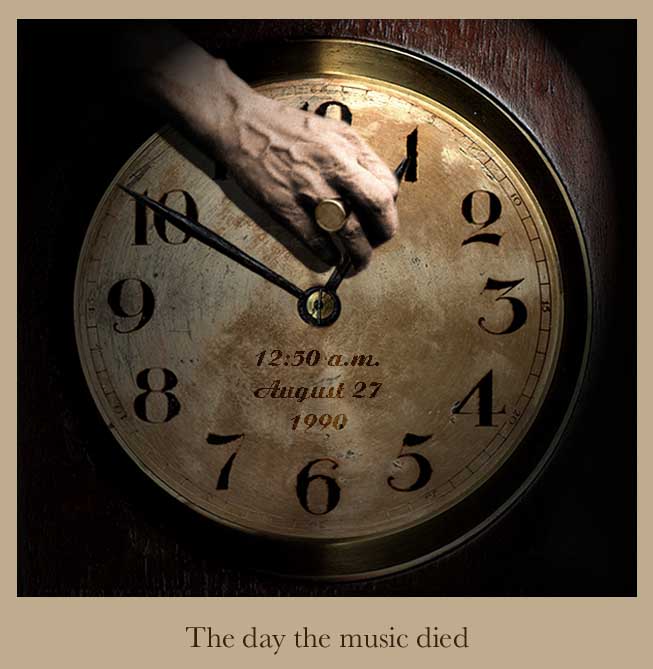
The helicopter took off in fog around 12:40 A.M. with Vaughan and four others aboard. Sweet Chicago would never be reached. Moments later the chopper's remains lay spread across more than 200 feet of a man-made ski slope in a field dotted with bittersweet and Queen Anne's lace. All on board were killed instantly in what National Transportation Safety Board investigator William Bruce later described as "a high-energy, high-velocity impact at a shallow angle." (Read the Official Accident Report)
Fans leaving the noisy concert site did not hear the crash, which occurred on the far side of the nearby hill. In fact a search for the lost copter wasn't begun until 5 A.M. -- more than four hours later -- after an orbiting search-and-rescue satellite picked up the craft's emergency-locator transmitter signal. At 7 A.M. searchers found the bodies of Vaughan; Bobby Brooks, Clapton's Hollywood agent; pilot Jeff Brown (who may have been unfamiliar with the hilly site's tricky take-off procedures); Clapton's assistant tour manager, Colin Smythe; and Clapton's bodyguard, Nigel Browne. Later that morning Clapton and Jimmie Vaughan were summoned by the Walworth County coroner to identify the bodies.
The first flash comes over the AP wire at about 7 am: Copter crash in East
Troy, Wisconsin. Five fatalities, including "a musician" .
Keen eyes at the Austin American Statesman newsroom catch that item and
begin putting two and two together. Every half hour, AP updates with details.
The mysterious "musician" becomes "a member of Eric Clapton's
entourage" and then "a guitarist".
By 9:30 rumors spread that Stevie Ray Vaughan, Austin's favorite son, was aboard the doomed craft. At 11:30, Clapton's manager confirms the worst: Stevie Ray Vaughan was indeed among the passengers in the five-seat helicopter that slammed into a fog-shrouded hillside near southeastern Wisconsin's Alpine Valley ski resort.
By noon, a shock wave reverberates through the capital city of Texas. It's the most devastating news to hit the Lone Star State's music community since Buddy Holly, along with Richie Valens and the Big Bopper, went down in a plane 31 years ago. People walk about tearfully, dazed and disoriented. Friends call friends who call friends.
" I found myself calling people I hadn't talked to in 15 years,'' says Austin singer-songwriter Natalie Zee. "Everyone was reaching out and trying to make connections with people who knew how important Stevie was to them. I mean...he was our homeboy."
The entire town is in mourning by five p.m. Merchants post signs and hoist banners proclaiming "We Love You Stevie," and "So Long Stevie," outside their stores. Even the Holiday Inn replaces the cheery "Welcome Conventioneers" adorning its marquee with a somber "SRV R.I.P." Plumbing stores, Tex-Mex restaurants, musical instrument stores, donut shops - all fly the flag of grief. The signs of mourning are all-pervasive in this central Texas town where Little Stevie Vaughan, the skinny kid from Oak Cliff, became Stevie Ray Vaughan, hometown hero and Austin's musical ambassador to the world. Fans begin converging on Zilker Park, where mourners gathered for a candlelight vigil on the night John Lennon was murdered. Now, ten years later, they sit side by side in the darkness, with 3,000 points of light flickering in a sea of sorrow. Tatooed Chicago bikers sit next to lawyers in Brooks Brothers suits, who sit next to New Agers who spread crystals on blankets and meditate in silence. Fans clutching pictures of SRV construct shrines to the fallen guitar hero. Young gunslingers tote their Strats, Buddhists chant nom-yo-renge-kyo and old friends weep openly as dj Jody Denberg of Austin's KLBJ pumps a steady diet of SRV through a makeshift PA out to the crowd. The sound of Stevie Ray's stinging Strat pierces the night air and goes directly to the hearts of these huddled blues fans, offering some kind of solace in the face of utter despair.
"It's depressing and spiritually healing at the same time,'' says one bereaved SRV fan. clutching a copy of Texas Flood that the guitarist had autographed some years earlier.
While the throng of mourners continues to grow at Zilker Park, others instinctively head to Antone's, the club that served as a focal point for the Austin blues scene throughout the mid-Seventies, and was a favorite hangout of the Vaughan Brothers over the years. Some SRV fans have driven from as far as Oklahoma just to be there. Others come on foot from their dorms on the campus of Texas University, listening to Paul Ray's "Blue Monday " tribute on KTU as they walk. One fan fondly recalls the night back in 1978 when Stevie Ray went toe to toe on stage at Antone's with Otis Rush. the great left-handed bluesman who wrote the tune that SRV named his band after. A mourner recalls the night he saw Little Stevie play with Albert King back in 1975. A younger fan relates in still-awed tones his excitement over witnessing a jam in 1987 that saw Stevie Ray and Jimmie joined by U2's The Edge and Bone. Local TV stations begin converging on the club by 9 p.m. They're looking for emotional testimony from SRV intimates, and they get plenty when Clifford Antone, the club's owner and close friend to both Vaughan brothers, breaks down on camera.
"I met Stevie when I was 22 and he was 17", he sobs, "The kid could always play. I mean, he could play as good then as he does now. People like that... it's just born in 'em, you know? He was Little Stevie back then, just a kid. He'd hang out and play and make you laugh. It was a very simple thing. It had nothing to do with the record business. or TV or movies or any of that shit. Him, me, Jimmie, Denny Freeman, Doyle Bramhall ...we were all just a bunch of kids drawn together by our love of the blues, you know? And even in recent years, when I'd see him, I'd say, 'Howya doin', kid?' I mean, he was my friend, just this little guy who played guitar. The rest is the world's trip, you know?"
It is somehow appropriate that W.C. Clark is booked this night at Antone's. A black bluesman from East Austin, W.C. played with Stevie Ray and singer Lou Ann Barton in the late-Seventies band Triple Threat Review. Last year, the three were reunited for a special Austin City Limits program that celebrated W.C.'s 50th birthday. "I'm dumbfounded," says Clark, appearing quite shaken. "He was an easygoing person, really lovable. I felt like a benefactor to him."
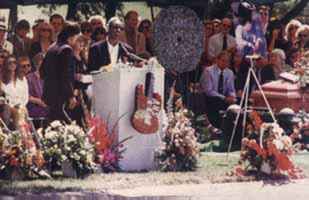
Browne, Raitt & Wonder sing "Amazing Grace" at Stevie's funeral
Old friends and colleagues show up at Antone's this night to hug each other and help wipe away the tears that won't quit. Doug Sahm, David Grissom, Paul Ray, Little David Murray, Derek O'Brien, Van Wilks, Marcia Ball and dozens of other Austin notables get up and play for Stevie Ray. And they recall both the lean years and the good times. Natalie Zoe remembers Stevie Ray as the nice guy who lived across the street in a funky shack-ratty house on Thornton Road, near the railroad tracks. "We were all young and broke back in the late Seventies." she says. "None of us on that street had any air conditioning, and it was hot, eight months a year. So we did a lot of hanging out on porches, picking guitars and trying to stay cool. I was playing steady gigs then and he used to help me haul my gear out of the house and into my car. He was always very gentlemanly, very neighborly. Just a nice, sweet guy."
Eddie Munoz, an old friend who played guitar in the early-Eighties band The Plimsouls, recalls SRV's uncanny ability to communicate directly through his instrument. "Stevie was a rarity. There are very few people who have that much soul and that much power who can command that much attention just by plugging in a guitar. I remember one time, a couple of years before he got signed, I was on tour with the Plimsouls and ran into him in New Orleans. We were hanging around the French Quarter and we walked into this open-air club where a blues band was playing. There were only three people in the audience, and Stevie Ray had his guitar with him, so the band let him sit in. And within five minutes, man, there was a crowd of a hundred people milling around outside, staring at this guy piping out this hot stuff on guitar. It was wild, man. The guy could always draw crowds by plugging that thing in. But he didn't carry any big pretense about it. He used to say to me, 'I don't know where it came from. It just happened. My brother Jimmie showed me some stuff and then it was like the damn broke."
He was a great guy and a decent human being", Munoz continues, still reeling from the news. "He was just so shy and unassuming, until you put a guitar in his hands. He lived for playing that guitar. Everybody's jaw dropped whenever he played. There are those people who are just so blessed - one person out of millions who can touch the instrument and it sings for them. He always had that." Guitarist Van Wilks remembers SRV as someone who transcended the various musical cliques around Austin.
"You had all these factions here in the early Eighties - the Antone's straight blues scene, the country scene, the New Wave college scene, the younger hard rock and heavy metal scene. But Stevie was able to transcend all of that without even being aware of it. He had respect from everybody in all those genres and scenes." Wilks catches himself using the past tense in reference to Stevie Ray. He freezes up in mid-sentence, pauses, hangs his head and continues in a hushed tone, as if the life had just run out of him: "Man, it just now hit me."
That night at The Steamboat, another Austin guitar hero, Eric Johnson, dedicates his set to Stevie Ray. Another cathartic act in a town coming to grips with cold, harsh reality.
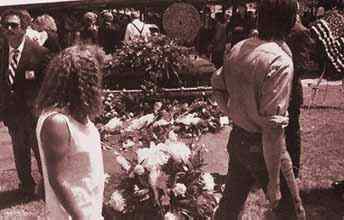
Mourners pass by and pay their final respects to Stevie
I pull into the park of the South Dallas neighborhood where Stevie Ray grew up. A red pickup truck with LIFE WITHOUT YOU emblazoned in white paint on the hood informs me that this is the right place. I park and walk toward the flickering lights. In the distance, a few hundred mourners are circled around a huge tree in the middle of a grassy meadow. Dozens of white candles placed around the thick tree trunk bathe the sad faces in an eerie glow. This is no beerguzzling, carousing hang. The mood is respectful, peaceful. Heads bowed, some hold hands in silence as the flames illuminate a series of photographs placed at the base of the great tree. Among the pictures is a telling shot of a 15-year-old Little Stevie playing a guitar. Same posture, same attitude. Even back then he had The Look. Vigil organizer Christian Brooks speaks softly of growing up with Stevie and Jimmie in Oak Cliff. A part-time drummer and full-time custom leather craftsman (he made the SRV strap that Stevie Ray wore proudly for so long), he recollects a true blue friendship that began at Kimball High and continued through the years.
Suddenly the reverential silence is shattered by a man overcome with grief. He steps into the ring of mourners and starts to testify: "I grew up with Stevie Ray. And I just wanna say that I loved Stevie Ray Vaughan." He begins meekly but gains courage and conviction as the crowd urges him on. "Now, if you don't mind, I'd like to sing a song for him." The mourners shout their approval. He closes his eyes, summons some inner reserve. and belts out a psalm with sanctified intensity. Several in the crowd raise their hands to the sky, praising god, tears streaming down their faces.
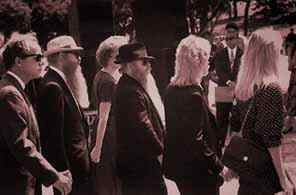
Members of ZZ Top proceeding to the ceremony
Near the burial site are more than 150 floral arrangements that have been sent from around the world. Several are shaped like Stevie Ray's Strat and bear his SRV logo. Off to one side, a recent photo of Stevie Ray rests on an easel, his trademark black bolero draped over one corner of the portrait. A placard propped against the spot where the casket will be laid reads: "We will cherish what you have given us and weep for the music left unplayed."
First to emerge from the chapel is Stevie Wonder. The hushed crowd looks on as he is led to a sheltered reviewing stand by the graveside. The casket is placed in a white hearse, which slowly drives to the site, mourners following behind on foot. Jimmie and his mother, Martha, walk alongside the late guitarist's fiance, Janna Lapidus. Behind them, strolling with heads bowed, Chris Layton and Tommy Shannon, flanked by Kim Wilson. Behind them are Jeff Healey and his band, a tearful Charlie Sexton, Dr. John, ZZ Top's Billy Gibbons, Dusty Hill and Frank Beard, Mark Pollac of Charley's Guitars in Dallas and Colin James, Charlie Comer, Stevie Ray's personal friend and publicist for the past eight years. Buddy Guy, overcome with grief, slips out of the chapel into a nearby car.
The Rev. Barry Bailey of the First United Methodist Church of Fort Worth (Stevie Ray's AA sponsor) opens the service with some personal thoughts, his rich voice booming out to the crowd through two huge stacks of speakers. "We're here to thank God for this man's life." he begins. "He was a genius, a superstar, a musician's musician. He captured the hearts of thousands and thousands of people. I am thankful for the Impact of this man's influence on thousands of people in getting his own life together in the name of God."
Stevie Ray's close friend Bruce Miller steps to the podium and reads the Twelve Steps to Recovery from the Alcoholics Anonymous Big Book, placing it on the casket as he finishes. Several mourners weep openly as Nile Rodgers eulogizes Stevie Ray by recalling a tune from the Family Style session he had produced only a few short weeks before: "In the song 'Tick Tock,' he sings the refrain, 'Remember.' And what Stevie was trying to tell me, and I guess all of us.. he was trying to tell me, 'Nile, remember my music. Remember how important music is to all of us. And just remember that it's a gift.' Stevie was truly touched by the hand of God. He had a powerful gift. And through his music he can'make us all remember things that are very, very impor- tant, like love and family. "
His voice begins to crack with emotion as he continues. "Jimmie and Stevie made me a part of their family when we were doing the record. And I feel very, very sorry that I wasn't able to say to Stevie, to his face, 'Thank you, Stevie. Thank you for making me remember music, thank you for sharing a part of your music with me. Thank you for sharing your love with me. Thank you for making me a part of your family. Thank you for making me your brother.' I'll always love you. I'll always cherish the moments that we spent together. And believe me, Stevie, I'll always remember."
With that, the soulful sound of Stevie's soothing vocal on "Tick Tock" pours through the speakers, touching hearts and raising goose bumps. The crowd claps and cheers as one.
Bonnie Raitt, Jackson Browne and Stevie Wonder lead the crowd in a singalong of "Amazing Grace.'' Bonnie carries the melody as the other two harmonize. When Raitt says, "Take it, Stevie," the magnificence of the Wonder voice, swooping and swirling around the notes with awesome, emotionally-charged power, causes many in the crowd to lose it. Tears flow as his voice soars.
Finally, the mourners line up. One by one they pass the casket. Some throw flowers, religious artifacts, guitar picks at the foot of the casket. The last to pay his respects, nearly an hour later, is Doug Castor, the young man who had mistakenly flown in to Austin from Pittsburgh two days ago. He wheels himself up to the casket and says his fond farewells.
*Authors Unknown

