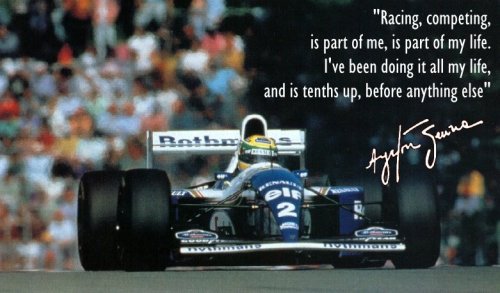
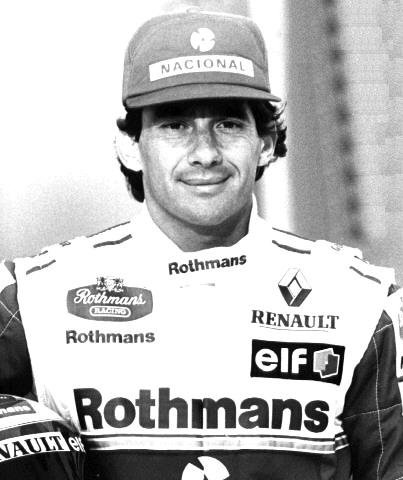
AYRTON SENNA - "THE GREATEST"
March 21, 1960 - May 1, 1994
' In Life Unbeatable - In Death Irreplaceable '
A simple bend. Yes, it was bumpy; Yes, he took it at 307 km/h, but this was a man who could make a car dance. Yet he crashed on that straightforward corner, and he died.
Imola, San Marino
Friday, April 29, 1994
9.30am: Free practice, timed but not counting towards qualifying, began. Senna completed 22 laps, recording a fastest time of 1min 21.598sec, more than a second faster than his team-mate, Damon Hill.
1.14pm: Fourteen minutes into the first qualifying session, Senna completed the fastest lap. Moments later, as he was returning to the pits, the Jordan of Rubens Barrichello hit the kerb in the middle of the 140mph Variante Bassa chicane, hurtled through the air, cleared a metre-high tyre barrier and smashed against a debris fence. The crash looked horrific, reminiscent of Gerhard Berger's five years before, and it stunned Senna, who regarded Barrichello as his heir, the keeper of the tradition of great Brazilian racing drivers.
There are conflicting reports about Senna's immediate reaction. Senna did not see the accident himself but sent Betise Assumpcao, his personal assistant, to the Jordan pits to find out more. Owen O'Mahony, Senna's pilot who happened to be in the pits, thought that Senna had gone straight to the medical centre. Senna certainly went to the centre. Finding the front door blocked, he vaulted a fence to get in the back. Barrichello, who regained consciousness minutes after the accident, found Senna looking over him. ``The first face I saw was Ayrton's,'' Barrichello recalled later. ``He had tears in his eyes. I had never seen that with Ayrton before. I just had the impression he felt as if my accident was like one of his own.'' The tears were the first of many that weekend, but within minutes Senna was back in the cockpit.
1.40pm: The qualifying session resumed. Senna bettered his time immediately and just before the close set what was to prove the quickest time of the weekend, a lap of 1min 21.548sec at an average of 138.2mph. The lap, in a car still unfamiliar to him and in the emotional aftermath of Barrichello's crash, was an emphatic reminder of Senna's supreme skill and courage.
But there was already a fragment of evidence that Senna was not as single-minded as usual. Walking past the Williams garage during practice, O'Mahony was surprised to hear Senna call him. ``Owen, I have something for you,'' Senna said, diving into his briefcase and producing three signed photographs of himself with O'Mahony. ``That was odd,'' O'Mahony said. ``I had been meaning to ask him for the pictures for a long time, but never got around to it. He had made a particular point of doing them for me anyway. The other odd thing was that he gave them to me in the middle of testing. It was all so out of character for him to think about anything other than racing. It was almost as if he wanted to tie up some loose ends.''
Senna was not happy with his car. He had a long and animated discussion with his race engineer, David Brown, and later that afternoon, having arranged to meet a small group of journalists to talk about his business interests, cut short the interview because of a ``big engineering problem'' with the car.
Mark Fogarty, of Carweek magazine, a well-known figure in Formula One, was one of the group. He recalled: ``I was struck at the time by how much effort he had to make to focus on our questions. If Senna agreed to do an interview, he would always give it his full attention. Sometimes, he even took so long answering a question you wondered if he had heard it, but he was simply thinking about the implications. This time, he just wasn't focused. His answers were halting and he looked glazed as if he was mentally worn out.''
After 20 minutes, Senna left to talk to Brown again. The journalists waited for an hour, but when Senna came back he postponed the rest of the interview until after qualifying the next day. He was too tired, he said, and it was too late.
After leaving the circuit at 8pm, Senna dined at the Trattoria Romagnola, a small restaurant in Castel San Pietro, where his regular menu was antipasta, Parma ham, tagliatelle with a plain tomato sauce and fruit. He took no coffee, no alcohol, and liked his mineral water carbonated and slightly warm. He returned to his room just after 11pm.
Saturday, April 30, 1994
9.30am: During the second free practice session, Senna completed 19 laps with a best time of 1min 22.03sec. At 1pm, the second qualifying session started.
1.18pm: Almost 24 hours to the minute after Barrichello's breathtaking escape, Formula One's 12-year run of good luck ran out. Unlike the Brazilian, Roland Ratzenberger, the popular Austrian, had no chance of survival. Witnesses said his Simtek car took off and hurtled at a speed of almost 200mph into a concrete retaining wall on the outside of the Villeneuve curve before careering back into the middle of the track. Ratzenberger suffered massive injuries and was taken to the medical centre before being flown to Bologna's Maggiore Hospital.
2.15pm: The death of Ratzenberger was confirmed, the first at a grand prix since Ricardo Paletti was killed at Montreal in 1982. Drivers know when accidents look bad and Senna, who had seen it on the monitor as he prepared to go out in the Williams, went straight to the back of the garage and covered his face with his hands. He feared the worst and went to see for himself. Hurrying down the pit lane, he commandeered a safety car and drove down through the Tamburello Curve to the scene of the accident.
He arrived just after the Austrian had been taken to the medical centre, but saw the debris scattered over the track, the car twisted and lifeless. Having driven back to the pits, Senna went to find Professor Sid Watkins, the head of the international motor sport federation (FIA) medical commission. He wanted further news. Despite an age difference of more than 30 years, Senna and Watkins had forged a firm friendship. It was Watkins's grim task to tell Senna of Ratzenberger's death, the first in Formula One for 186 grands prix. Watkins recalled Senna's reaction. ``He was very shocked. He had never faced the reality of his profession before so starkly because no one had been killed during his time in Formula One. He was always fatalistic about death; he was a religious man and intelligent enough to think it through.
This was the first time it had come so close. He was very quiet, but he remained resolute, not questioning out loud the meaning of his sport or his own position.'' Watkins and Senna talked for about five minutes. In the meantime, Martin Whitaker, the press officer of the FIA, had also gone to the medical centre for further news of Ratzenberger. He saw Watkins and Senna talking and hung back. ``When they had finished, I asked Senna if he knew what had happened. He didn't reply. He just looked at me and walked away,'' Whitaker said. ``I won't forget the look. To say it was fear would be over the top. He was just very worried. There was something different about him. You can see it in the photos of him that weekend.''
When the qualifying session was resumed, Senna had no appetite for racing. Williams withdrew and he went back to the motorhome where he was left alone with Damon Hill and Hill's wife, Georgina. Betise Assumpcao was also there for a time. ``His spirits were so low. I just stroked his head, talked to him a little, but he was very quiet,'' she recalled. Hill has never confirmed reports that Senna broke down and had to be calmed by him but Frank Williams was concerned enough about Senna's emotional state to ask for a meeting with him later in the evening. He checked with Assumpcao how Senna was. Meanwhile Senna declined to attend the traditional pole position winner's press conference. He should have been fined, but Whitaker advised that no action should be taken. His advice was heeded.
3 pm: Senna was called from the motorhome to attend a meeting of the race stewards. The stewards wanted to reprimand Senna for taking an official car to the scene of Ratzenberger's crash. Senna was in no mood to accept the censure of the FIA and the race director, John Corsmit.
Corsmit's point was legitimate. He said that Senna should not have taken a car without permission, however extreme the circumstances. Senna, still emotional, replied that he represented all the drivers, was a three-times world champion and concerned about Ratzenberger and about the safety of the track. He had also, he pointed out, got the permission of a pit-lane official before getting into the car. The exchange was highly charged, with Senna at one point shouting: ``At least someone is concerned about safety.''
Corsmit, an old but respected adversary of Senna's, took no further action. He thought the Brazilian was not himself the whole weekend. ``He seemed bothered by lots of other things.'' Senna was certainly too upset to continue his interview from the previous evening or to pose with the bride and groom when he returned to the Castello to find a wedding reception in full swing.
The strain on his face and his manner struck Fogarty so forcefully, almost four hours after Ratzenberger's death, he told colleagues that night that he felt Senna had a sense of foreboding. ``I know you can look back and make sense of a lot of things,'' Fogarty said. ``But I just got the impression he had a really bad feeling about it. He just looked dreadful.'' Senna agreed to complete the interview by phone later in the week.
Senna called Galisteu twice that night, the first time before dinner. He told her that he did not feel like racing the next day, but said nothing about fears for his own life. He felt it would be morally wrong to race. ``He was shaken. Crying, really crying,'' she said. ``He told me he did not want to race. He had never spoken like that.''
Galisteu told Senna he did not have to race. Senna said he had to, it was his job. Later, after a dinner at the Romagnola which was planned as a celebration of Josef Leberer's birthday but was, in the words of Julian Jakobi, a ``sombre affair'', Senna found the message from Frank Williams and went to see him in his room. According to the Williams team, Senna seemed much calmer and more positive than he had been in the afternoon and confirmed that he would be ready to drive the next day. He also called Galisteu again, sounding, she recalled, in far better spirits. Senna said he was going to race, but that he couldn't wait for the whole thing to be over. His last words to her were: ``Come and pick me up at Faro airport at 8.30pm tomorrow. I can't wait to see you.''
Sunday, May 1, 1994
Tamburello. A left-hand corner on the Imola track. It was bumpy, but it was fast.
As Ayrton Senna rounded Tamburello in the San Marino Grand Prix on Sunday, May 1, 1994, he rounded a corner for the last time. Halfway through the corner, his steering column snapped. When this happened, he was travelling at 307 km/h (190 mph). With no way of avoiding the wall, Senna rammed into it.
The result of the horrific smash was serious head injuries, and the end of an era in Formula One racing. Senna died on the way to hospital, and the world of Formula One was changed forever. The man labeled "The Greatest" was gone, and somebody was to blame.
 The start of the race.
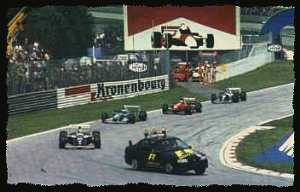 Under the control of the pace car due to the accident on the
start line. Pedro Lamy's Lotus slammed into the back of JJ
Lehto's Benetton which had stalled, scattering debris all over the track. A
wheel flew over the debris fencing injuring nine people.
Under the control of the pace car due to the accident on the
start line. Pedro Lamy's Lotus slammed into the back of JJ
Lehto's Benetton which had stalled, scattering debris all over the track. A
wheel flew over the debris fencing injuring nine people.
2.15pm: The Williams pit radioed to Senna that the safety car was about to pull off. Senna acknowledged the information. It was the last contact. When the race began again, Senna and Schumacher quickly opened a gap on the rest of the field.
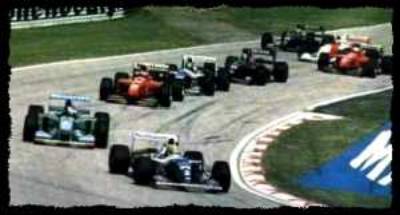 Leading the race shortly before the accident.
The horrific smash.
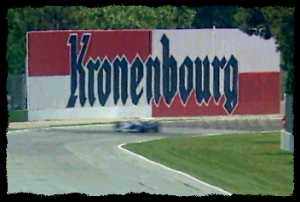 Entering Tamburello at 307 km/h.
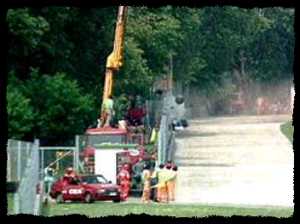 Slamming into the wall.
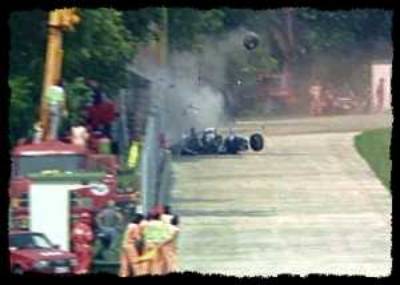
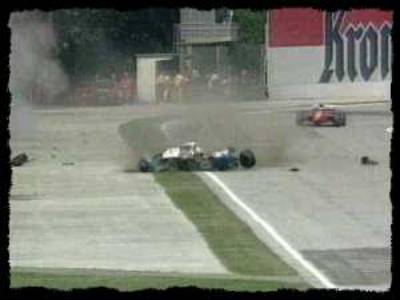
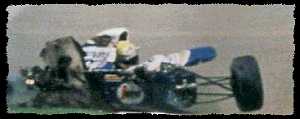 The aftermath.
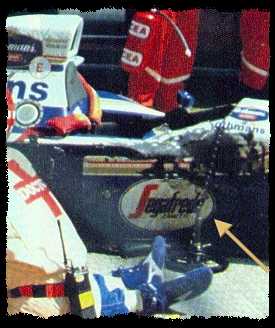 The arrow indicates where Senna's car literally snapped.
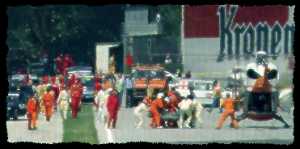 Being placed into the helicopter for the journey to Maggiore Hospital. On the
way, doctors fought to revive Senna's heart.
Being placed into the helicopter for the journey to Maggiore Hospital. On the
way, doctors fought to revive Senna's heart.
4.20pm: Schumacher crossed the line to win his third successive grand prix. Soon after, electrical brain tests confirmed that Senna was brain dead and being kept alive only by artificial means. Under Italian law, doctors are not allowed to turn off the machines for 12 hours, but even this support proved insufficient.
At 6.40pm on Sunday, May 1, 1994, chief medical officer, Dr Maria Theresa Fiandri, pronounced Ayrton Senna dead.
Back at the track, in the shattered remains of Senna's car, they discovered a furled Austrian flag. Senna had intended to dedicate his 42nd grand prix victory to Ratzenberger's memory.
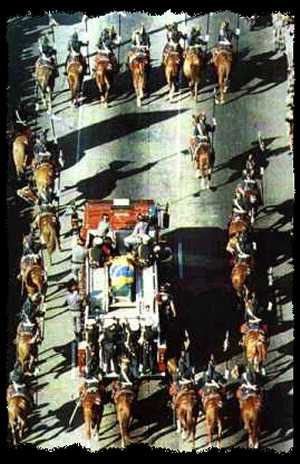 Senna's funeral. The great Brazilian's death was mourned world-wide.
Ayrton Senna knew that the concrete wall on the outside of the Tamburello corner at Imola was an invitation to disaster. He also knew that it would be futile to make an issue of it. In the Formula One scheme of things, drivers were just part of the show, and modifications to circuits were an expensive dent in the bottom line.
So Senna raced at Imola, and he hit the wall.
And he died.