Goal-Use background information to supply essential story elements.
Project.
Create a class story collection that includes each student's work. Have a student team work together to design an appropriate cover for the collection and choose a catchy, pertinent title. Place the collection in the class library.
Type your story in the box above!
OR
SAMPLE OBJECTIVE #2: Write a summary paragraph on the WORLD WIDE WEB (WWW) OWNERSHIP RIGHTS... (Use(10) Search Engines to research the Internet.)
SAMPLE OBJECTIVE # 3-Students will create A model 21st Century Military International Bilingual E-School On-Line...BOYS'SCOUT IN SPAIN!...AN INTERNATIONAL MILITARY "FUNERAL AND/OR BIRTHDAY PARTY."
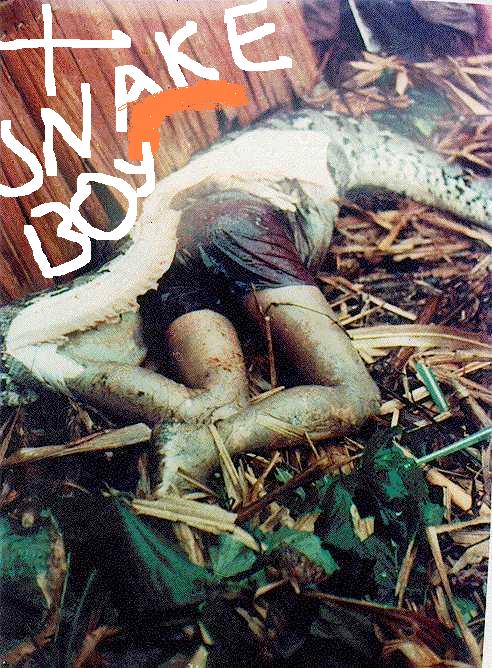
[THIS IS A DEAD BOY IN THE BELLY OF AN ANACONDA SNAKE.]
SAMPLE OBJECTIVE # 4-Students will Define woman power and create a database of important women in Science who contributed to international anti-kidnapping Laws.
HALLOWEEN WAS IN OCTOBER...TERROR BY NIGHT!
About the
Webpage.
THE ANTI-TERRORISM AROUND THE WORLD POLICY PROJECT...Teach And Learn With The Internet...A MANAGERIAL PERSPECTIVE.
An Advertisement For All Ages!...Do you need Private Computer-Aided Instruction in all Subject Areas Customised To Meet Your Needs?...Please Call Jessie Moses (Professional Educator)at
Iran put on show its new Shahab-3 ballistic missiles in a military parade,
with the rockets sporting slogans including "We will crush America
under our feet" and "Israel must be wiped off the map".
N.M Teachers on Leave Over War Protests.
[IT'S NECESSARY TO USE EDUCATION AS A TOOL TO FIGHT CRIME!].
[PHILOSOPHY UPDATE-New Attacks Planned Daily by Al-Qaeda!...The Triumph of Death Over Life!]
YOU NEED MICROSOFT XP COMPONENTS TO VIEW THE INTERACTIVE LINKS, POWERPOINT SOFTWARE, MACROMEDIA FLASH 6.0, EXCEL SPREADSHEET, GRAPHICS CARD, VIDEO CARD, COLOR MONITOR.
[UPDATE-New Attacks Planned Daily by Al-Qaeda!]....
Aziz, who surrendered to U.S. authorities on April 24, has also said Iraq (news - web sites) did not possess stocks of chemical, biological or nuclear weapons on the eve of the war, an assertion that echoes the previously reported statements of other detained Iraqi leaders and scientists. Yet Hussein personally ordered several secret programs to build or buy long-range missiles in defiance of international sanctions, according to Aziz's reported statements.
The former deputy prime minister has described an argument he had with Hussein in 1999, in which the Iraqi president insisted that U.N. Resolution 687, enacted to limit Iraq's armaments, prohibited long-range missiles only if they were armed with weapons of mass destruction.
Aziz said he countered, "No, it's a range limit," and all Iraqi missiles able to fly beyond 150 kilometers (about 93 miles) were banned, according to a senior U.S. official familiar with the interrogation reports. Hussein demanded in reply, "No, I want to go ahead," according to the senior official.
After nearly five months of prisoner interviews, document searches and site visits, "We know the regime had the greatest problem with the 150-kilometer limit" on missile ranges, said Hamish Killip, a former U.N. arms inspector now working with the Iraq Survey Group, a CIA (news - web sites)-supervised body appointed by President Bush (news - web sites) to lead the hunt for Iraqi weapons of mass destruction. Hussein and his most senior military commanders saw the range limit "as an invasion of their sovereignty," Killip added. They fumed because hostile neighbors might hit Baghdad with missiles, but Iraq would be unable to answer in kind.
Yet investigators have found no comparable evidence to date that Hussein was willing after 1999 to risk being caught in major defiance of U.N. bans on nuclear, chemical or biological weapons, officials involved in the weapons hunt said.
"They seem to have made a mental separation between long-range missiles and weapons of mass destruction," Killip said.
Aziz's statements about the Iraqi missile program have been largely corroborated by documents and interviews with engineers and scientists, officials said. On other subjects, the English-speaking bookworm's reliability as a witness is uncertain. After a turn as the Iraqi president's histrionic spokesman and foreign minister during the early 1990s, Aziz had grown estranged from Hussein as the war approached earlier this year, and officials involved in the interrogations say they are cautioned by Aziz's long history of deceit and opportunism.
Still, Aziz's extensive cooperation with interrogators has become a fulcrum of recent U.S. and British efforts to explore enduring mysteries of Hussein's conduct during the last two years, several officials said.
As the hunt for major finds of chemical or biological arms has turned cold, U.S.-led investigators increasingly seek to understand why Hussein might have acted as he did if he truly had no sizable arsenal of contraband weapons. From their digs in looted factories and sprawling ammunition dumps, they are moving more and more to an exploration of Hussein's mind.
Probing Hussein's Plan
In addition to Aziz, interrogators have systematically interviewed dozens of former Iraqi generals, intelligence officers and scientists in recent months, while trying to isolate them from one another to prevent coordinated answers.
Among the interrogators' questions: If Hussein did not have chemical or biological weapons, why did he fail to disabuse U.S. and other intelligence services of their convictions that he did? Why did he also allow U.N. inspectors to conclude that he was being deceptive?
In early weeks, said officials involved, generals and intelligence officers close to Hussein typically blamed their government's poor record-keeping for arousing suspicions in Washington and at the United Nations (news - web sites), repeating a defense used by Iraqi spokesmen during years of cat-and-mouse struggles with weapons inspectors.
More recently, however, several high-ranking detainees have said they believe that Hussein was afraid to lose face with his Arab neighbors. Hussein concluded, these prisoners explained, that Saudi Arabia, Kuwait, the United Arab Emirates and other countries paid him deference because they feared he had weapons of mass destruction. Hussein was unwilling to reveal that his cupboard was essentially bare, these detainees said, according to accounts from officials.
In separate interviews with The Post, several former high-ranking Iraqi generals not held in detention offered similar views. Hussein "had an inferiority complex," said Maj. Gen. Walid Mohammed Taiee, 62, chief of army logistics as the war approached earlier this year. "From a military point of view, if you did have a special weapon, you should keep it secret to achieve tactical surprise. . . . But he wanted the whole region to look at him as a grand leader. And during the period when the Americans were massing troops in Kuwait, he wanted to deter the prospect of war."
Interrogators asked Aziz whether Hussein was also trying to bluff Iran, fearful that his hostile neighbor might be developing weapons of mass destruction. Aziz replied, according to the senior U.S. official familiar with his interrogation reports: "Every time I brought up the issue with Saddam, he said, 'Don't worry about the Iranians. If they ever get WMD, the Americans and Israelis will destroy them.' "
In the end, say investigators, all of this fragmentary testimony about Hussein's thinking about special weapons is uncorroborated by hard documentary evidence or an unimpeachable inside source.
"The question we all have is, 'What was so damned important that you were willing to go through all of this?' " said Killip of the Iraq Survey Group. He continued: "I've not heard any totally convincing explanation that's backed up with facts. And it's truly puzzling."
Foreign Contacts
Aziz's extensive interrogations -- eased by a U.S. decision to quietly remove his family from Iraq to safe exile in a country that American officials would not name -- paint Hussein on the eve of war as a distracted, distrustful despot who was confused, among other things, by his meetings with Russian and French intermediaries. Aziz said Hussein emerged from these diplomatic sessions -- some secret at the time -- convinced that he might yet avoid a war that would end his regime, despite ample evidence to the contrary.
Aziz has told interrogators that French and Russian intermediaries repeatedly assured Hussein during late 2002 and early this year that they would block a U.S.-led war through delays and vetoes at the U.N. Security Council. Later, according to Aziz, Hussein concluded after private talks with French and Russian contacts that the United States would probably wage a long air war first, as it had done in previous conflicts. By hunkering down and putting up a stiff defense, he might buy enough time to win a cease-fire brokered by Paris and Moscow.
Aziz's account, while provocative, has not been corroborated by other sources, said U.S. officials involved in the interrogations. They said they were aware that Aziz might be trying to pander to his American captors' anger at French and Russian conduct before the war.
The public record of French and Russian back-channel contacts with Hussein on the war's eve is thin and ambiguous. Former Russian prime minister Yevgeny Primakov, long close to Hussein, made an announced visit to Baghdad in February and a secret trip just days before the war's opening on March 20. A few weeks later, after Baghdad's fall, Primakov held a news conference to explain that, at his clandestine last-ditch meeting, he had urged Hussein to resign.
Primakov said Hussein listened attentively to his ideas and asked him to repeat himself in front of Aziz. But then Hussein changed the subject and mentioned that in 1991, the leadership of what was then the Soviet Union had also suggested he resign, and he had ignored them.
"Until the last minute, Russia and President [Vladimir] Putin did everything in their power to prevent this terrible war," Primakov declared at his news conference, according to the Russian Interfax news agency. Russian commentators raised doubts about Primakov's version, however, arguing that he was too close to Hussein to deliver the sort of tough message he described.
The extent and character of French contacts with Hussein before the war is even less clear. Several media outlets reported early this year that France had opened a private channel to Hussein, but the French Foreign Ministry denied these reports, insisting that its diplomats had made plain to Hussein that he should stand down.
In any event, Hussein emerged from these contacts convinced that Washington would not launch an immediate invasion of Iraq, according to Aziz, as U.S. officials described his statements. Even as U.S. and British forces massed on the Kuwaiti border, Hussein was so sure of himself, Aziz reportedly said, that he refused to order an immediate military response when he heard reports that American ground forces were pouring into Iraq, concluding that the crossing was some sort of feint.
Taiee, one of the former major generals interviewed by The Post, agreed that Hussein had "not expected a war." The Iraqi president had concluded that "there would be bombardment as in '98 and the regime would continue and he would be a hero. Then, in case war did happen, these promises he had received from the French and Russians -- plus the resistance he thought the army would put up, not knowing that they would go home -- this would be enough to win a cease-fire and a settlement."
But Maj. Gen. Amer Shia Jubouri, 50, a former army division commander and chief of the Iraqi war college, said in an interview that he believed "the French and Russian governments delivered very clear messages to Saddam that the war was going to happen," and that if Hussein believed otherwise, it was a result of the president's own confusion.
"He obviously misunderstood the theory of deterrence," said Jubouri. "You have to know when this theory can be successful, and when it can be disastrous."
Unexpected Breakdown
Once the war began, Hussein fulfilled few of his threats. The CIA warned that Hussein might use chemical weapons. Instead, after initial resistance, the regime and army melted away.
Investigators have considered the possibility that Hussein intended all along to make a strategic withdrawal from Baghdad and fight a guerrilla war, but they say they can find no evidence of such a strategy from interrogations or documents. They also doubt Hussein could have persuaded his generals to abandon Baghdad as part of a defensive strategy, and they argue that if this was really Hussein's plan, it was poorly executed.
American and British interrogators have asked dozens of generals who served in high-ranking command roles in Iraqi army divisions during this year -- some imprisoned, some living freely -- why Hussein did not use chemical weapons to defend Baghdad. A number of these generals have said that they, too, believed chemical weapons would be deployed by Hussein for the capital's defense. Yet none of the officers admitted receiving such weapons himself.
"The only consistent pattern we've gotten -- 100 percent consistent -- is that each commander says, 'My unit didn't have WMD, but the one to my right or left did,' " said the senior U.S. official involved. This has led some American interrogators to theorize that Hussein may have bluffed not only neighboring governments and the United States, but his own restive generals.
"He would not hesitate to deceive even his hand-chosen commanders if he thought that by this he could achieve success," agreed Jubouri, the former general.
U.S. officials said they remain uncertain about the scope of Hussein's chemical weapons program during 2002 and earlier this year, despite their failure so far to discover Iraqi stocks or any capacity to produce them.
"We have not yet found stocks of weapons, but we are not yet at the point where we can say definitively either that such weapon stocks do not exist," the leader of the Iraq Survey Group, David Kay, told Congress on Oct. 2. U.S. officials said that conclusion still holds one month later.
The investigators' most significant new discovery over the last month, officials said, was that Hussein made a secret deal to purchase Nodong missiles from North Korea (news - web sites), in addition to a previously reported clandestine deal to buy North Korean missile parts between 1999 and 2002. Neither shipment came through, however, because North Korea's government said it was under too much U.S. pressure in 2002 to risk a delivery by sea.
The substantial evidence of Iraq's secret long-range missile programs, combined with more fragmentary testimony in which Hussein reportedly asked scientists how long it might take to reconstitute chemical arms, has led some investigators to conclude that Hussein saw missiles as his most difficult challenge. In this hypothesis, Hussein wanted to build or buy long-range missiles before he took on the risks of secretly restarting banned programs to make weapons of mass destruction.
"The pattern I think we're seeing is, they were working on the long pole in the tent," the missile program, said the senior U.S. official involved in the weapons search. When Hussein asked scientists how long it would take to restart sarin and mustard gas production, he learned the timelines "were all so sufficiently short" that he could afford to hold off until the missile program was further along, the official said.
Yet as the threat of war approached, Hussein apparently took no step to speed the manufacture of special weapons. Perhaps, as Aziz reportedly has said, this was because he believed he could survive the coming war. Or perhaps, as many of his military subordinates now insist, it was because a fading, confused Hussein had outmaneuvered himself.
Investigators of the Iraq Survey Group have discovered that in the months before the war, many specific military and civilian defensive measures ordered by Hussein in past conflicts were only partially carried out or were completely ignored. There appears to have been "some kind of breakdown in the structure that was controlling things," Killip said.
Former military leaders, including dozens of detained generals who have undergone interrogations, have cited the Iraqi president's military incompetence, isolation, and reliance on family and tribe in a time of crisis as central factors in the regime's collapse.
In discussing Hussein's failure to use chemical weapons in the defense of Baghdad, officials said, the generals often rant sarcastically that Hussein's government did not even prepare land mines and other basic military defenses to block or slow the U.S. advance. Why, they ask, should chemical weapons be any different?
"There was no unity of command. There were five different armies being used, no cooperation or coordination," retired Maj. Gen. Abed Mutlaq Jubouri, 63, a former division commander later jailed by Hussein for conspiring against the regime, said in an interview with The Post. "As to the defense of Baghdad, there was no plan."
[This was the co-ordinated attack of the World Trade Center Twin Towers In Manhattan.]
American Airlines #11
Boeing 767
7:45 a.m. Departed Boston for Los Angeles
8:45 a.m. Crashed into North Tower of World Trade Center
American Airlines #77
Boeing 757
8:10 a.m. Departed Dulles for Los Angeles
9:39 a.m. Crashed into Pentagon
United Airlines #93
Boeing 757
8:42 a.m. Departed Newark for San Francisco
10:03 a.m. Crashed in Stony Creek Township
United Airlines #175
Boeing 767
7:58 a.m. Departed Boston for Los Angeles
9:05 a.m. Crashed into South Tower of World Trade Center.
E-Mail: jessiemoses@juno.com
OR
New email address is jessiemoses@37.com.
[A Spanish Version...Coming Soon!].
New Page 2
Curtains Ordered for Media Coverage of Returning
Coffins
By Dana Milbank
Tuesday, October 21, 2003; Page A23
Since the end of the Vietnam War, presidents have
worried that their military actions would lose
support once the public glimpsed the remains of U.S.
soldiers arriving at air bases in flag-draped
caskets.
To this problem, the Bush administration has found a
simple solution: It has ended the public
dissemination of such images by banning news
coverage and photography of dead soldiers'
homecomings on all military bases.
In March, on the eve of the Iraq war, a directive
arrived from the Pentagon at U.S. military bases.
"There will be no arrival ceremonies for, or
media coverage of, deceased military personnel
returning to or departing from Ramstein [Germany]
airbase or Dover [Del.] base, to include interim
stops," the Defense Department said, referring
to the major ports for the returning remains.
A Pentagon spokeswoman said the military-wide policy
actually dates from about November 2000 -- the last
days of the Clinton administration -- but it
apparently went unheeded and unenforced, as images
of caskets returning from the Afghanistan war
appeared on television broadcasts and in newspapers
until early this year. Though Dover Air Force Base,
which has the military's largest mortuary, has had
restrictions for 12 years, others "may not have
been familiar with the policy," the spokeswoman
said. This year, "we've really tried to enforce
it."
President Bush's opponents say he is trying to keep
the spotlight off the fatalities in Iraq. "This
administration manipulates information and takes
great care to manage events, and sometimes that goes
too far," said Joe Lockhart, who as White House
press secretary joined President Bill Clinton at
several ceremonies for returning remains. "For
them to sit there and make a political decision
because this hurts them politically -- I'm
outraged."
Pentagon officials deny that. Speaking on condition
of anonymity, they said the policy covering the
entire military followed a victory over a civil
liberties court challenge to the restrictions at
Dover and relieves all bases of the difficult
logistics of assembling family members and deciding
which troops should get which types of ceremonies.
One official said only individual graveside
services, open to cameras at the discretion of
relatives, give "the full context" of a
soldier's sacrifice. "To do it at several stops
along the way doesn't tell the full story and isn't
representative," the official said.
A White House spokesman said Bush has not attended
any memorials or funerals for soldiers killed in
action during his presidency as his predecessors had
done, although he has met with families of fallen
soldiers and has marked the loss of soldiers in
Memorial Day and Sept. 11, 2001, remembrances.
The Pentagon has previously acknowledged the effect
on public opinion of the grim tableau of caskets
being carried from transport planes to hangars or
hearses. In 1999, the then-chairman of the Joint
Chiefs of Staff, Army Gen. Henry H. Shelton, said a
decision to use military force is based in part on
whether it will pass "the Dover test," as
the public reacts to fatalities.
Ceremonies for arriving coffins, not routine during
the Vietnam War, became increasingly common and
elaborate later. After U.S. soldiers fell in Beirut,
Grenada, Panama, the Balkans, Kenya, Afghanistan and
elsewhere, the military often invited in cameras for
elaborate ceremonies for the returning remains, at
Andrews Air Force Base, Dover, Ramstein and
elsewhere -- sometimes with the president attending.
President Jimmy Carter attended ceremonies for
troops killed in Pakistan, Egypt and the failed
hostage rescue mission in Iran. President Ronald
Reagan participated in many memorable ceremonies,
including a service at Camp Lejeune in 1983 for 241
Marines killed in Beirut. Among several events at
military bases, he went to Andrews in 1985 to pin
Purple Hearts to the caskets of marines killed in
San Salvador, and, at Mayport Naval Station in
Florida in 1987, he eulogized those killed aboard
the USS Stark in the Persian Gulf.
During President George H.W. Bush's term, there were
ceremonies at Dover and Andrews for Americans killed
in Panama, Lebanon and aboard the USS Iowa.
But in early 1991, at the time of the Persian Gulf
War, the Pentagon said there would be no more media
coverage of coffins returning to Dover, the main
arrival point; a year earlier, Bush was angered when
television networks showed him giving a news
briefing on a split screen with caskets arriving.
But the photos of coffins arriving at Andrews and
elsewhere continued to appear through the Clinton
administration. In 1996, Dover made an exception to
allow filming of Clinton's visit to welcome the 33
caskets with remains from Commerce Secretary Ronald
H. Brown's plane crash. In 1998, Clinton went to
Andrews to see the coffins of Americans killed in
the terrorist bombing in Nairobi. Dover also allowed
public distribution of photos of the homecoming
caskets after the terrorist attack on the USS Cole
in 2000.
The photos of coffins continued for the first two
years of the current Bush administration, from
Ramstein and other bases. Then, on the eve of the
Iraq invasion, word came from the Pentagon that
other bases were to adopt Dover's policy of making
the arrival ceremonies off limits.
"Whenever we go into a conflict, there's a
certain amount of guidance that comes down the
pike," said Lt. Olivia Nelson, a spokeswoman
for Dover. "It's a consistent policy across the
board. Where it used to apply only to Dover, they've
now made it very clear it applies to everyone."
Saddam's Ex-Defense Minister Surrenders .
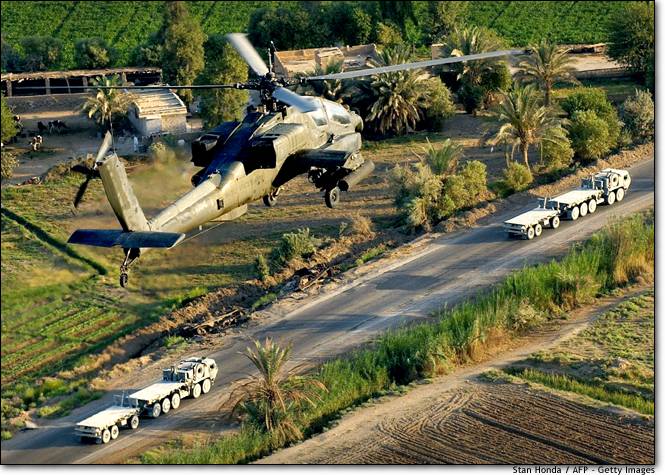
(AP) - Saddam Hussein's last defense minister surrendered Friday to an American commander, and U.S. troops backed by helicopters and armored vehicles fought an overnight battle near Tikrit after coming under a coordinated attack that killed three soldiers and wounded two. Though Americans have been the targets of near-daily attacks, the battle in and around the village of Uja — Saddam's birthplace — was unusual because of its intensity and length. The fighting lasted from 8 p.m. Thursday until daybreak Friday, the military said.
Iraq's Weapons of Mass Destruction - The assessment of the British Government
The UK government has released its dossier on Iraq's weapons of mass destruction. Published on the 24th September at 8am the dossier details the threat posed by Saddam Hussein's regime.
Read the dossier online:
Foreword by the Prime Minister
Executive Summary
Part 1:
An Advertisement For All Ages!...Do you need Private Computer-Aided Instruction in all Subject Areas Customised To Meet Your Needs?...Please Call Jessie Moses (Professional Educator)at
Mobile Telephone # 868-770-1501...Services Provided Includes The Use Of Productivity Tools such as Microsoft Excel Spreadsheet, Word Processing Software Packages-Word and Corel WordPerfect, Mavis Beacon Typing Drills, Database Management Software, Law For Managers, Communication For Business...Presentation Software- Kid-Pix Programs and PowerPoint Software...All ages Can Attend (Parent and Child Programs For Summer-Time)
A 21st Century E-School On-Line
WELCOME TO THIS ONLINE SCHOOL IN CYBERSPACE...LEARN AS MUCH AS YOU CAN TO MEET YOUR OWN OBJECTIVES!...A NON-PROFIT PROJECT ON FORMULAE FOR THE BUDGET SABOTAGE SPREADSHEET!