
Deer Park Primary School (History)

The First 100 Years
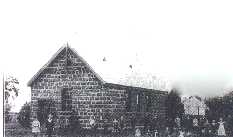
On April 4, 1871 a letter was written to the Victorian Board of Education proposing that a school be built to accommodate the 95 children living in the Shire of Braybrook. The only school available was a denominational school at Derrimut, near Mount Cotteril which meant many children gained little or no access to education. The Board of Education responded to the will of the people and allocated 2 acres of the south eastern corner of Position 5, Section 21, near the Kororoit Creek in the Parish of Derrimut to accommodate a school. It was agreed in 1873 that a stone building measuring 40ft by 20ft be built to accommodate 100 children and 'State School 1434 Braybrook' was built (named because of its close proximity to the post office) at a cost of 405 pounds by builder 'Mr. Martin'.
Lessons commenced under Headmaster Robert G. Ely who came from School No. 7 at Aitkins Gap. Record rainfalls that year took their toll on the newly constructed school house. Bad leaks just one month after the school opened led to continuing structural problems not helped by the extensive flooding of the surrounding area.
Children learned of the first settlers to the area - brothers William and Laurie Jackson who arrived in Williamstown from Tasmania in 1836 bringing with them a cart, two horses and five hundred sheep. They settled by Kororoit Creek after being confronted by hostile tribes in Sunshine after first sighting Mount Derrimut.
Followers of the Jackson Brothers relied on Saltwater (Maribyrnong) River for a healthy supply of fish and crustaceans while the surrounding swamp land cradled herds of wildlife. Deer Park soon attracted large numbers of settlers, mainly gold diggers, their presence slowly destroying the plant and animal life. 1849 catalogued the heaviest recorded snowfall for the era, with a rapid thaw towards the end of the year causing massive floods. While the children could appreciate the legacy of urban legend and history as their new school succumbed to heavy rainfall, they must surely have wondered at tales of Black Friday 1851 when drought conditions caused a huge fire which swept its way toward Melbourne, stopped only by the extensive swamp land surrounding Deer Park.
A new Headmaster was appointed in 1876 to what was officially known as a dilapidated school just three years after its construction. Mr. William Capes endured drought and flood caused by unpredictable seasonal fluctuations, the surrounding area suffering as much as the school, plagued by ever decreasing student numbers.
The school was then known as 'The Kororoit Creek on Derrimut School' and at the request of the Headmaster J. W. Russell changed its name along with the surrounding area, to Deer Park in 1890.
In an attempt to modernise the school in 1919 for the 46 attending students, new desks were requested by Headmaster George Reid who commanded the school from 1908 to 1923. Mr. Reid also made requests to remodel the school in 1922 after the building had endured many years of unpredictable Victorian weather. The school had no windows in the north or west wall and concerns for the schools structure were supported after a visit by an inspector from the Board of Education.
In 1924 new Headmaster Thomas Smythe and the School Committee paid tribute to the memory of the Hume and Hovell expedition by erecting a monument at the junction of Ballarat and Station (formerly McMahons) Roads. The unveiling ceremony, held in a warm December, was attended by students and local people.
Lessons were temporarily disrupted when children moved to the local hall in the final months of 1926 while much needed remodelling of the school commenced.
Sadly, the school continued to deteriorate and in 1928, the new Headmaster W. G. McKernan continued to lobby the Department of Education for architectural assistance. In 1929 the Minister for Education proposed that the school be repositioned to a five acre site which would be donated by the Nobel Family who were factory owners in the local area. Unfortunately, this proposal never came to fruition and the school continued to operate with three teachers and sixty students crammed into one tiny room.
Running water was introduced in 1929 and after a visit from the Minister of Education, and electricity connected at the start of the new decade. Soon after it was agreed that the school undergo reconstruction but the elements once again proved to be more foe than friend.
Lightning stuck the Nobel factory on 3rd March 1931, the impact of the strike destroying several of the school windows. As a result local wildlife overran the school and part of the ceiling collapsed after shock waves from an explosion at the Nobel factory in 1935.
New Headmaster J. D. Kennedy continued to fight for the schools refurbishment, incensed by the impossibility of 70 children being crammed into one room. Requests were granted through the summer of 1937 and students were once again taken to the local hall for the lessons while the school was renovated and a brick corridor added at a cost of 375 pounds.
On 2nd July tragedy enrolled at Deer Park School. Fire engulfed the main building almost totally destroying it. Police reports detailed that the fire brigade was called to the scene at around 3:35am when 7 men and 1 hose cart from Sunshine, the same from Footscray, tried to control the flames, but to no avail. New Headmaster Laurence N. Tyley had left the school the previous day at approximately 1:50pm without concern. The briquette heater had been cleaned and re-laid for the next day - nothing out of the ordinary. It was noted that the fire started near the timber porch and art room, fanned by a fresh north westerly breeze. A witness, Joyce O'Brien of Ballarat Road noticed a small fire at 11:45pm thinking it was simply the camp fire of a swagman. Later, a boy was to confess to emptying ashes under the west side of the water trough instead of in the bin. Reports were sketchy at best, the most plausible explanation being that the hot ashes were emptied by swagmen next to the school, the fire gaining momentum throughout the night.
Once again the students were taught in the local hall while the future of the school was considered. The children had to endure appallingly cold conditions. A petition was raised by local people totalling 120 signatures, protesting the impossible environment the children were expected to learn in and once again the people were heard.
A new brick building, including a toilet block and ground works was constructed, officially completed on 30th April 1945 at a cost of 3,874 pounds. Headmaster Tyley headed a school which was the first of its kind in Victoria housing two classrooms with sliding panels between them. The new Deer Park Primary School was officially reopened on the 13th September 1945 at 2:30pm on its original 2 acre site with 52 students in its class.
In the early 1950's grades 1, 3 and 4 were taught at the local hall while a Bristol prefabrication unit of 2 rooms was constructed on the school grounds. After structural problems with building, the new rooms were put into use in July 1952 under Headmaster G. Cox at a cost of between 6,000 and 9,000 pounds.
St. Albans Primary School experienced overcrowding in 1956 and students were relocated to Deer Park Primary which saw the addition of another Bristol Unit. It was also in this year that the Mother's club (known today as Parent & Friends Association) was thought to have been established within the school, its chief project for the year being the Annual Bazaar (known today as the Fete). A successful Social Services League followed in 1958.
An additional 6,000 pounds in 1960 gave the school two more classrooms, two staff rooms and an office linked by a central corridor. Six more rooms were added from 1966-68 under the leadership of Headmaster K. J. Moylan.
The school was able to construct its library after the School Council borrowed $4,000 in 1969. The Canteen opened in a shelter shed in 1971 at a cost of $2,634.
Two portable classrooms were added in 1971 to help accommodate the schools expanding 765 student population. With the introduction a Deer Park West Primary School 220 pupils were transferred over in September 1971. Deer Park Primary was now a thriving school with 17 permanent classrooms, a library and canteen.
The Deer Park Sunsetters were established at the school in 1973 successfully taping messages and Christmas songs.
Retold by Mrs. Judy Davies.
Since the Centenary

The following is a chronological account of Deer Park Primary School since the school celebrated its centenary in 1974. This account in prepared by Mrs. Barbara Arnold. Mrs. Arnold retired from Deer Park PS in 1995 after spending 25 years as the school's secretary.
1975 - Principal: Don Marriager, 29 classrooms with just on 1000 pupils. Every month a new portable classroom would arrive for the growing enrolment.
1976 - There were now an amazing 36 classrooms. Two schools were operating on the site, accommodating about 1,200 children. Sydney Bainbridge was appointed as Principal of Deer Park PS. He remained in the position for three weeks before retiring. John Butterfield, a state wide relieving principal, took over for the rest of the year. Laurie Enterkin was appointed as Principal of Deer Park North PS. Building commenced during the year for the new school in Mawson Street. A special fete was held during the year with an auction to finish off the day. There were about 250 lots auctioned and it was conducted by a genuine auctioneer. About $3,000 was raised with half the money going to purchase playground equipment and seating for Deer park North PS. It was considered a gift from the children of Deer Park. These auctions were then continued each year as a fund raiser. What a range of goods were sold! There were no such things a Garage Sales in those days. Everyone donated old furniture, fridges, stoves, beds, televisions, radios, lawn movers, wheelbarrows, painting and even pets.
1977 - Ron Silva was appointed as Principal. Ron remained at Deer Park for eight years. When Deer Park North PS moved into their new facilities, Deer Park PS moved into the vacated portables so that the $1,000,000 facilities upgrade could commence. The school was bricked over and double glazing was installed. The classrooms were altered, a new office area was made and a staff centre was built in the old library. A new library, canteen and multi-purpose room was built. At the same time eight classrooms and a gallery area connecting the eight rooms was built. The schools two Bristol portables, comprising 4 classrooms in total, were being moved. One went to Braybrook PS. The other was to be repositioned beside the basketball courts as a change rooms and indoor playing area. All went well until someone started up a bulldozer in the middle of the night and demolished the whole building. It was totally flattened. Did we have some visitors that day! There were police and Education Department officials galore, including the Regional Director Mr. Ron Ginger.
1978 - This was one of the wettest years on record. The whole school occupied portable classrooms. There was mud absolutely everywhere. The school ran a 'mud timetable' from Easter to September with school finishing at 3:00pm each day. There were no play areas for the children, while everyone wore gum boots, including the staff. Ron Silva would phone the Education Department every two weeks for more screenings to cover the mud. Of course, the screenings would sink into the mud which would require more screenings.
1979 - Finally, at the end of the year the school moved back into the main building, which was now fully renovated. After the portable jungle it was like heaven. All the administration areas were together with a large office for the school secretary! (It measured 6'8" by 6'8" with a 7 foot ceiling). Nevertheless, new furnishings were installed and the whole school looked wonderful.
1980 - A great year at Deer Park PS. The new garden in the court yard commenced growing. The Dental Therapy Unit was built on site. There were 18 classrooms, a P.E. teacher, an art teacher to teach in the new art room, a librarian, two teacher aides, a dental therapist, a dental nurse and three Vice-Principals. What more would you want. On November 15th, the official opening of the new school took place.
1981 - The school's enrolment starts to slowly decline.
1982 - The Special Assistance Unit - Language commences.
1985 - Clare Holt appointed as Principal. The school comprised 16 classes.
1986 - Bill Clark was acting Principal until 3rd term when Gorge Murdoch took over. Arrangements were made for a free bus service to transport children in the Tamar Drive area to school. This lasted for three years.
1987 - The Education Department transferred to the 'four year term'.
1988 and 1989 - The school begins gearing up for the introduction of computers.
1990 - The school's office is computerised.
1991 - John Forrester is acting Principal and Denise Howes is appointed in June.
1992 - A permanent stage is built in the courtyard for the school concerts and assemblies.
1993 - Deer Park and Deer Park North schools are accepted as intake 1 'Schools of the Future'.
1994 - Denise Howes transferred as Principal in June. Greg Yorath was acting Principal in term 3. Steve Lyon appointed to principal position in team 4. A new school emblem and a new motto was chosen for the school. The motto being: Our Best Always. This was chosen from the entries entered by the children of the school.
1995 - The school's enrolment dropped to seven classes. Barbara Arnold retires after 25 years of service to Deer Park PS as the school secretary.
1996 - The school is given a grant to refurbish the school facilities.
1997 - Steve Lyon transfers as Principal at the end of term 1. Mark Guest is acting Principal for term 2 and then Neil Sproal is appointed as Principal as from term 3.
1998 - The upgrade of the school's facilities are completed in term 1. This included painting and carpeting all rooms, new student furniture and the installation of PC computers to all classrooms.
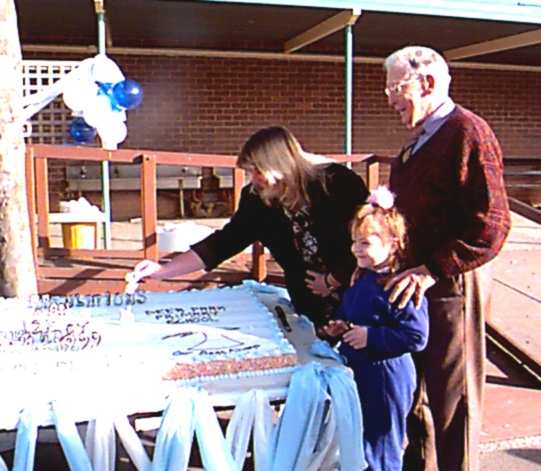
1999 - Deer Park Primary Schools gears up to celebrate its 125th Anniversary.
2000 - Let's see what the
future brings.
Email me 