Jessica Berry
The Future of the Universe
uThe Geometry of the Universe
The fate of
the Universe depends upon the geometry of spacetime and the density of matter
in the Universe. Until recently,
cosmologists were considering three possibilities:
1. Spherical
Geometry/Closed Universe
A closed
universe would be curved like the surface of a sphere:
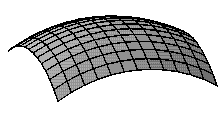
Rules of
geometry in a closed universe:
·Positive curvature of space
·Parallel lines converge
·Volume of a sphere < 4/3ðR3
·Angles of a triangle add up to more than 180 degrees:
W:
The value of Omega is the ratio between the actual density of the universe
and the critical density. Critical density: the density needed to just halt the
expansion of the universe (about 1 hydrogen atom per cubic meter).
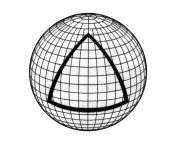
Density:
W>1: the
Universe is relatively dense
Fate of
the Universe:
In this
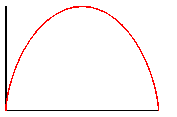
scenario, there would be enough mass to stop the expansion of the
Universe. Eventually, the Universe
would stop expanding and collapse on itself.
Graph
of expansion of the Universe vs. time
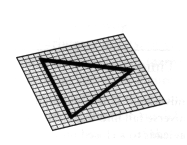
2. Euclidian
Geometry/Flat Universe
This
universe would be flat like a sheet of paper:
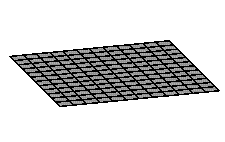
Rules of
geometry in a flat universe:
·Zero curvature of space
·Parallel lines remain at a constant distance
·Volume of a sphere = 4/3ðR3
·Angles of a triangle add up to 180 degrees:
Density:
W=1: the density of
the Universe is equal to critical density
Fate of
the Universe:
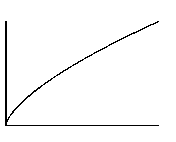
In this
scenario, there would be exactly enough mass to stop the expansion of the
Universe, but only after an infinite amount of time. The Universe would continue to expand forever, but continuously
slow down and approach stasis.
Graph of expansion of the Universe vs. time
3. Hyperbolic
Geometry/Open Universe
An open
universe would be curved like a saddle:
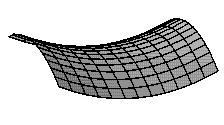
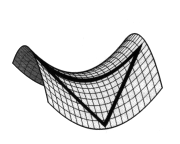
Rules of
geometry in an open universe:
·Negative curvature of space
·Parallel lines diverge
·Volume of a sphere > 4/3ðR3
·Angles of a triangle add up to less than 180 degrees:
Density:
W<1: the
Universe is not dense
Fate of
the Universe:
In this
scenario, there would not be enough mass in the Universe to stop the expansion
of the Universe. The Universe would
expand forever.
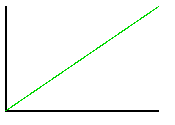
Graph of expansion of the Universe vs. time
Learn
more about the topology of the universe (Nicholas
Bower’s webpage)
Cosmologists
could not solve this mystery until they determined the density of dark energy
in the Universe. (The dark energy is
what enables the Universe to resist gravity and continue expanding.) The Wilkinson Microwave Anistropy Probe
(WMAP), a project launched in 2001, determined the composition of the
Universe.
What’s in the Universe? 4% matter 23% dark matter 73% dark energy
Due to
these results (small amount of dark matter, large amount of dark energy), we
know that the Universe is flat and will expand forever at an ever-decreasing
rate.
Learn more about the results: Wilkinson Microwave Anistropy Probe (WMAP)
uA Timeline of the Future of the Universe
THE FUTURE OF THE SUN, THE EARTH, AND THE MILKY WAY
~4 billion years from now: the Sun will become a red
giant; the Earth’s atmosphere will be destroyed
~5 billion years from now: the Sun will become a white
dwarf
~5 billion years from now: the
Andromeda Galaxy may collide with the Milky Way
~10 billion years from now: the Earth will freeze
THE FUTURE OF STARS
~1014 years from now: all stars will have
stopped shining.
THE BLACK HOLE AGE
~1025 years from now: dead stars will begin to
decay
~1030 years from now: the only matter remaining
in the Universe will be in black holes
THE DARK AGE
~1067 years from now:
star-sized black holes will have evaporated
~1097 years from now:
galaxy-sized black holes will have evaporated
~10100 years from
now: black holes made from clusters of galaxies will have evaporated.
uThe Future of the Sun, the Earth, and the Milky Way
When all the hydrogen in the center of the Sun has been
converted into helium, the helium will begin to form carbon. This reaction will generate so much energy
that the outer layers of the Sun will be pushed outwards. The center of the Sun will grow hotter than
ever before, and this will cause the Sun to swell to the size of a giant
star. By the time the radiation from
the center of the Sun reaches the surface, it will be weak. Since weak radiation is red, the Sun will be
red. When the Sun turns into a red
giant, the Earth will become very hot, around 3000 degrees Fahrenheit, causing
the continents to melt, the oceans to boil, and the atmosphere to disappear.
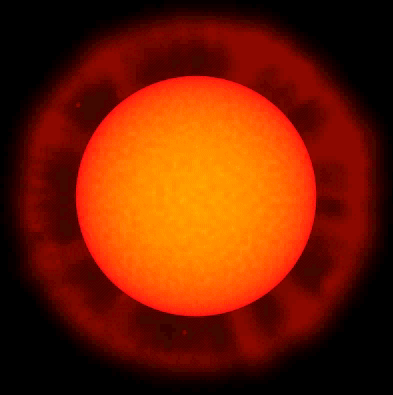
What the Sun might look like as
a red giant
[Taken from http://www.historyoftheuniverse.com/starold.html]
The red giant phase will last about one billion
years. At this point, the Sun will have
run out of energy to form carbon and heavier elements. Without any source of energy, the outer
layers of the Sun will fly off into space.
The mass that remains is called a “white dwarf”. The white dwarf will gradually cool down,
causing the Earth to cool. Eventually,
the Earth will cool so much that it will freeze; any oxygen gas left over will
freeze as well.
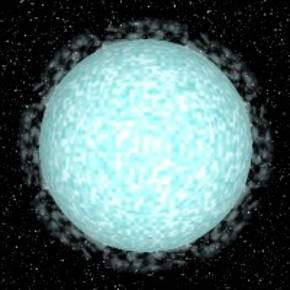
What the Sun might look like as a white dwarf
[Taken from research.umbc.edu/~fpatna1/ star-gallery/]
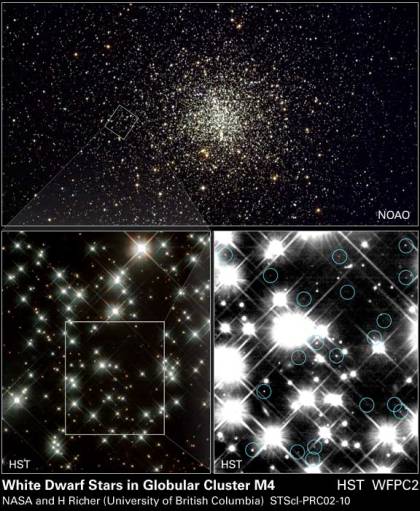
Picture of white dwarf stars
These are views of white dwarf stars
in the Milky Way. The top photograph
was taken from the ground of a cluster (“Globular Cluster M4”) of several
hundred thousand stars. The lower two
pictures, each showing smaller regions of the cluster, were taken from the
Hubble Telescope. In the photograph on
the right, blue circles mark where the white dwarf stars are.
[Taken from http://imgsrc.hubblesite.org/hu/db/2002/10/images/a/formats/web_print.jpg]

Scientists have found that the Andromeda Galaxy and the Milky Way are hurtling towards each other at very fast speeds. They speculate that in about 5 billion years they will collide head on, merging into one huge galaxy.
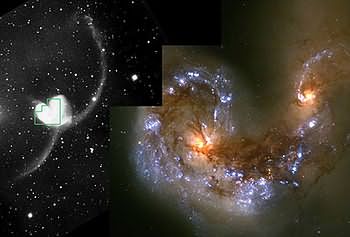
What a
collision of two galaxies looks like
On
the left is a wide view of two galaxies, called the Antennae, colliding
(the
Hubble Telescope captured this view in 1997).
On the right is a
close
up of the area within the green outline.
The two bright spots of
orange
are the centers of the two galaxies.
[Taken from http://hubblesite.org/newscenter/archive/1997/34/]
uThe Future of Stars
Eventually, the stars in our
Universe will start to run out of fuel and will stop shining. The only stars left will be “dead stars”
that don’t radiate any light.
●Neutron stars: the remains of stars high
in mass when they run out of fuel ●Black holes: extremely dense remains of
stars high in mass ●Brown dwarfs: objects that don’t contain
enough mass to form stars
Dead Stars
●Red dwarfs and white dwarfs: the
remains of stars low in mass when they run out of fuel
●Black dwarfs: the remains of red
dwarfs when they run out of fuel
Finally, galaxies will run out
of hydrogen gas and star formation will cease.
uThe Black Hole Age
In about 1025 years,
the protons in the remaining dead stars and brown dwarfs will begin to
decay. Eventually, by 1030
years from now, nothing will be left but electrons, positrons, neutrinos and
radiation, and the only matter remaining in the Universe will be in black
holes.
uThe Dark Age
Black holes slowly emit very
small amounts of radiation. After a
very long time, then, a black hole can lose all of its mass. Eventually, in perhaps 10100
years, all of the black holes in the Universe will have evaporated. Nothing will be left in the Universe but a
few subatomic particles.
uLinks to look at for more information
uOther
references
Ferris, Timothy. The Whole
Shebang. New York: Simon and Schuster, 1997.
Greene, Brian. The Elegant
Universe. New York: Vintage Books, 1999.