It's The Boat
Learning to sail a sailboat is all about the sailboat. Many people have
tried sailing and have found it difficult to master the basic principles
involved in sailing. These nice people were on the wrong boat. Learning to
sail is easy. Builders of small sailboats want to sell their products
and make a profit. They can't afford to overbuild their boats or they will
go out of business. The small boats that they build are normally light boats.
Several generations of small sailboats where designed to sail on the thousands
of lakes we have in this country. Lakes normally have very little wind because
they are surrounded by land. You can't learn to sail if don't have wind and
you can't learn to sail if you own a light boat with lots of wind. I think
the best solution for this very real problem is a heavy little sailboat. The
Com-Pac 16 is the little boat that could. Everyone that's owned one has become
sailors.
Sailboats today are built using by-products of oil. That's why sailboats
cost as much as they do and that situation is not going to change anytime
soon. We have tried boats with water-ballast, plastic boats and other solutions
that really don't work that well. A boat needs to be built well to hold passengers
and ballast in a dynamic environment. An ideal learning boat has certain attributes
that are well know to most experienced sailors. All large sailboats posse
these attributes and they are easy to sail. What is the boat's displacement
should be your big question if you want to learn how to sail. Compare different
boats by the pound like you would meat and potatoes. An experienced sailor
can sail almost any small sailboat. He or she knows what's suppose to happen
before it happens. A new sailor buys a boat and hopes to learn how to sail.
Many new sailors fail because they have the wrong boat.
An ideal learning sailboat should be a small trailable boat that has ballast.
It should be a shoal draft boat that will promote trailing and prevent excessive
heel in heavy wind. It needs to have a moderate sail plan that will encourage
owners to go sailing in any wind condition.
No one is going to get good at sailing by going once or twice a year. A
new sailor needs to go sailing as much as possible and when the wind is blowing.
If you own a light sailboat that can only sail in light air, your not going
to go sailing very offen. The wind speed would have to be just right and you
would have to be available at that time. Conditions like that may only occur
once or twice a year. Getting good at sailing requires time in the boat.
A cool thing about sailing is that you never stop learning.
The little Com-Pac 16 is a good looking boat that is well made and unfortunately,
out of production. Used boats are available and the factory may start a run
of new Com-Pac 16s soon. The Com-Pac Factory built 3000 boats over several
decades. The first boat was built in 1976 and the last boat came off the assembly
line in 2002. The 16 was designed by Clark Mills, the designer of most popular
sailboat in the World, the Optimist Pram. I think Clark knew something about
sailboat design. Most 16s come with a trailer and a motor. They float on
and off the trailer and can be parked in your back yard. The 16 has 450 pounds
of ballast with a total displacement of 1100 pounds. That's a 40% ballast
ratio. That's how big boats are built and that's how they maintain their
stability. You step on a 16 when it's in the water and it doesn't move much.
You will be able to see your boat's attitude against the horizon and your
sail trim points as you sail. You can see them and make adjustments and then
see the difference. That's how we learn to sail through cause and affect.
So far we have a boat that lives on a trailer and sails like an ocean going
yacht. That's not bad for a small boat. The 16 is a shoal draft sailboat.
That's great for sailing in shoal waters and more important, the boat will
slide sideways when the keel loses its bite on the water. The 16 only heals
to 45 degrees before it goes sideways. It will round up in heavy air like
most sailboats and also slide sideways in big gusts. This is an excellent
safety feature for small sailboats. You will sail in bigger winds if the heel
angle is small and you're not worried about turning over. It's a fact; you
can't learn to sail if you only sail in light wind. The 16 sail plan is small
for its size. Sailing a 16 in light air requires some practice. A good 16
sailor learns how to read the wind by using his boat as an interpreter. We
practice big wind sailing in the spring or on the coast where the wind is
stronger. We can practice light air sailing on lakes in the summer. Our boat
is on a trailer and we can go anywhere. We can have lots of fun doing both.
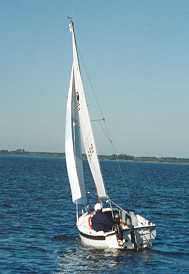
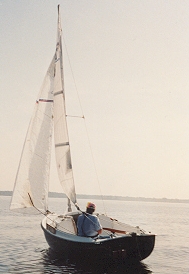
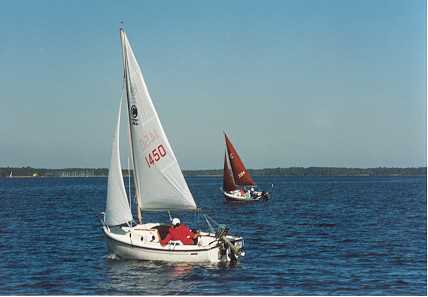
The
first graphic above is a Com-Pac 16 sailing on the wind. The water is dark
everywhere. You can look at the Wind Categories chart (Yacht Performance link
on the left) and tell what speed the wind is blowing. The person at the helm
is sailing from the low side of the cockpit. You can see better from that
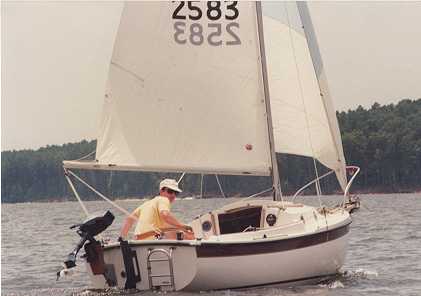
position and the boat points a little higher with a small heal angle. The
second graphic shows a Com-Pac 16 sailing in almost no wind. The water is
slick. The boat is moving, but not very fast. Here again the crew is on the
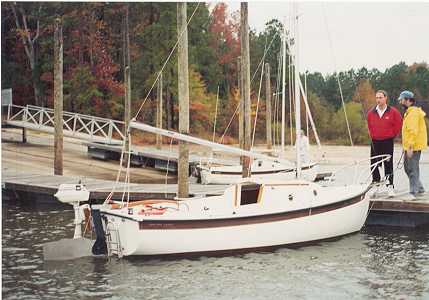
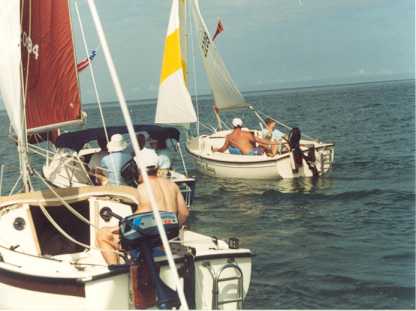
low side for the same reason. The graphics below show what Com-Pac 16s do
well, sailing and having fun. Remember, everyone becomes a sailor with a
Com-Pac 16.