
JMT is presently the one and only service bus operator in Jersey, and has been for many years.
Formed in 1923, the company has changed ownership over the years, but it has been the largest bus operator in the island and had swallowed up all of its competitors by the early 1960s. It has held the monopoly on bus services ever since, despite occasional proposals from other bodies. The fleet currently comprises 68 buses, a number of which are little used apart from work on schools contracts.

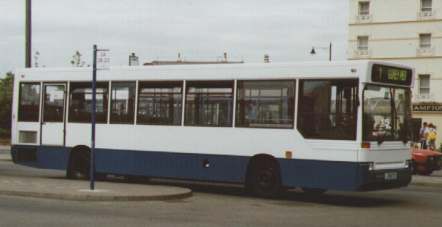
Two MCW Metroriders, a Leyland Swift, and several Duple Dominant-bodied Ford R1014s
representing some of the bus types serving Jersey in the 1990s
1923-70 - Green and cream, green wheels
1970-93 - Blue and white - blue
skirt, lighter blue window surrounds, rest white, blue wheels
(Mid 1970s - "JMT sun" logo fleetname)
1993-98 - Blue, white and black - blue skirt, black side window surrounds on Dominants and Vanguards, rest white, black wheels (blue on Darts when delivered), "JMT Express/The Island's Own Bus Company" fleetnames (large on sides, small on front)
1998 on - As 1993 livery, with "Jersey bus" fleetnames gradually replacing "JMT Express" graphics.
Seddon 682 received an overall advertising livery for Mary Ann lager in 1973, the first vehicle to be so treated. The next 20 years saw an increasing number of advertising schemes to the point where the majority of vehicles in the fleet were wearing such means of valuable additional revenue. Following the decision to eliminate advertising involving tobacco products, many vehicles were painted plain white and indeed the 1991 batch of Leyland Swifts were delivered as such. Dominant 61 was the first bus to receive the revised fleet colours in 1993.
1969 - Fleet very mixed, notable for the proportion of vehicles carrying Reading bodywork. Many 1950s Albions and Leyland PD2s still in service. Secondhand vehicles included a number of ex-London Transport RTL-class buses. 1960s purchases less consistent - two batches of five Leyland Tiger Cubs (first underfloor-engined buses in the island) and Bedford VAS, four Albion Vikings and three Seddon Pennine IVs. Small fleet of coaches also owned including three unusual 1964 Bedford SB/Strachans.
1970 - Ownership changes to Mr R. Lewis of Trimdon Motor Services, livery and vehicle policy changes. Adoption of one-man operation speling end for old half-cab double-deckers. First new vehicles - five Bedford SB/Duple coaches used on bus routes (later passing to the associated Tantivy). Ex-TMS 1967 Ford R192/Plaxton Derwent buses brought in to update fleet, first 8ft wide buses in Jersey, but restricted to certain routes. Standardisation promised.
1975 - Standardisation well under way. Twenty Willowbrook-bodied Ford R192s taken in 1972/73, five more in 1975 followed shortly by five R1014s with restyled bodywork. Final deliveries for '75 were five R1014 with the more modern looking Duple Dominant bus body. Many old buses gone, full OMO in effect. Acquisition of three 1968 Bedford SB/Duple Midland buses with the takeover of Redline's airport service - replaced by additional departures on route 15, consideration given to acquiring Leyland Atlanteans for this service but none obtained. Coaching now no longer carried out owing to common ownership with Tantivy.
1985 - Four Ford/Dominants delivered every year from 1977. Demonstrator bus on revised R1015 chassis fitted with Wadham Stringer Vanguard bodywork appears in 1984 and acquired later, results in change of body supplier (specified with Allison auto transmission). Nothing but Fords operated, rate of fleet renewal such that oldest Fords already removed from service, in some cases exported to England for further use (uncommon fate for Jersey buses).
1992 - Ford has ceased bus chassis production, last for Jersey in service by 1987. Little else suitable available; demonstrators of several types tried, followed by order for four long wheelbase MCW Metroriders in 1988 (closest thing to minibuses in current operation) and five Leyland Swift/Wadham Stringer Vanguard IIs in 1991. Swift production ends, rear-engined buses being considered.
1994 - Slight relaxation of length restrictions allowing longest Dennis Dart to be bought, 9.8m model required to maintain passenger capacity. Width bang on limit. Five enter service in mid-'94, Plaxton Pointer bodies. Similar batches taken in '95, '97 and '98.
|
1999 - Original Dart no longer available, replacement Dart SLF is low-floor (good) but 100mm wider to allow wheelchairs etc to pass through front arches (less good). Nevertheless "Mini Pointer" Dart demonstrator S451 WAT borrowed in early 1999 with a view to buying some for a new circular town service though authorities not keen on idea of larger vehicles. |
Summer '99 - Batch of four L-registration battery-electric Optare MetroRiders obtained, previously operated by both Oxford Bus Company and Stagecoach Oxford. Three put into service. Slightly shorter with wider doors than existing MCW Metroriders, now ten years old. First buses not to be bought new since 24 joined the fleet as an ex-demonstrator in 1985. Withdrawn after a few months operation when further subsidy for the service was not forthcoming.
Summer 2000 - Batch of six Dennis Darts built at same time as JMT's original five acquired from Isle of Man Transport, detail differences to Jersey examples. Reflects difficulty in obtaining new vehicles for service and profitability of operations to pay for them. Drivers strike over brief threat of competition from Pioneer Coaches, voicing concerns over job security.
The company operates different timetables according to season:
Summer - Increased services on all routes. Buses run at higher frequencies and later into the evening. Some services run exclusively during the summer (eg. route 14 to St. Brelade's Bay) and are aimed at tapping the considerable tourist market especially to the beaches and attractions.
Winter - Service reduced from summer. Network similar but some routes not run between October and May. School bus work undertaken in term time serving several schools mainly secondary.
While in the past coaches were owned, nowadays owing to the fact that Tantivy Blue Coach Tours are under common ownership, private hires are not dealt with.
The most popular routes year-round are:
JMT produce a "pocket-sized" timetable booklet with details of the services plus an Island map on the centre pages. Timetables cost 50p from the company's enquiry office at the Weighbridge Bus Station in St. Helier.
|
JMT fleet list: |