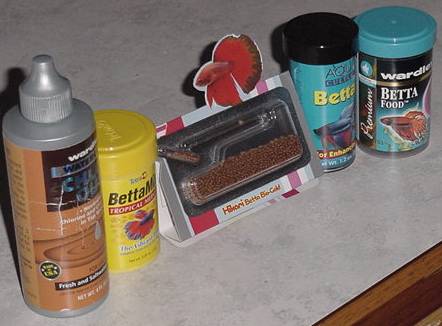
| Here is my attempt at some of the different foods bettas eat. Most of them I use in my rotation weekly for my bettas. I hope this list gives you a better grasp on food variety. Dry Foods (commercial) HIKARI Bio-Gold (carboard container)- This is a really nice floating food. It generally only works for adults though because of its large size. You should feed 2-3 pellets 2 times a day. Bio-Gold can be a very pricey choice. Tetra BettaMin (yellow container)- This is a flake food which is nice for juvenilles and small adults. they should only get a few flakes per feeding otherwise you may cloud the water. Wardley Betta Food (far right)- My bettas do not like this food. Most will stick their noses up but I can't blame them because it smells like chemicals. I'm sure they prefer food that is more natural. But this is a matter of knowing your fish. HBH Betta bites (no picture)- I don't have these and I've never used them, but a friend who has used them feeds 2-4, twice a day. They are an Appetite- Stimulating food. They are granular and generally smaller than Bio-Gold. AquaCulture Bettas - (between Bio-Gold and Wardley) These are little granules. The are very rich and should not be a base food. If you feed these, only one feeding a day. Bettas can get fat just like humans and this food is very rich and oily but my bettas tend to like the taste. (not recommended) TetraMin Granules - sometimes betta specific foods aren't the best. This granular food is easily crushed between your fingers for feeding smaller bettas. If you drop lightly onto the surface it will gently swirl giving the appearance of being "alive". Bettas can't resist snatching it up. Feed slowly (they sink) Tetra Freeze-Dried Bloodworms - a tasty treat. Do not feed on regular basis. Some say that swim bladder problems are associated with these so you may want to soak them in water before feeding. Azoo 9 in 1 Betta Pellet - Small granular pellet. Young bettas as well as full-grown adults enjoy these. feed 4-5 pellets per feeding. TetraSelect Tropical Crisps - Medium wafers. Very colorful which my bettas enjoy. I like to crush the wafers over their bowl so it is easier for them to eat. Feed 2-3 crisps per feeding. MarineLand LABS BIO-Blend - large pellets. These can be difficult for small and medium sized bettas to consume. I recommend only using these for large adults. Nice and easy dispense container. Feed 3-4 pellets per feeding. Live Foods Black Worms - I have yet to try these with my bettas. Many breeders claim it is an excellent food for conditioning a pair to spawn as well as a fun treat. I am going to order some in the near future. Grindal Worms - Smaller version of white worms. Excellent for juvenilles as well as adults. Very Easy to culture. Good for conditioning pairs. White Worms - Great conditioning food for breeding. Very nutritous. Feed only 2-3 worms per fish as it is very high in fat. Easy to culture. Other Foods Frozen Bloodworms/Brine Shrimp - Excellent treat to give on occasion or during conditioning. No worries of having "live" cultures. My bettas love these (especially the bloodworms). Tetra Nature's Delica Whole Waterfleas/ Whole bloodworms - Gel packet. This is a very convenient way of getting good nutrition to your fish but yet one of the messiest. If this food is fed in too large of a quantity it will easily foul the water(makes it cloudy). My bettas love this food and the best part is...no refridgeration. It has its benefits but it also has its downfalls. That is for you the owner to decide whether it is worth the extra water changes. First Fry Foods Infusoria - This is the single best first food for the tiny fry. Because it is microscopic, it fits easily into their tiny mouths. I do not mess with jars of old water and lettuce. To me, that seems very messy. I simply use lots of live plants in my spawning tanks. The plants attract the infusoria and so does the male's bubble nest. But using only live plants this supply soon depletes. Vinegar eels - I have yet to try these small critters for my fry. But from what I know, they can last months in their jar without maintanance. Yet vinegar is a dangerous thing to work with considering it is a natural pH decreaser. Microworms - These cultures can be a very smelly thing to have around but are a relatively simple food to feed to your new fry. They are easy to harvest in large numbers if you have many mouths to feed. BBS (baby brine shrimp) - This is probably the #1 preferred fry food by breeders. It can be very tedious task to hatch but bbs is about the most nutritious fry food availible. |
 |
| Did you know... that a betta's stomach is as big as his eye? Bettas have very short digestive tracts. This is why it is important for you as an owner to feed your fish small amounts twice daily. |