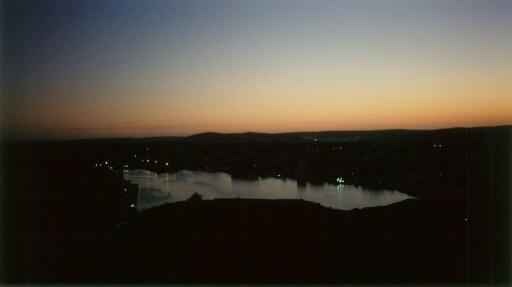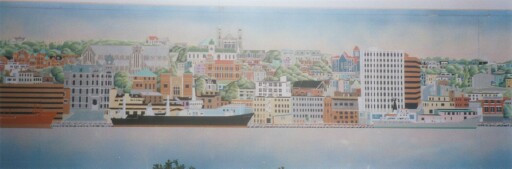
St. John's, NFSignal Hill is one of the world's most geologically rich places in the world. The rocks of Signal Hill are 550 million years old. If you visit the Johnson GeoCentre you will be delighted. Eight-five percent of the GeoCentre is located underground displaying over 500 feet of ancient, exposed rock in the lower portion of the building. Across the road from the GeoCentre is Gibbet Hill. Gibbetting was a practice whereby if you were convicted of any crime, even as petty as forgery, you could be hung, by chains for several days, on this hill, Gibbet Hill. The gibbet was erected on this spot in 1750, and from here sailors coming into the harbour had a great view of the harbour. The idea was to deter people, especially the sailors, who had already earned themselves a nasty reputation, from committing crime. After the body had begun to decompose, they would dip it in tar, stuff it in a barrel, and roll it down over the hill into this pond: Deadman's Pond, which was believed at the time to be bottomless. 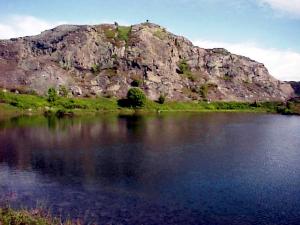 On the other side of Gibbet Hill (formally known as the Crow's Nest) is a field where defences were laid during the War of the Spanish Succession. The Signal Hill Tattoo is a group of young people aged 16-20 that perform reenactments of military exercises that would have been performed by the Royal Newfoundland Company circa 1861. The Tattoo is made up of a fife and drum band and artillery and infantry drills. Performances are held Wednesdays and Thursdays, Saturdays and Sundays at 1500h and at 1900h, throughout July and August. 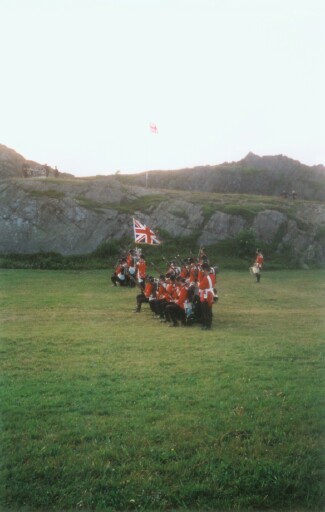 The name "tattoo" comes from the tradition of shutting the beer tap to at days end and returning to quarters. It is here on Signal Hill that Marconi received his first transatlantic wireless radio signal from Poldhu in Cornwall, England on 12 December 1901. It is said that radio and television were, then, born here at Signal Hill. Marconi received the 'S', which in Morse Code is one short beep. Construction on Cabot Tower began in 1897 in commemoration of the 400th anniversary of John Cabot having discovered Newfoundland and in celebration of Queen Victoria's Diamond Jubilee. 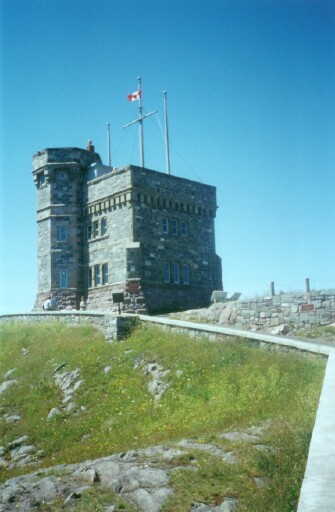 It is atop Signal Hill that one has the best view of the city 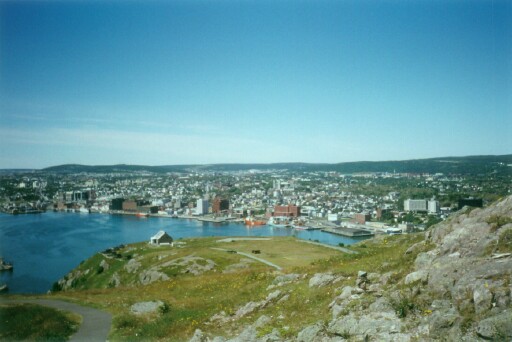
and of Fort Amherst. 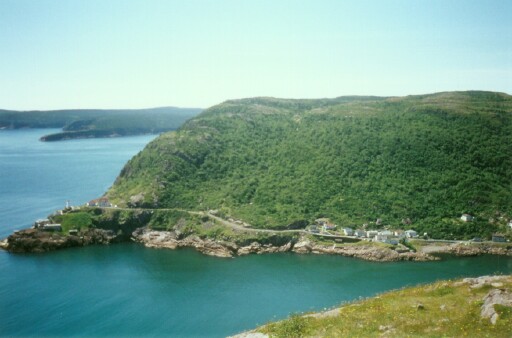 This concludes our tour of Historic St. John's. Sign my guestbook if you are intersted in seeing pictures of modern St. John's. 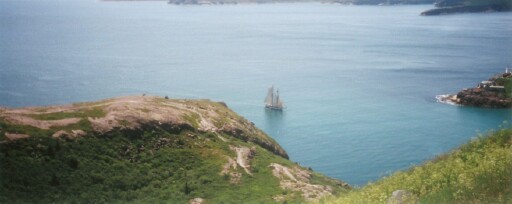

|