The Author
|
|
Jen Aquino was 14 years old when she fell in love with colorful words and beautiful language.Insomnia may be severely taking its toll on her, but she still makes sure to have time for writing. A fan of Phillipine literature, especially flash fiction and short stories, the author hopes to bring creative writing closer to young adults through this site. She is currently a senior Journalism major in the University of the Philippines.
|
Featured Book
|
|
Sleepless in Manila
Cristina Pantoja Hidalgo
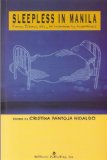
In this delightful compendium on insomnia, 38 fine Filipino writers -- mostly young, many of them award-winning, a few writing from Montreal, San Francisco, Paris and Singapore, and all insomniacs--describe their struggles with this affliction in hilarious essays, poems and stories. They also divulge the countless remedies for sleep disorders that they have tried, or simply imagined, with wildly different results; and the things they do when all is lost and insomnia has won the night. The rollicking humor is interspersed with carefully researched, indubitably useful, sometimes astounding nuggets of information.
Other books by Cristina Hidalgo
|
The Writing Will
|
The Writing Life: Things To Keep in Mind
taken from Annie Dillard's "The Writing Life"
-
When you write, you lay out a line of words. The line of words is a miner's pick, a woodcarver's gouge, a surgeon's probe. You wield it, and it digs a path you follow. Soon you find yourself deep in new territory. Is it a dead end, or have you located the real subject? You will know tomorrow, or this time next year.
-
It is the beginning of a work that the writer throws away.
-
Several delusions weaken the writer's resolve to throw away work. If he has read his pages too often, those pages will have a necessary quality, the ring of the inevitable, like poetry known by heart; they will perfectly answer their own familiar rhythms. He will retain them. He may retain those pages if they possess some virtues, such as power in themselves, though they lack the cardinal virtue, which is pertinence to, and unity with, the book's thrust. Sometimes the writer leaves his early chapters in place from gratitude; he cannot contemplate them or read them without feeling again the blessed relief that exalted him when the words first appeared?relief that he was writing anything at all. That beginning served to get him where he was going, after all; surely the reader needs it, too, as groundwork. But no.
-
The writing has changed, in your hands, and in a twinkling, from an expression of your notions to an epistemological tool. The new place interests you because it is not clear. You attend. In your humility, you lay down the words carefully, watching all the angles. Now the earlier writing looks soft and careless. Process is nothing; erase your tracks. The path is not the work. I hope your tracks have grown over; I hope birds ate the crumbs; I hope you will toss it all and not look back.
-
You write it all, discovering it at the end of the line of words. The line of words is a fiber optic, flexible as wire; it illumines the path just before its fragile tip. You probe with it.
Do not hurry; do not rest.
-
The line of words is a hammer. You hammer against the walls of your house. You tap the walls, lightly, everywhere. After giving many years' attention to these things, you know what to listen for. Some of the walls are bearing walls; they have to stay, or everything will fall down. Other walls can go with impunity; you can hear the difference. Unfortunately, it is often a bearing wall that has to go. It cannot be helped. There is only one solution, which appalls you, but there it is. Knock it out. Duck.
-
Courage utterly opposes the bold hope that this is such fine stuff the work needs it, or the world. Courage, exhausted, stands on bare reality: this writing weakens the work. You must demolish the work and start over. You can save some of the sentences, like bricks. It will be a miracle if you can save some of the paragraphs, no matter how excellent in themselves or hard-won. You can waste a year worrying about it, or you can get it over with now. (Are you a woman, or a mouse?)
-
A painting covers its tracks. Painters work from the ground up. The latest version of a painting overlays earlier versions, and obliterates them. Writers, on the other hand, work from left to right. The discardable chapters are on the left. The latest version of a literary work begins somewhere in the work's middle, and hardens toward the end. The earlier version remains lumpishly on the left; the work's beginning greets the reader with the wrong hand. In those early pages and chapters anyone may find bold leaps to nowhere, read the brave beginnings of dropped themes, hear a tone since abandoned, discover blind alleys, track red herrings, and laboriously learn a setting now false.
-
How many books do we read from which the writer lacked courage to tie off the umbilical cord? How many gifts do we open from which the writer neglected to remove the price tag? Is it pertinent, is it courteous, for us to learn what it cost the writer personally?
More about the book
|
|
Calling all Writers!
Beginner's Seminar to Poetry and Short Story
1-6pm| October 20, 2008| Bahay Kalinaw, UP Diliman
For details: Contact Camille at 434.6524

Let them fly with books
|
|
Uncontrollable Writing Urges| A Guide to Creative Writing
August 2008
Jen Aquino
|
| | | |