email Gwendalyn at [email protected] or call (913) 244-7072
Welcome to

If you can dream it, I can make it!
email Gwendalyn at [email protected] or call (913) 244-7072
Welcome to
If you can dream it, I can make it!

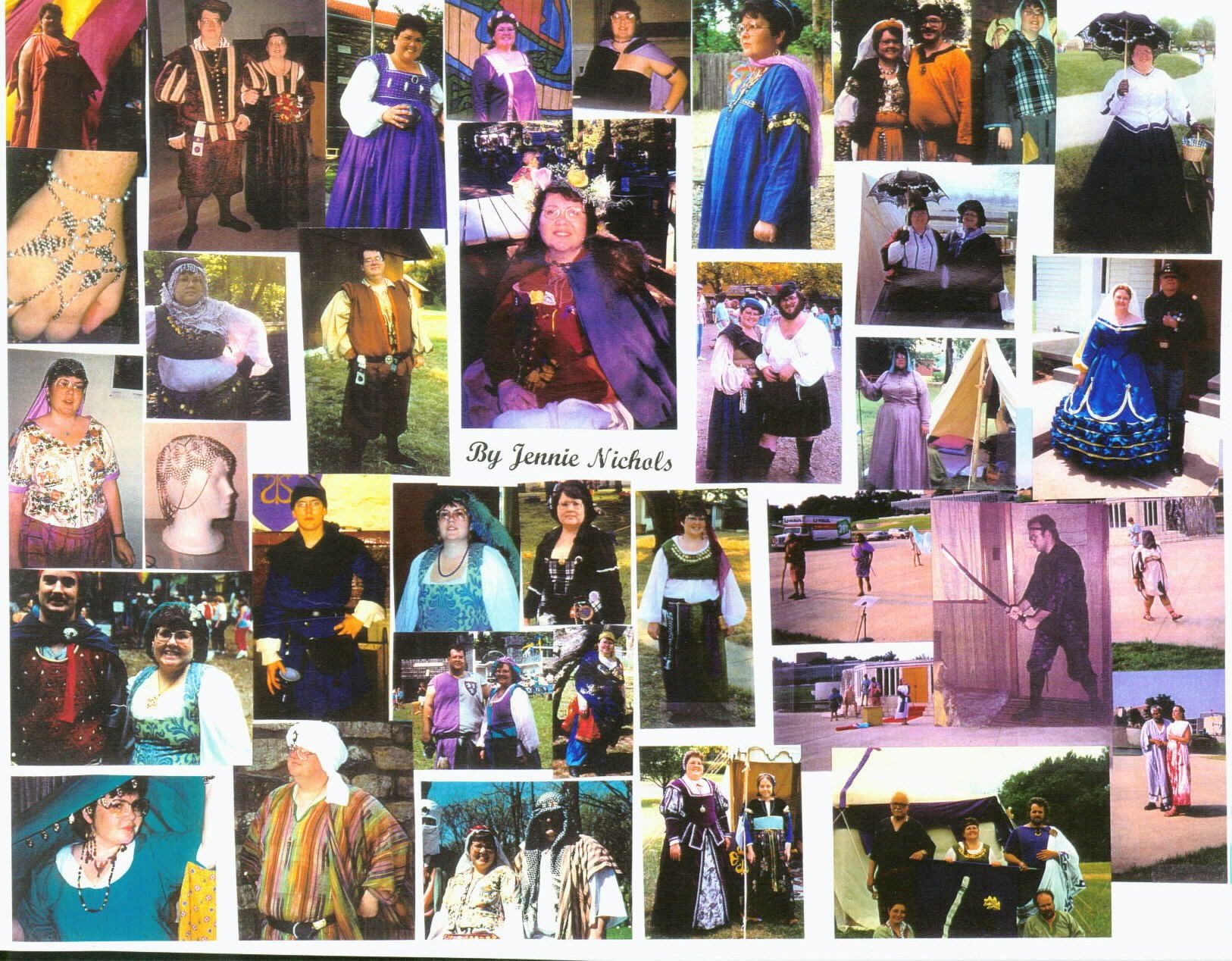
COSTUMING, MY PASSION
Here is my costuming section.
I have been sewing since I was 9 years old, and making my own patterns for costumes since I was 21. Actually I started earlier than that. I made my first SCA costume for Sam Mize when I was a freshman in college at 18. I have now made more than a dozen chest bodices and I don't know how many costumes. Chest bodices for busty ladies are my specialty. The concept of the medieval corset is to lift and jam together making a long, long, line of endless cleavage. Down, guys.
I like to help my friends sew. Sewing is hard work and takes precious time. If you're not good to me I might as well be spending my time with someone else, I have learned. I still do the Renaissance Festival and make costumes for that. I am also a Civil War reenactor. Someone told me I spend a lot of time in the past. I have had my house accused of being a museum. I'm very proud of my wall of fabric. Actually it's a wall and a half now.
The biggest project I did was a Civil War wedding gown, made this spring for one Juanita Webster, now Mrs. Jeff Guernsey, (my webmaster to make this site). She chose Simplicity 5724 in royal blue with pineapple yellow trim. I wanted her to outshine everyone at her wedding, so I made her hoop skirt a little bit extravagant. It's 150 inches around the bottom. The patterns usually don't exceed 144 inches. Actually there weren't that many people in period dress at her wedding, but she was still stunning. She said she felt like a princess. The bertha I found difficult, so I threw out the instructions written and did what I thought looked good. A bertha is a folded layer over the breast area.
I have only been a Civil War reenactor for 2 years. I have zoned in on studying ladies' underwear first. I know a lot about foundation garments throughout the ages now. The most important pieces of women's period costuming are the undergarments. Sillouette is all important. Also, would you go around without a bra on? What would people think! I am still learning how to construct a Victorian corset. I have been loosing a bunch of weight lately, so I will soon have to make myself another as even the 4 inch gap which is supposed to be in the back of a Victorian corset is now gone on mine. I have been a size double x for several years. I was told that using 2 pieces of the 1/2 inch boning side by side would work for a woman of my size. I was also told to make the corset a double layer of canvas. Since we spend a lot of time outside in the summer time, I was determined to make one of those layers thinner so it won't be quite so hot and unbreathable.
Remember, your fabric needs to be ALL COTTON!! 100% ! This is especially important for being out in the heat. It really helps, believe me. And of course it's more authentic than polyester. I hate anything plastic or polyester showing! Bad reenactor! No sweet potatoe biscuit! Remember, we are teaching history. Do your research. The corset I am wearing (summer, 2003) is a Frederick's of Hollywood that I bought and reboned. That one piece of plastic boning on each seam doesn't hold my puppies up!!! Get real!! It buckled. The authentic corsets are fairly straight down the front. They don't buckle when you sit. I'm going to put three pieces side by side in the front of the future corsets that I make for me and any other queen-sized ladies.
The Victorian corset laces up the back with 2 lacings, which meet in the middle. There is a reinforced strip of fabric around the middle to strengthen the corset. In the vertical line the two eyelets closest to the middle are closer together than the other eyelets. The lacings cross over and tie in the front. i.e. the right lacing goes around to the left side of the body, and the left one around to the right. The corset should be tight enough to support you but I don't like to wear it so tight it hurts. Remember, I sing. That means I have to have my full lung capacity. It does squish my stomach and I don't eat as much. The medieval corset and the Victorian corset are great because you don't have anything cutting you around your middle, and it forces you to have good posture. It makes you look younger and the Victorian one gives you a waistline. Get hold of me and I'll show you my research on corsets and help you make one that fits.
I haven't made anything, except what was originally a Spanish farthingale, for a hoop skirt yet. This is the completely conical one for 1860. They were putting extra fabric in the back which is a glimmer of the bustle, but you really don�t have the actual bustles until 1870. The elliptical hoop skirt came in around 1867. My friend Jan Spevak in Wellingtom has made one of these and other types of hoop skirts. She is much more of an expert on hoop skirts than I. Again, the biggest ones are about 144 inches at the bottom. For an Elizabethan farthingale 110 inches would be the biggest for the bottom circumference.


