
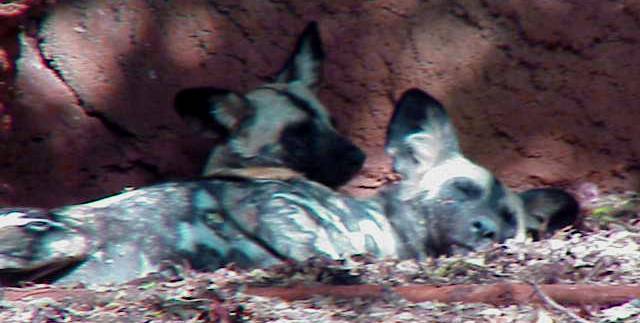
Range: From what I can tell, the sub-sahara to South Africa with healthy populations in Tanzaniz, Botswana and South Africa. These animals are huge travelers so consequently an accurate count of the remaining population remains sketchy at best. They are considered to be the rarest carnivore in Africa and had, in the past, been ruthlessly exterminated as vermin. Because the dogs require vast home ranges, it makes conservation efforts difficult.
Description: About the size of a medium domestic dog with a mottled color pattern. The ears are large and disrinctive and the head is shaped closer to that of a hyenas than dog. Legs are long and slender. There are four digits on each foot and the paws on the front feet are larger and broader than on the hind which, apparently, marks clearly in the spoor.
Behaviour: Hunting mainly happens at dawn, twilight and during full moon periods.They rely on sight rather than smell during a hunt and will hunt in pack. The Wild Dog is one of Africa's top predators whose main enemies are lions and hyenas. They have great stamina and can run at 35 mph for over 3 miles
The African Wild Dog is a very social animal. The pack consists of an Alpha male and female and they are the only members of the pack that will urine scent and are the ones responsible for all the mating. The pack is made up of 6 to 30 dogs that are predominately male. Unlike most wild animals it is the females that disperse while the males stay. Outside of the Alpha male and female there is no hirearchy and pups seem to have a privilege position in the pack. If there are pups at the kill, the sdults will allow them to eat first, unlike the lion.
Breeding: The Alpha male and female tend to have a litter during the dye season when the hunting is favorable. A litter can consist of 2-6 pups after a gestation period of 60-72 days. Pups will stay around the den of theie birth for the first three months. The entire pack takes responsibility of feeding and caring for the pups for 10-14 months
Additional sources of information can be found at:
Honolulu Zoo
ZOO IN THE WILD
Africam