
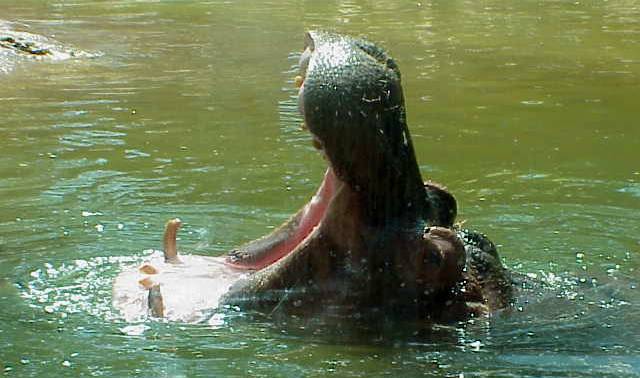
Here we have one of the three female Hippo's of the Honolulu Zoo demonstrating the size of her incredible mouth. The picture was taken through a rather grimy looking window which accounts for the lack of crispness of the photo, nevertheless, I am happy to have gotten the picture.
The Hippo is another Afican mammal easily identifiable. There is simply no other animal that looks like it. General description: They are very large with short, barrel shaped bodies that are supported by short, stout legs. Their tusk-like canines and incisors are formidible weapons and are frequently used against each other, crocodiles and boats. The skin of the Hippo is very thin and water evaporation happens much quicker with Hippo's than with other animals, which is one reason why they need to be underwater water or in a very humid climate. Hippo skin is virtually hairless and has no sweat glands, but rather specialized sweat glands that secrete a reddish fluid that is resistant to ultra violet light and protects their skin from the sun. It is this reddish secretion that attributes to hippos the urban legend of "sweating blood".
Habitat: Water. Hippos are in the water before or as the sun comes up and stay there until the sun goes down. This helps to protect the Hippo from sunburn, dehydration and eleviates the great weight of the hippo off it's legs. Hippo's require great stretches of open water in which they can completelly sumberg themselves, and if left undesturbed, the Hippo can use the same stretch of water for years.They occur widely south of the Sahara. They are great wanderer's and sometimes show up in areas in which they would not normally be found in an attempt to establish a good grazing ground. Hoppo's can consume 150 pounds of grass in one night. They can hols their breath underwater for up to six minutes and, because of their high center of gravity, can walk along the bottom of the pool.
Hippo's can be found in schools of 15-20 but during the dry season, when water space is at a premium, the schools can be up to 150-200 strong! Basic social structure is presominantly females with young and one bull male. Juvenile male Hippo's are usually viciuosly driven out by the territorial dominant bull. Territorial disputes can often lead to serious injury and death.Everything that I've read about him, he is one cranky character. Hippo's are responsible for more human fatallities in African than any other animal. They are, despite their immense size, very quick and short tempered. When you see a Hippo opening it's mouth and yawning, it could very well be threatening another Hippo. A terrirorial male marks his boundries by vigoruouly wagging his tail when defecating, thereby spattering his dung everywhere. Too charming.
Breeding: Mating happens in the water (it would have to) and the gestation time is usually anywhere from 225-257 days with the female giving birth to one offspring. The female hippo leaves the school and goes off to find a secluded spot to have her baby and after the birth, mother and young will stay secluded for several months. Babby hippo's are 60-100 pounds at birth and about 3 feet long. They can swim in the water a few minutes after birth. Baby hippo's are preyed upon by lion's and croc's but an adult hippo is usually more than a match for them. Young hippo's spend most of their time in the water on the bacK of their mother, the effort to stay afloat would wear them out if they did not.