
[AskEric] [Discovery School] [StudyWorks Online] [My School] [Science Club]
AskERIC is a great website for
all sorts of teacher resources. I was searching the site for lesson plans which
you can use in a science classroom, and I came across a lesson plan I did when I
was teaching 7th grade science in Athens. The lesson plan tries to
reinforce the concept of radar mapping and probes. The purpose is to figure out
how you can describe a surface without seeing it. The lesson asks each student
to create some sort of surface inside of their box, place strategic holes in the
cover of the box, and then let another student (without looking in the box)
measure the rise and fall of the play dough and plot the distances. When
finished, the students should then look inside the box to measure the distances.
With those results, they can then compare them to the “blind” findings.
An AskERIC Lesson Plan
http://ericir.syr.edu/cgi-bin/printlessons.cgi/Virtual/Lessons/Science/Space_Sciences/SPA0037.html
Submitted by:
Jan Mader, Great Falls, MT
Date: May 1994
TITLE: 20,000 LEAGUES UNDER THE
SEA (Exploration)
Just from this one example, you
can see that a resource bank of lesson plans is a great thing for teachers. My
mentor teacher actually told me about this lesson plan, but it was neat to find
that another teacher had actually submitted her version for other teachers to
use! Science teachers can really utilize many parts of AskERIC because they
house more then just lesson plans. They list all of the following services too:
Need
to know the latest information on special education, curriculum development or
other education topics? Just AskERIC! When you submit your education question to
AskERIC Q&A, you'll receive a personal e-mail response within two business
days from one of the network information specialists in the ERIC system! We will
send you a list of ERIC database citations that deal with your topic and will
also refer you to other Internet resources for additional information. It's that
easy!
In
response to questions we've received at AskERIC, our network information
specialists have compiled over 3000 resources on a variety of educational
issues. This collection includes Internet sites, educational organizations, and
electronic discussion groups. We will continue to add new resources as we find
them.
Got an
education question? Perhaps it's been asked before. Check out our Question
Archive! We have created a collection of over 110 responses to questions
received through the AskERIC Question & Answer Service. These responses may
include ERIC citations, Internet sites, discussion groups, and/or print resource
information.
The
AskERIC Lesson Plan Collection contains more than 1100 unique lesson plans,
which have been written and submitted to AskERIC by teachers from all over the
United States. Contributions from individuals are essential to the collection;
it is how it grows!
The
ERIC database, the world's largest source of education information, contains
more than one million abstracts of documents and journal articles on education
research and practice. By searching AskERIC's web-based version of the ERIC
Database, you can access the ERIC abstracts, which are also found in the printed
medium, Resources in Education and Current Index To Journals in
Education. The database is updated monthly, ensuring that the information
you receive is timely and accurate.
AskERIC maintains the archives of 25+ education-related discussion groups, including K12Admin, a school administrator discussion; LM_NET, a worldwide discussion group for school library media topics; and EDTECH, a discussion of educational technology issues. You can search the archives or browse through each month sorting by date or thread.
 |
Just from this menu you can see how Discovery school can help you as a science teacher, your students, and even the parents. For example, I made a quiz for students to take on Insects. All the kids have to do is complete the activity on the web page I created, and then they can click the “Take the Quiz” link and easily take an on-line quiz. It was also very easy for me to set the quiz up. The walked you through the steps and give you all the quiz options you need. For example, you can make multiple choice, short answer, and T/F questions. My only recommendation is to have some sort of outline of what you’d like on your quiz before you go to make the on-line version. You can visit my quiz at: http://school.discovery.com/quizzes8/jennaj10/InsectQuiz.html. |
Discovery
School also offers the following options for all teachers:
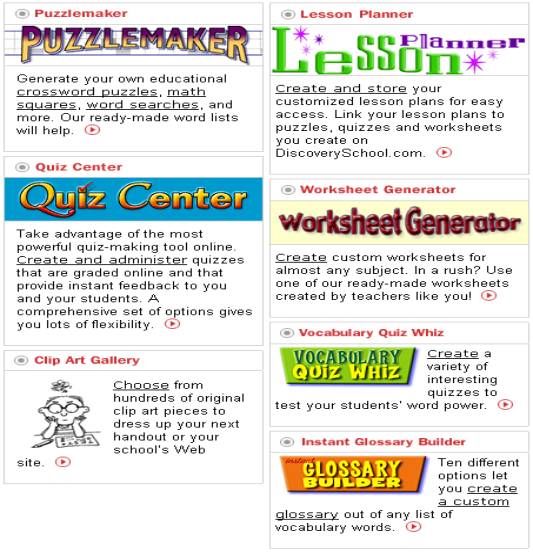
In addition to the things you can make at Discovery School, they also list programming you might be interested in recording to show your science students. You can also link to their Science Fair database where the share project ideas, question answers, tip sheets, and book resources. They also include interactive activities and live web cams (on Discovery Channel).
Here's
what you'll find at StudyWorks! Online:
·
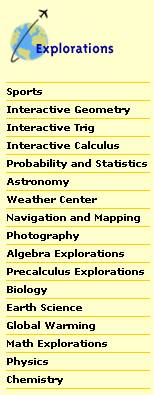
Explorations
provide in-depth looks at everyday activities, such as sports and photography,
and the math and science behind them. This section also features learning tools
for major subject areas.
·
Just for Fun
is your recreation center, with online games and puzzles.
·
News and Links
covers the latest news in math and science and features links to other top
learning sites on the Web.
·
Learning Center
includes additional learning modules which StudyWorks! Users can download or
purchase, as well as online courses.
·
Homework Hints
offers fast, friendly help from teachers and other students through online
forums.
· Test Yourself features online tests that help you see how you are doing in each of your subjects.
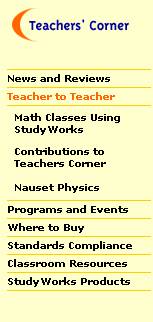
Inside of the explorations page
and teachers corner, you can:
(4)

I have not created my own classroom online yet, but I plan to when I start teaching. This is just one of the many examples of sites that will let you build your classroom online so parents and kids can access information at home. This may not be the best site online for this purpose, but I am listing this site to let people know about possibilities with putting your class on the web. They have Online Gradebook-"Teachers will save time, motivate students, and keep parents better informed with our online grade book!" and Quiz Lab, the Web-based quiz maker "Give online quizzes to students and have them graded automatically." Sites like this one also offer message boards, e-mail (so you can e-mail parents), class information pages, and grade viewing.

The Science Club
is a great site to find resources and activities. Every science teacher could
find some uses for the Science Club. One of the links I enjoyed was the link to
the Yucky site. It lists all sorts of yucky topics like, “What is eye gunk.”
You can also link to ask an expert type-sites. For example, they list a group
called Mad Scientist Network. You can also find Science Fair ideas. This site is
not fancy, but it is a huge Warehouse of opportunity. They have links to:
The about us page lists the following information about the organization. Since 1987, The Science Club has been bringing science to life for over one million elementary school children, teachers, and parents. The Science Club fuels the wonder and joy of learning, through school assemblies, parent and teacher workshops, television, video, and print. The Science Club has also designed programs for museums, agencies, and educational organizations.
