|
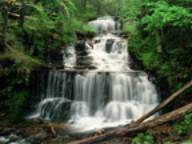
What is a Waterfall?
A waterfall is an area
where flowing river water drops abruptly and nearly vertically.
Which are the tallest Waterfalls?
Angel Falls in
southeastern Venezuela is the highest uninterrupted waterfall in the world,
dropping 979 m (3212 ft). The falls are named for American aviator and
adventurer James C. Angel, who sighted them in 1935.
Yosemite Falls, which
plunges 739 m (2425 ft) from Yosemite Creek, is the tallest waterfall in North
America.
http://www.geocities.com/
Yosemite/2687/info.html
Click the book for information on ordering
|
|

|
Introduction
Do sugar cubes
dissolve when a wet paper towel is placed on it? Do troglobites bite? What
happens when water doesn't evaporate? All these curiously curious questions
and more will be answered when we explore the world of caves and
waterfalls. We go on a WebQuest to locate different caves and waterfalls
around the US, and take down facts and pictures so we can all share what we
find out about cave life, creation, location, and environment. So, put your
thinking caps on and grab your detective spyglass for this classes
adventure!
Objectives
-Given a lesson on
erosion, each student will be able to answer questions on how it takes
place, how to speed up the process/slow it down, and effects of erosion.
-Given a lesson on
waterfalls and caves and a chance to search for information, each pair of
students will be able to write a page report covering such topics as
wildlife, activities, economic impact, and size of the cave they have
chosen.
Materials
The materials for this lesson are: computers with Internet access,
paper, pencil, 9 sugar cubes, paper towel, small dish, water, and a faucet
Padilla, M. (2000). Science Explorer: Environmental Science.
Upper Saddle River, New Jersey: Prince Hall, Inc.
|
|

|
Invitation
EEEP activity. To
give the kids an idea of how soil can be firm and then begin to disappear
after groundwater starts to soak in, we will conduct an experiment with
sugar and water. In a small dish, a pair of students will build a cube out
of 9 small sugar cubes. Then they will fold a piece of paper towel until it
fits on top of the cube. After wetting this paper towel, they will place it
on top of the cube and let it sit for fifteen minutes. While it is sitting,
the kids should sprinkle water on the cubes every couple of minutes. When
the paper towel is removed we will talk about what happened. I will ask
some questions like, What happened to your cube? and How is the effect of
water on a sugar cube similar to groundwater eroding limestone? How could
we speed up the action? How could we have slowed it down?
During the down time of the fifteen minutes, I will show them:
Waterfalls of the Smokies
|
|

|
Exploration
The kids will be asked to pair up with someone they do not hang out
with everyday, choose a cave/waterfall and get on the computers and search
the sites listed below for information on their chosen cave/waterfall. They
are to find 12 facts on one of the caves/waterfall of their choice that I
talked about in class (Alabama: DeSoto Caverns Park, Rickwood
Caverns, and Sequoyah Caverns Tennessee: Bristol Caverns, Cumberland
Caverns, Forbidden Caverns, Lost Sea, Raccoon Mt. Caverns, Ruby Falls, and
Tuckaleechee Florida: Florida Caverns State Park), and they can
start with the addresses I give them:
Project
Databases
The waterfalls of
North Georgia
Caves:
Cave web site
Cave words defined
Kids Domain: Caves
Journey into Amazing
Caves: Caves you can visit
Virtual Cave tour
Waterfalls:
Waterfall Facts
Help on taking notes on
your waterfall (just use 1-4)
Have
a little fun
Go on a virtual tour of High Falls or
try these virtual
tour of Ruby Falls.
|
|

|
Explanation
First I will find
out what the kids remember about terms like groundwater and stalagmites by
asking questions. I will ask them if they have any stories about when they
visited caves or waterfalls around the area. While they are telling
stories, pictures will be posted for the kids to see examples of waterfalls
and caves. After I have an idea of where the kids stand, I will begin to
teach them about the concepts listed below.
*Waterfalls will show how erosion takes place. Waterfalls may occur
where a river meets an area of rock that is very hard and erodes slowly.
The river flows over this rock and then flows over softer rock down stream.
The softer rock wears away faster than the harder rock. Eventually a
waterfall develops where the softer rock was removed.
*A link to Georgia would be to talk about Anna Ruby Falls. The
Falls are located in the Chattahoochee National forest. The water for the
falls is supplied by Curtis and Young Creeks. Both creeks start in the Tray
Mountains where they are fed by underground springs, rain, and snow. Curtis
Creek drops 153 feet and York Creek drops 50 feet.
*Caves: When water is not evaporated, it soaks into the ground. As
it fills the openings in the soil, it trickles into cracks and spaces in
the layers of rock. This groundwater affects the shape of the land. When
groundwater sinks into the ground it combines with carbon dioxide to form a
weak acid called carbonic acid that can breakdown limestone. The limestone
is carried away with the water and eventually large holes develop that form
caves. Stalactites are deposits that hang like an icicle from the roof of a
cave. Stalagmites are formed by the slow dripping of water into a cone
shape on the cave floor.
*Cave life consists of troglobites (ex. eyeless cave shrimp),
troglophiles (ex. mites), and trogloxenes (ex. bats). Some caves contain
over 200 species of animals. The temperature of a cave varies with air
movement, and the lack of light produces stress in caves because there are
limited amounts of food.
*There are many caves around the area. Alabama: DeSoto
Caverns Park, Rickwood Caverns, and Sequoyah Caverns Tennessee:
Bristol Caverns, Cumberland Caverns, Forbidden Caverns, Lost Sea, Raccoon
Mt. Caverns, Ruby Falls, and Tuckaleechee Florida: Florida Caverns
State Park.
|
|

|
Taking Action
The students will
be asked to complete a report on their cave/waterfall, and they will be
told that their report will be turned in and graded for including twelve
facts, pictures, complete sentences, at least three developed written
paragraphs, and correct grammar. After the reports are complete, we will
have an .Around the US in Mrs. Jenkins. class: Special Report on Caves and
Waterfalls. segment. The reports will be turned in and graded for including
twelve facts, pictures, complete sentences, at least three developed
written paragraphs, and correct grammar. The kids will also take:
Cave quiz
http://www.caveofthewinds.com/test/cavequiz.html
Conclusion
I hope my students
will take what they have learned in class and get together with their
parents and go see one of these neat caves! Hopefully their new knowledge
of cave wildlife, how waterfalls and caves are formed, and the environment
surrounding these neat places, will enable them to teach their parents
while they visit one of the places we studied. The kids should also be able
to locate other caves and waterfalls from our WebQuest.
|
|
|


