An insect unit isn't complete without live insects in the classroom. Many students like to bring insects for 'show and tell.' While some insects are very hard to keep alive for more than a few days, others can be maintained for much longer periods of time. There are some guidelines in both cases that this publication will attempt to address.
 S. Bailey, 1995 |
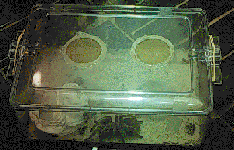
In general, the bigger the container, the better. At the very minimum, a container should be at least twice the insect's width and five times its length. Gallon jars, aquaria, and plastic food containers are very easy to find and make great bug houses. |
Be sure the container is rinsed of any soapy (or other chemical) residues, which may harm the insect. Lids should be ventilated, or use a fine, screen-like material (such as nylon stockings) placed over the top. Secure the lid, you don't want the insect to escape!
| Adult insects can get by for a few days with a little moisture (from a clean sponge or cotton-stoppered test tube filled with water). |  S. Bailey, 1995 |
Keep the insect by itself (so it is not eaten or doesn't eat others) and keep the container out of direct sunlight, and away from heating or cooling vents and drafts. Most insects are more comfortable with even a minimal habitat such as rocks, sticks and/or crumpled paper towel for the insect to hide in. Immature insects such as caterpillars must have food to survive. Ensure a food supply before bringing caterpillars into the classroom.
Long-term visitors have a few more needs. The container will need to be cleaned periodically (caterpillar containers should be changed every few days at least). Research the insect's natural environment, and try to make its container hospitable. Always have a source of moisture available. Make sure you will be able to provide plenty of food for the insect. Is it a predator or a leaf feeder? Where can you get food? If you can't determine what the insect eats, don't plan to keep it for more than a few days. Check to be sure there is enough food and water to tide the insect over on weekends. During long holidays it may be best to either take the insect home or set it free, as weather permits.
Insects are everywhere!! Insects are often encountered, at least with a little searching, in homes, yards, around building foundations, basements, crawl spaces, flower or vegetable gardens that are NOT heavily sprayed with pesticides, around lights at night, near streams and lakes, abandoned fields, parks, and forests.
Dead insects in reasonable condition (for collections) can often be found on windowsills, car grilles, roadsides and walking paths.
Some insects are very sedentary and are easy to catch with a pair of tweezers. Others fly, some pretty slowly and others (like dragonflies) are FAST! Catching insects takes some practice. It is best not to catch dangerous insects such as bees and wasps at first.
Collectors may want to keep an observation notebook to help them keep track of their expeditions. It is a good idea to make labels for insects that include collection date, location and habitat, as well as the collector's name.
 |
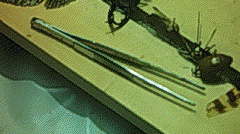
Tweezers or forceps, to pick up insects |
|
35mm film canisters, to hold small insects |
|
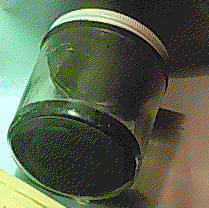
Killing jars, made from peanut butter jars with nail polish remover or alcohol on an absorbent material such as cotton balls or newspaper. Place a crumpled piece of tissue paper in the jar, to give insects a place to 'hide' so they don't beat themselves up trying to escape. Write 'POISON' on the outside of the jar, so the contents are not mistaken. |
|
Collanders can be used for aquatic collection, to 'scoop' out insects at the water's surface or underwater at the edge of a stream or lake. Aquatic insects include water striders, whirlygig beetles, backswimmers, diving beetles, immature mosquitoes, immature dragonflies, and giant water bugs (many of these bugs can bite!). |
|
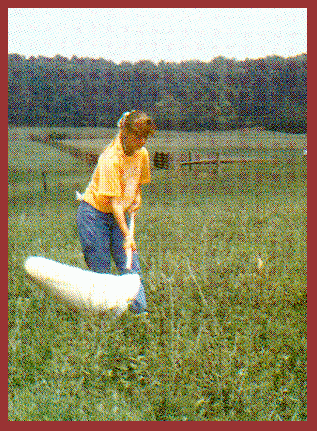
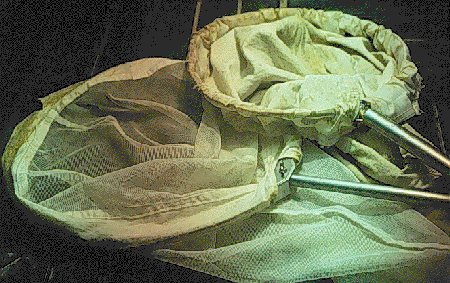
Sweep nets are used for sweeping the grass of meadows and abandoned fields, as well as catching insects in bushes and up in trees. Because they are made of solid material, sweep nets won't snag like butterfly netting. Unwind a wire coat hanger (or No. 9 wire), bend the wire in the form of a round loop, and thread the wire through the casing of an old pillowcase. Tape the ends of the wire to a dowel rod or broomstick with duct tape or electrical tape, or tighten the wire to the broomstick with a hose clamp. |
|
Butterfly nets are best for catching flying insects. They are assembled like the sweep net, except that the body of the net is made of netting (purchased from a craft store, 1/2 yard will do). Cut and sew the netting material into a 'cone' shape, then fold the edge over and sew a casing through which to thread the wire loop. Attach to a dowel rod or broomstick as described for the sweep net. |
|
Beat sheets are used to collect slow moving and small insects which have been jarred from plants. An inverted umbrella, white pan or sheet of paper is placed under plants. Shake or jar the insects off of plants onto the beat sheet, then grab them with tweezers or shoo them into jars. |
|
Berlese funnels are useful in collecting small insects from soil, leaf litter, or compost. Place a wire screen over a funnel, with the tip of the funnel resting in a jar above at least 2" of alcohol (ethanol is the best type but rubbing alcohol will work). Scoop a bit of soil or debris onto the screen, and then place an electric light directly above the funnel. The heat from the lamp forces insects down the funnel, into the alcohol. Leave undisturbed for 2-5 days, or until soil is dry. If the material is very fine, place a paper towel between the screen and the soil, so fine particles won't get into the alcohol. |
|
Light traps are used at night to catch insects. "Black lights" or ultraviolet lights may be more successful than regular outdoor lighting, but even normal outdoor lights attract lots of insects. A white sheet placed behind the light may help with collecting since it gives the flying insects a place to land and fewer escape routes. |
|
Bait traps attract insects with food. Rotten meat attracts carrion feeders, while other insects like overripe fruits, fermented foods, sugary foods, or oils (peanut butter). Some insects are even attracted to dung. "Sugaring" is a method of painting tree trunks, etc. with a fermented mixture of fruits, sugar, and an alcoholic beverage such as rum or beer, and is a good method to catch certain types of nocturnal insects. |
|
Pitfall traps are useful for catching ground dwelling insects and can also be baited. Soup cans are an excellent size for pitfall traps. Punch small drainage holes in the bottom, and shield the trap from debris and rain. The top of the can should be level with the ground surface, so an insect will fall right in. Either check traps often or preserve the insects with a mixture of saltwater or soapy water in a can without drainage holes. |
|
Pheromone traps use synthetic female hormones to attract male insects to its source. Pheromones for several pest insects are available commercially. Check with the nearest Cooperative Extension Service Office for sources of pheromones and the best time to set up a particular trap, to make sure seasonal insects are in flight. See Entfact 010--Plans and Parts List for the "Texas" Style Cone Trap, and Entfact 112--Using Pheromone Traps in Field Crops for more information. |
|
5-10 egg cartons |
|
LARGE mixing bowl |
|
paint- bright, dark or metallic color |
|
1 inch diameter or smaller round mirrors |
|
newspaper |
|
glue gun |
|
medium size mixing bowl |
|
flour |
|
glue (optional) |
This project is a bit complex but well worth the effort. The mirrors are about 15 US cents each as of 1995. The glue gun is essential in getting the 'skeleton' of the compound eye together.
 S.Bailey, 1995 |
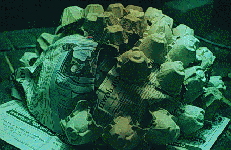
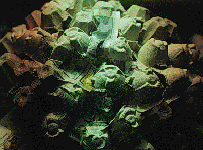
To begin with, cut up the egg cartons into individual 'eyes.' Invert the LARGE mixing bowl, and cover with 1 or 2 layers of newspaper. Using the glue gun, attach individual eyes to each other, or to the newspaper covering the bowl, using the bowl as a mold. The closer together the eyes fit, the better. |
Once the inverted bowl is covered with individual eyes, rip sheets of newspaper into thin strips. In the medium size mixing bowl, mix flour and water into a paste (paper mache). Adding extra glue is optional.
|
Use the newspaper, dipped in paper mache paste, to fill and smooth out the spaces in between individual eyes. Allow to dry. This may take one to several days. |
 S.Bailey, 1995 |
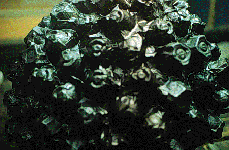
Gently pull the compound eye off of the large mixing bowl. If some of the newspaper in- between sticks, don't worry. Add a layer of paper mache newspaper strips to the inside part of the compound eye, again smoothing out and filling in spaces between the individual eyes. Allow to dry.
 S.Bailey, 1995 |
Once the compound eye is completely dry, gently remove from bowl. Cover both surfaces of the eye with at least 2-3 coats of spray paint, in a bright, dark, or metallic color. |
|
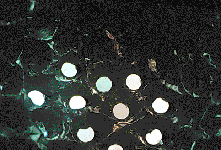
On the inside (concave side) of the compound eye, CAREFULLY hot glue a mirror to the bottom of each individual eye. |
 S.Bailey, 1995 |
The compound eye can be displayed with a large easel, or on a shelf. By looking into the compound eye, students can get an idea of what an insect might see.
Paper Mache Insectsby
Stephanie Bailey,
|
||||||||||||||||||||||||||||||||
|
mixing bowl |
|
flour |
|
water |
|
all-purpose glue |
|
hot glue gun and glue sticks |
|
paint in various colors |
|
coat hanger or similar wire (florist wire is too thin!!) |
|
combinations of feathers, pipe cleaners, nerf-or other soft balls, toothpicks, foam, party favors, etc. |
|
plastic wrap, window insulation wrap, or crepe paper (membranous wings) or construction paper, tissue paper or thin fabric (colored wings) |
Step 1: Group students into manageable sizes, and either let them decide what bug they're going to make or tell them what to try. They could even take some time to look in books for models of the exact insect species they want to make.
Step 2: Rip up newspaper (you'll need a lot) into thin strips about six to eight inches long, and 2 or so inches wide.
Step 3: Balloons make excellent molds for paper mache insects. All sizes and types of balloons are useful: long, skinny balloons are good for butterfly, dragonfly, walking stick, praying mantis, caterpillar, and cricket bodies; long but wavy balloons are excellent caterpillar bodies; and even the normal round balloons make good insect heads, fly and beetle bodies, depending on the size. Balloons of all shapes and sizes can normally be found at either drugstores or stationery stores. Depending on the model(s) you're planning to make, blow up balloons, and then tie them off.
Step 4: Make paste - there are several recipes for paper mache. A simple, tried-and- true method is to start with a few cups of flour, add a little water at a time (it will be very thick at first) and stop adding water when it feels like glue. Some directions also advise to include glue in the paste, but flour and water will do the trick.
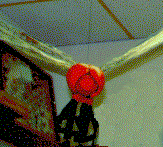
Step 5: One piece at a time, dip strips of newspaper in paste, and squeeze off excess paste with fingers. Apply to balloons, until the balloon is completely covered. Put several coats of newspaper on, and then allow to dry. You will probably have to repeat this step several times, to mold and shape the body to specification, but make sure the insects are completely dry (a couple days) before putting on the next layer. If more than one balloon will make up the final insect (e. g. head, thorax, abdomen), glue them together after the first layer is dry. Once the body is fully formed and totally dry, Apply at least one coat of paint, and preferably more, to protect the insect from moisture. This can also be the first step of decoration.
 S. Bailey 1995 |
Painting is the main way to decorate the insect's body, and can be as simple or detailed as the artist wants. Besides paint, other body decorations might include glitter-painted or nerf-ball eyes, feather or pipe cleaner antennae, party favor or pipe cleaner mouthparts, and cut up coat hanger wires or pipe cleaner legs, etc. as imagination allows. With a little creativity, these bugs will look amazingly real! |
The final touch is the wings. Overhead projectors allow easy enlargments of illustrations to the size needed. Have students use ratios to determine what size enlargement of illustrations or specimens is needed by measuring the length of the body in the picture compared with the paper mache body, and calculate the length of wings that will give the correct ratio for the size of wings in the picture or specimen.
| Transfer the projection to window insulation film (e. g. 3M brand), clear contact paper or plastic wrap for membranous (see-through) wings for dragonflies, flies, or wasps. Use crepe paper or thin fabric for butterfly, moth or grasshopper wings. Trace the wings with a permanent marker or pen (temporary or water-soluble markers won't work on the plastic). | 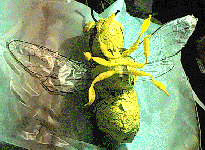 S. Bailey 1995 |
Finally, use coat hanger wire or something a little thinner (florists' wire is too thin), shaped and glued to the outer margins of the wings to give the wings the rigidity they need. Finally, hot glue the inner wire portion of wings to the body. Regular glue will not hold them. With very heavy wings, you may have to cut a notch in the body wall for extra glueing surface area.
For butterflies or moths use colored feathers for the bodies (moths especially are very hairy). Long feathers make great moth antennae. Use pipe cleaners for legs and (coiled up) mouthparts. Color in wing patterns with markers, fabric paints or glue cutouts of tissue paper to wings. These insects will look better if the body is no more than 2/3 the length of wings. They also look better when there is a 'notch' between front and back wings.
| Dragonflies, damselflies, mayflies, and dobsonflies all have long, thin bodies and big, membranous wings. | 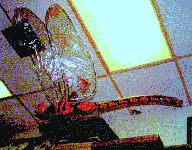 S. Bailey 1995 |
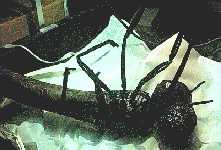 S. Bailey 1995 |
Use a long, thin balloon, but build up sections for the head and thorax a bit more than the abdomen, to make it more realistic. Dragonflies and damselflies have thick legs with spines for catching prey -- use foam legs with toothpicks glued into them. |
| Mayflies look similar but have very thin legs, antennae and cerci (tails). Use twine or rope, dipped in the paper mache to stiffen them. Male dobsonflies have very large mandibles (jaws), which can be made from molding rolled newspaper in paper mache or simply cutting out foam. | |
| Praying mantises and walking sticks have thin bodies as above but walking sticks have no wings. Use pipe cleaners, twine or rope for the legs and antennae, dipped in paper mache and bend the legs to dry. Additionally, praying mantis front legs are thicker, use foam wrapped around coat hanger wire, then glue in toothpicks to look like the thick spines. | 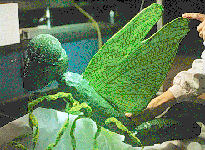 S. Bailey 1995 |
 S. Bailey 1995 |
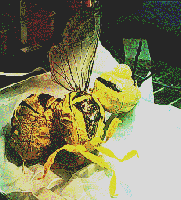
Flies, beetles, bees, wasps, and bugs all would need the regular, rounded balloons. For beetles, build up the wing covers on either side of a pencil. The groove will not be too big, but will be enough to separate the wings. Toothpicks or pieces of yarn glued to the body will simulate the hairy bodies of flies. |
Use long wavy party balloons for caterpillar bodies--they're already segmented! Look up strange and wild caterpillars for models, e. g. hornworm, hickory horned devil, monarch, cecropia, spicebush swallowtail, etc. (See EntFact 003--Stinging Caterpillars and EntFact 008--Saturniid Moths--for pictures of some of these caterpillars.)