Home
STS Table of Contents
The
Great Solar System Search and Report

Introduction Initiation
Exploration Explanation
Take Action Assessment

Introduction
Grade: Middle
School
Time Frame: 3
to 4 days
Objectives: Given a treasure hunt
activity and some lecture/discussion, students will be able to:
- Know characteristics and movement patterns of the
nine planets in our Solar System
- Know
characteristics of the Sun and its position in the universe
- Know
that the planet Earth and our Solar System appear to be somewhat unique
-
Know that gravitational force keeps
planets in orbit around the Sun and moons in orbit around the planets
-
Know characteristics and movement patterns of asteroids, comets, and meteors
Materials: Computer
lab, TV/VCR, paper, pencil, Bill Nye Video
Overview:
Overhead Notes
Benchmarks
On-Line
- The sun is a medium-sized star
located near the edge of a disk-shaped galaxy of stars, part of which can be
seen as a glowing band of light that spans the sky on a very clear night.
The universe contains many billions of galaxies, and each galaxy contains
many billions of stars. To the naked eye, even the closest of these galaxies
is no more than a dim, fuzzy spot.
- The sun is many thousands of
times closer to the earth than any other star. Light from the sun takes a
few minutes to reach the earth, but light from the next nearest star takes a
few years to arrive. The trip to that star would take the fastest rocket
thousands of years. Some distant galaxies are so far away that their light
takes several billion years to reach the earth. People on earth, therefore,
see them as they were that long ago in the past.
- Nine planets of very different
size, composition, and surface features move around the sun in nearly
circular orbits. Some planets have a great variety of moons and even
flat rings of rock and ice particles orbiting around them. Some of
these planets and moons show evidence of geologic activity. The earth is
orbited by one moon, many artificial satellites, and debris.
- Large numbers of chunks of rock orbit the sun. Some of
those that the earth meets in its yearly orbit around the sun glow and
disintegrate from friction as they plunge through the atmosphere—and
sometimes impact the ground. Other chunks of rocks mixed with ice have
long, off-center orbits that carry them close to the sun, where the sun's
radiation (of light and particles) boils off frozen material from their
surfaces and pushes it into a long, illuminated tail.
Astronomy
for Kids (kid size planet facts):
 |
 |
 |
        
Take a
Journey Through Our Solar System!
We live in a very small part of the universe, but it's what we
call home, and it's a very interesting place. You can visit all
of the members of our planetary family by clicking on the name
or the picture of the planet you want to visit. Enjoy your trip!
How Big is the Solar System? Even
though we live in a very tiny part of the universe, our
neighborhood is still a very large place. If you would like to
find out just how big it is, visit the How
Big is the Solar System page. |

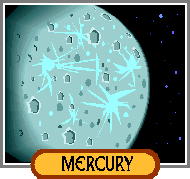
Mercury
is the closest planet to the Sun. Mercury is named for the Roman
messenger god because it quickly appears and disappears from the
morning and evening skies. Many astronomers have never seen
Mercury because it's only visible a few days out of the year,
and does not rise very far above the horizon.
|

Mercury |

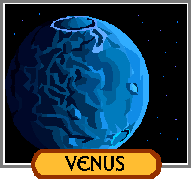
Although Venus
is named after a goddess of beauty, the reality of this planet
is far from its name. Venus is a very unpleasant place, with
winds that blow constantly at hundreds of miles per hour and
extremely high temperatures. This planet is an example of a
runaway greenhouse effect on a planetary scale. |

Venus |

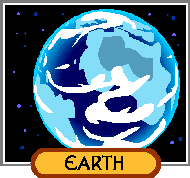
Earth.
Our home in the planetary neighborhood, and as the saying goes,
there's no place like home. Our planet is unique in the solar
system, and not just because we live here. Did you know that
Earth is only planet in the solar system that can have eclipses
of the Sun? |

Earth |

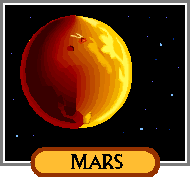
Always known as the Red Planet, Mars
has probably been the source of more science fiction (good and
bad) than any other planet. Mars is much smaller than Earth, but
recent research shows that it once had flowing rivers. Mars also
has a canyon that stretches over 2000 miles. |

Mars |

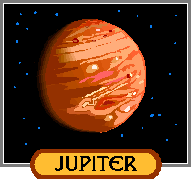
The ruler of the night skies, Jupiter
is by far the largest planet in our solar system. Jupiter is so
large that over 1300 Earths would fit inside it! It also makes
up its own miniature solar system with its family of at least
sixteen Moons! |

Jupiter |

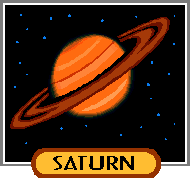
The Ringed Planet, Saturn
is probably the most visually stunning planet in our planetary
neighborhood. Saturn's giant rings are actually made of of
thousands of small particles of dust and ice. The divisions in
the rings we see from Earth are caused by some of Saturn's
smaller moons. |

Saturn |

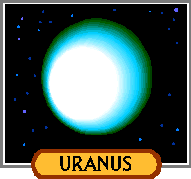
One of the mysterious gas giants, Uranus
has rings like Saturn, but they are very faint and weren't
discovered until the planet was visited by the Voyager
spacecraft. The planet is also the only one in our solar system
that lays on its side instead of standing straight up. |

Uranus |

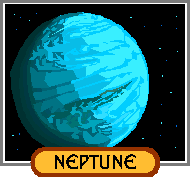
Neptune
was the last stop that the ground breaking Voyager spacecraft
made on its journey through the solar system. The amazing
mission had one more surprise for us, though, as it found
"geysers" on Triton, one of Neptune's moons. |

Neptune |

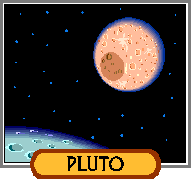
The most distant planet in our solar
system, Pluto
is so far away that the Sun is not much bigger or brighter than
most of the other stars in its sky. Pluto also has a moon,
Charon, that is nearly as big as the planet itself. |

Pluto |
|
Back
to top
Initiation
Teacher:
Movie Conductor
Students: Spectators
Method: Watch
Bill Nye the Science Guy in Plants and
Moons video #41 which talks about the 9 planets and some common facts about
them.
Exploration
Teacher:
Facilitator, Coach
Students: Decision
Makers, Investigators
Methods:
First the kids will be broken up into groups of 6. They will then draw out of a
cup two pieces of paper with their topic assignment on it (topic
cards). The kids can then be
taken into the lab to complete the Treasure Hunt below. After the treasure hunt,
each student should choose some sort of presentation method to present the
information by (Power Point, Inspiration, Word, Hyper Studio, Poster, Overheads,
etc.) and create a presentation for their two topics to be presented at the end
of the unit. Schedule more lab time and
assign this part as homework.
Treasure Hunt

an Internet-Based Treasure Hunt on the Solar System
Instructions | The Questions
| The
Internet Resources | The Big Question

Use the Internet links below to uncover some
"Treasures of the Solar System. Each resource link will help you find the
right information for your assigned topics. Use the links and paper/pencil or
Word to take notes.
Back to Treasure Hunt
top
Planets:
- Classify it as a Gas Giant or Jovian planet.
- Where is it located?
- What is its size?
- What is it made of?
- What is it like on the surface?
- Does it have a moon(s)? rings?
- Can you see it from Earth?
- How did it get its name?
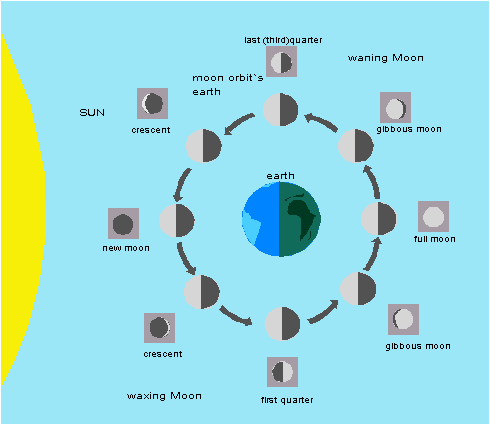
Moon:
- Describe the moon's phases from our view on Earth.
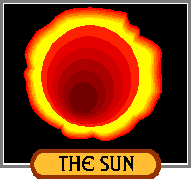
Sun:
- Describe the different layers of the sun.
- What is its location in the solar system?
- What temperatures are the different layers?
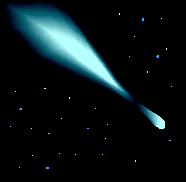
Comets, meteors, meteorites, and asteroids:
- What is each composed of?
- What does each look like?
- Describe its flight path.
- How can each one interact with Earth (can we see it/can it hit Earth)?
Back to Treasure Hunt
top
Resources (click a picture below)
Click a site below, and then clink a link that pertains to what
you're looking for:
Back to Treasure Hunt
top
Look over all the questions above and your answers to them and
state what you feel are the 4 - 5 ways to classify objects in the solar
system.
Back to Treasure Hunt
top
Back to top
Explanation
Teacher:
Expert, Tour Guide
Students: Curious
adventurers, Presenters
Methods: The
teacher should present overhead notes and points from
the overview on the different topics (planets, moon, sun, comets, meteors, meteorites, and asteroids)
while discussing them with the class.
Back to top
Take Action
Teacher:
Consultant, Facilitator
Students: Creators
Methods: The
kids could then begin to build a concept map on paper about the facts they found
and the notes presented in class.
Back
to top
Assessment
Most
of the assessment here should be observation. You can look at the treasure hunt
results and check them off for completeness. The concept maps should be a work
in progress during the unit.
Back
to top

