 |
|
|
|
Introduction Invitation Exploration Explanation Take Action Assessment

Grade: Middle School
Time Frame: 1 day (and one assignment spans over several days)
Objective: Students will be able to recognize that the positions of the sun, the moon, and earth affect the phases of the moon.
Materials: Darkened room, bare light bulb (a floor or table lamp with the shade removed works fine), ball (2-3" diameter) to represent the moon, globe of earth (8-12" diameter), paper, drawing paper, and pencil
Overview: Information is from: THE MOON SEEN FROM EARTH
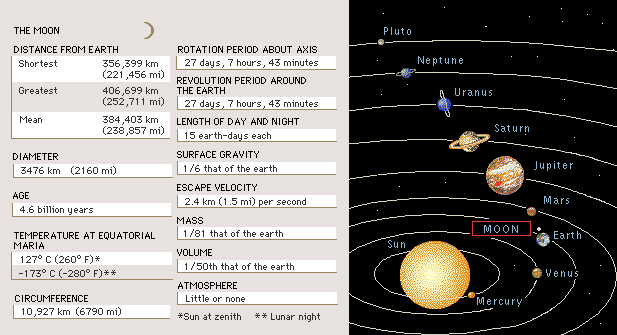
At any one time, an observer can see only 50 percent of the Moon's entire surface. However, an additional 9 percent can be seen from time to time around the apparent edge because of the relative motion called libration. This is because of the slightly different angles of view from Earth, due to different relative positions of the Moon along its inclined elliptical orbit.
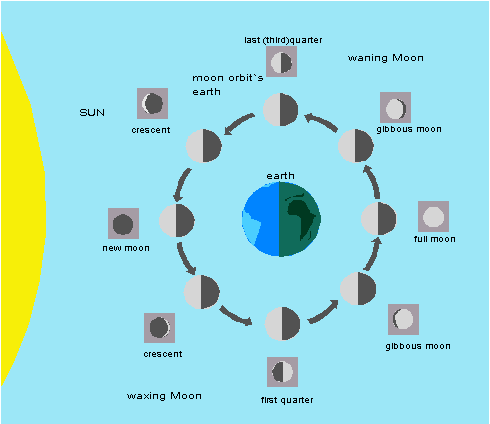
The Moon shows progressively different phases as it moves along its orbit around Earth. Half the Moon is always in sunlight, just as half Earth has day while the other half has night. The phases of the Moon depend on how much of the sunlit half can be seen at any one time. In the phase called the new moon, the face is completely in shadow. About a week later, the Moon is in first quarter, resembling a luminous half-circle; another week later, the full moon shows its fully lighted surface; a week afterward, in its last quarter, the Moon appears as a half-circle again. The entire cycle is repeated each lunar month. The Moon is full when it is farther away from the Sun than Earth; it is new when it is closer. When it is more than half illuminated, it is said to be in gibbous phase. The Moon is said to be waning when it progresses from full to new, and to be waxing as it proceeds again to full. Temperatures on its surface are extreme, ranging from a maximum of 127°C (261°F) at lunar noon to a minimum of -173°C (-279°F) just before lunar dawn.
Teacher: Explainer
Students: Observers/Record Keepers
Methods: Several classes before you want to conduct this lesson, have the kids keep a chart on the moons phases for several nights. Ask them to draw the moon and describe what they see. They should also write the time and date of the observation. Click the link for a sample blank journal entry sheet.
Teacher: Facilitator, Coach
Students: Performers
Methods: Have students do the experiment in cooperative groups, making sure they identify each phase of the moon.
The following steps are adapted form The Moon Phase Trek.
How do the positions of the sun, the moon, and Earth affect the phases of the moon? How many phases of the moon are there? Draw each prediction of the moon phases on your paper. Demonstrate moon phase exploration activity to class. Move desks to create space and divide into groups. Give each group of four students a flashlight, softball, and moon charts.
1) Turn on the light and darken other lights in the room. Select a member of your group to hold the flashlight; this person will be the “sun.” Select another member of your group to hold up the ball so that the light shines directly on the ball; this person will be the “moon” in your experiment. The remaining member(s) in your group will be the Earth and should sit between the sun and the moon.
2) Observe how light shines on the moon. The student who is holding the “moon” should begin to walk in a slow circle around the Earth, stopping at least seven times at different spots (as indicated on moon chart worksheet). Each time the “moon” stops, observe the moon and shade in the corresponding dark portion. The person with the light (the sun) and the Earth must remain stationary while the moon is rotating around the Earth.
Teacher: Expert,/Tour Guide
Students: Curious Adventurers/Discussers
Methods: A discussion of what they saw as they did the experiment and how the moon's rotation, as well as that of the earth and sun, effect the phases of the moon that we see should now be held. Also, use the overview facts from above.
Take Action
Teacher: Consultant, Facilitator
Students: Predictors
Methods: Since the kids have been tracking the moon for several days, see if they can predict the stages of the moon for next week. Write their ideas on the board and track the moon the next week to see if their predictions came true.
This site on the moon phases may help with accurate tracking. Example of calendar:
| Sun | Mon | Tue | Wed | Thu | Fri | Sat |
|---|---|---|---|---|---|---|
1 |
2 |
3 |
||||
4 |
5 |
6 |
7 |
8 |
9 |
10 |
11 |
12 |
13 |
14 |
15 |
16 |
17 |
18 |
19 |
20 |
21 |
22 |
23 |
24 |
25 |
26 |
27 |
28 |
29 |
30 |
You may want to grade the kids moon trek journal, but for the activity, use informal assessment and just make sure the kids are participating in the activity and discussion.
