Girl’s
Views on Science Education: A Study of Female Students’ and Teachers’ View
of the Science Classroom
Introduction
My mom is a biologist; so, I grew up around science. In the
sixth grade I attended a day workshop with my mom promoting girls and science.
We learned about job possibilities from women speakers. They told us what
they did and the challenges they faced. When I took Biology in the ninth grade I
did not really enjoy it because my teacher was so bad, but my mom tutored my
brother and me each night so we could learn the material. Even though my class
experience was limited, I learned a lot from studying with my mom. With her
encouragement, I built my confidence. My dad helped me in the same way with
math. Confidence is an attribute many girls lack in subjects like math and
science. Be it because they think these subjects are for boys or they do not get
support at home, you will see that many girls avoid scientific careers all
together. I wonder why this happens.
As my curiosity grew, I wondered how I could find out why
girls are not as interested in science classes and scientific jobs like
engineering and research as boys. So, I started to consider some questions that
might lead me to some answers.
1. Are girls less successful in science class than their male counter parts?
2. What teaching methods benefit girls in science class most?
3. What percentage of girls plan on going into science related fields when they grow up?
4. What issues intimidate girls in science class?
5. Do girls react better to male or female science
teachers?
I think that it is important to look at girls’ ideas
about science because they are an untapped resource to some extent. Females have
many characteristics that men do not usually possess, and having more females in
scientific fields can complement the male characteristics already in place.
Also, I feel that women have had trouble entering this field, and the few role
models you see, are overly exceptional. Many had to struggle to get to a
position that a male could easily attain. For example, the fighter pilot in the
news who is suing the government for the dress they require women to wear in the
Middle East had to wait years until the military would lift a ban on women
fighter pilots. She is so incredibly accomplished, and they were still hesitant
to let her go solo. No man ever had to face this type of barrier. So, from an
example like this one, I think it is important to see what the girls are
thinking and get some suggestions on what can be done to change this type of
atmosphere.
Literature
Review
My study is a very popular one. I had no trouble finding
other research studies, web sites, web articles, pamphlets, books, and magazine
articles devoted to my topic. The next pages only cover a small amount of the
documentation that is out there on girls and science.
Education World reports that
According to Gender Gaps: Where
Schools Still Fail Our Children, a 1998 report from the American Association
of University Women, fewer girls than boys take advanced math and science
courses in high school, and girls as a group are outperformed by boys on
standardized math and science tests. Those gaps persist throughout college and
beyond. "Only 18 to 25 percent of all scientists, and 9 to 10 percent of
engineers are women," Jahan noted. "And for some girls, the high
school years may already be too late" to stimulate an interest in science
and engineering.
When I read this and started considering the grim
statistics, I wondered how women who are already scientists in this era felt
about this male dominated field. One of the first articles I came across that
could answer this question is called, The "Problem” of Women in
Science: Why Is It So Difficult to Convince People There Is One? by Sheila
Tobias. Here is a short excerpt from her article that personifies the issue that
there is still a problem.
There have always been women
scientists. How did they deal with such traditions and proscriptions? Mostly, as
Margaret W. Rossiter (1982), Evelyn Fox Keller (1985), and Vivian Gornick (1990)
have amply documented, by accepting the restrictions and accommodating their
ambitions to men's needs for domination. Until the new wave of feminism about a
quarter of a century ago, the survival strategy of the typical American woman
scientist was to persuade the men who taught her, funded her, and with whom she
worked, that there were (as Betty Friedan puts it baldly in her oft-delivered
talk) three sexes--men, women, and me. "What must be true of women in
general is not true of me," such women asserted.
To prove that to you, I will make
myself as much like you, the dominant sex, as I can. I will deny my sisterhood
with other women if that is the price I have to pay, deprive myself of family,
if that is necessary. I'll have no spouse, pretend to have no social life, and
certainly not display my sexuality. You may safely conclude I am not like other
women, and therefore I don't deserve a female's status.
There is documentation for this
pattern of accommodation, which Sheella Mierson and Francie Chew call internalized
sexism and others the Queen Bee Syndrome. Rossiter, the historian of
American women in science, tells us that women scientists were thankful for the
tradition of using initials, not first names, on research papers, so they could
appear as much like men (that is, to disappear as women) as they could. Rossiter
reports that many such achievers were reluctant to answer questionnaires about
being women in a man's world. Those who were married followed their husbands as
research associates, happy to be able to do science at all.
When Gornick interviewed 100 women
scientists in the 1970's, some of them by then in their 60's and 70's, most of
them had had, they reported to her, "good lives." It did not occur to
them that they might have had better lives, might have done science at a much
higher level, had they been willing to fight for what they deserved. They had
not organized; they had not made waves; they had not complained. Such women
might do science, even good science, but--and this is my interpretation--being
"in denial" of how their own lives and work had been affected by their
gender, they could not have been good mentors for young women. They had
internalized the values of their oppressors, feminists would say.
In this excerpt, Tobias is quoting very recent scientists-
Margaret W. Rossiter (1982), Evelyn Fox Keller (1985), and Vivian Gornick
(1990). When a female scientist is quoted in the nineties as bending over
backwards to appease her male counter parts, we know we have not advanced
equality in the field of science. This is a huge disservice to women everywhere.
How does an intelligent grown women get into a position where she has to be
gender neutral to be considered a “scientist?” Let us take a look at some
more of the research to find out.
As you can imagine, young children begin to associate
themselves with a certain role in life. Girls mostly gravitate to dolls and boys
toward trucks. Part of this is because of parents. When parents hear they are
having a girl, they paint the room pink with little hearts and cute stuffed
animals. When parents hear they are having a boy, the room is usually blue with
stuffed animals, but they will be dinosaurs for example. This gender
stereotyping moves with a child as he/she grows older. Girls will get ballerina
wallpaper and boys will get racecars. Girls will play house and Barbies while
boys will play with Tonka trucks and Hot Wheels.
A paper written by Nancy Kober supports my conclusions on
early stereotyping. She says the roots of the problem begin well before formal
schooling. “Parent and societal attitudes, adult examples, and deep-seated
myths about the respective proficiencies of girls and boys are just some of the
factors that shape girls' attitudes about science.” “The toys they play
with, the tools they use, the storybooks they read, the types of encouragement
they receive--all affect girls' perceptions about and familiarity with science (Kober,
Nancy).” So, “even from the age of five, both girls and boys have definite
views about what constitutes "men's work" and "women's
work", according to research undertaken for the Engineering Council in
1991” (Opportunity Towards A Balanced Workforce).
With the creation of these “roles,” kids begin to view
life’s occupations as men’s work or woman’s work. Even in my house, my mom
did the inside chores and my dad did the outside chores. I even remember
thinking that I wanted to be a nurse because girls were nurses or teachers, and
boys, like my dad, could be an auto repairman or work with computers. From my
research, lots of other kids feel this way too. According to the people at
Opportunity Towards A Balanced Workforce (OTABW), "being a scientist"
appears to be the most stereotyped of all occupations. When children in the 1991
research project were asked to assess jobs and activities according to those
suitable for men, those suitable for women, and those suitable for both genders,
children thought science was more of a man's pursuit than, say, firefighting or
climbing mountains. This suggests, said researchers, that "there is quite a
psychological barrier to overcome" if more girls are to be attracted to
science subjects (OTABW). To me that is amazing! Science is more male then
firefighting?! It’s a wonder any girls go into a scientific field of study if
they really feel this way.
An action research project conducted in the early eighties, Girls into Science and Technology (GIST), found that girls did not have a positive view of female scientists. “In one exercise, for example, in which 10 and 11 year olds were asked to write up an imaginary interview about the life and work of a woman scientist, girls readily expressed their concerns about careers in science. While girls thought science was a difficult and demanding job, which might take them away from family life, and tended to describe the appearance of women scientists in unflattering terms, boys had a more positive view of women in science” (OTABW).
"She is famous, she made lots of people better with Interferon. If it was not for Interferon, people would die. She is tall, brainy, clever and saved people's lives. I think she should get a lot of money for doing experiments that succeeded", wrote one boy.
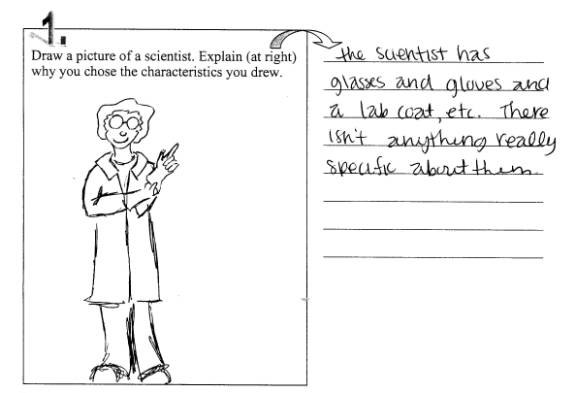
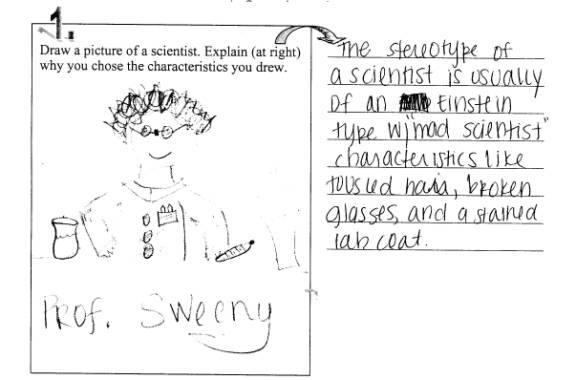
When I look at the pictures of scientists drawn by my
research participants, very few of them drew girls and the few who did, drew the
female scientists as nerds with glasses and pocket protectors.
In
1991 the Engineering Council did research into girls and science, and they found
that “primary teachers reported that while girls generally preferred painting,
drawing and writing stories, boys preferred building and modeling with
construction kits and being physically active”
(OTABW). From these findings and
other facts, the researches concluded, “teachers have a major role to play in
challenging children's beliefs about what they can and cannot do. The problem of
gender stereotyping is not differences but people writing themselves off from
things unnecessarily. Teachers need to be more aware "of the extent and
pervasiveness of gender stereotyping" among young children, researchers
recommended, and girls should be helped and encouraged to fully involve
themselves in the science and technology curricula” (OTABW). I agree
completely with these statements. If a teacher in a math or science class calls
on boys more
frequently than girls, the girls will become disinterested and withdraw or think
that only the boys are smart enough to answer. In addition, if a teacher sets up
lab teams with a male student as the lab leader, girls can begin to get the
impression they are not competent enough to lead a team. Teachers in “male
dominated fields” need to be cautious and aware of their own stereotyping and
avoid letting themselves or the students fall into predictable patterns like
letting the boys run the experiment and the girls keep the data sheet. This
sends a message that the girls are the secretaries of the numbers and the boys
are the lab problem solvers.
Nancy Kober also says that the reasons behind girl’s
problems in a field like science are a result of “girl’s receiving
differential treatment” in the regular science classroom.
Once girls enter school, their
experiences are further influenced by classroom patterns, sex stereotyping, and
even overt discrimination. Girls receive less encouragement than boys from
teachers, counselors, and other school personnel. Teachers have higher
expectations in science for boys and are more likely to call on boys than girls
to answer complicated questions. Teachers also show girls less attention and
give them less feedback. One study found that 79 percent of student-assisted
science demonstrations were carried out by boys. Sometimes science classes
create environments that are more comfortable for boys than for girls. For
example, girls may be less familiar than boys with certain equipment or
techniques, such as connecting a car battery. According to one study, in lab
situations boys tended to take control of equipment, with girls often relegated
to the complacent role of note taker. Texts, materials, and media reinforce
messages that science is a male domain. Girls need only take note of the
shortage of female role models among high school science teachers and department
heads, scientists who volunteer in schools, and women in technological and
science careers (Kober, Nancy).
Concerning the encouragement, I can remember times when my
counselor would warn my mom against placing me in an advanced classes because I
might not be able to keep up and thus not graduate on time. This to me is a huge
set back in the ideal that a girl can be anything she wants to be. I know I had
a lot of support over the years, and I strongly feel a lot of it came from
teachers. But the funny thing is, I can remember the teachers who tried to
discourage me over the one’s who did not.
I am currently a QA Engineer at a mid-sized software
company in Roswell. When I began working for this company, I worked in the
training department. The number of females was fairly 50/50 to that of males,
but when I moved up into the Engineering department, the number quickly changed.
I work in a sub-department of approximately eighteen people. Out of the eighteen
members, three are women-myself included. The team I work on has two of the
women, and two other teams in the department have no women at all. In addition
to my unusual personality, the department benefits from my other talents, but I
can say it is quite odd to be one of the only females in a department full of
guys. So, when I read the following statement from the people at Opportunity
Towards A Balanced Workforce, I was not too surprised women felt this way.
Research, quoted in the February issue of Labor
Market Trends, indicates that women actively choose not to enter SET careers in
the knowledge that they are likely to feel "cultural discomfort". It
is argued that some women pay both personal and social costs when they cross the
threshold into a "male domain" and that these costs continue to be
paid until the number of women on male territory reaches a critical mass. This
is because, researchers say, young women in science and engineering, for
example, find themselves working with values, systems and performance criteria
which have been set up by men for men and not for women.
Sheila Tobias has another view on why women are challenged
in scientific fields. She thinks that the traditional roles that women are
expected to follow do not coincide with what a “Scientist” does. In her
paper, The "Problem" of Women in Science: Why Is It So Difficult to
Convince People There Is One?, she expresses the following opinion:
I think that the temperament
required for dedicated, original work--the staying-up-all-night kind of work,
the I-can't-think-about-anything-else-darling-not-even-you-tonight, because
I've-got-those-things-growing-in-the-petri-dish kind of intensity--is
antithetical to what is considered normal behavior for a female. Insofar as she
experiences the feelings of the scientist, she is not feminine, and insofar as
she accedes to the needs of her feminine nature, she won't be taken seriously as
a scientist. Those childbearing years, when a woman is healthiest and has the
most energy for child rearing, coincide with the peak opportunity years in any
profession. And, to the extent that she is tempted to take a break, the cost to
a woman's career, given the dominance of the male model in science, is high.
Indeed, many of the reasons women give for leaving science and the reasons men
give for not encouraging them to stay involve this double bind.
Encouraging
Girls to Stay With Science
According to Nancy Kober, “girls tend to drop out of the science pipeline earlier than boys.” Since four years of science is required at the high school level, plenty of girls take Biology, but Kober goes on to say, “…fewer girls--even highly talented ones--take chemistry or physics compared with boys. Of the students who take chemistry (an already limited segment of the school population), 34 percent are girls and 66 percent are boys; for physics the figures are 22 percent girls and 78 percent boys” (Kober, Nancy). When I was in middle school, I was given the option to take Algebra or Geometry my freshman year and either Physical Science or Biology. My teachers recommended that I stick to the more average track (Algebra and Physical Science), but I had an involved mother, and she insisted I take Biology and Geometry. She told them we would struggle through it, and her daughter could handle the challenge. I did it (with my mom and dad’s help), and did it well. By my junior year, I had taken Biology, Chemistry, Physics, Geometry, Algebra II, and Trigonometry. My senior year I was on track to take advanced Calculus and AP Biology, but opted to go to college a year early instead (against my counselor’s wishes because if I failed I would not graduate from high school). With all of this said, it is apparent that the biggest way to get a girl into a scientific field is through support and encouragement. Don’t be a naysayer…tell those girls they can do it!
Methods
I started this project by considering several questions
that I would like to find more about. At first, I chose really general questions
that were unrelated. The following five questions are some examples of topics I
considered.
1. Why are girls less successful in science class than their male counter parts?
2. Is the overhead an effective teaching tool?
3. Are computer’s a valuable part of student’s learning or are they just a fad?
4. Does a study skills class each day benefit students study habits?
5. Does a window hinder students learning?
The next week, I began to consider four more questions
based on one of the questions from above. Since I plan to go into the field of
math and science, I decided that following the girls and science theme would be
the most valuable avenue to explore considering my future classroom activities.
Here are the five questions I decided to consider covering for this paper.
1. Are girls less successful in science class than their male counter parts?
2. What teaching methods benefit girls in science class most?
3. What percentage of girls plan on going into science related fields when they grow up?
4. What issues intimidate girls in science class?
5. Do girls react better to male or female science
teachers?
The next week, I began considering ideas for collecting
data. Since I am not currently teaching and I work full time, I had to consider
some less traditional options (in other words, calling in favors). Teacher A
works at a parochial, private school in
Dekalb County. There are 1000 students with approximately 52% females and 48%
males. The average SAT is above the national average (which ultimately means way
above state of Ga.). 99.5% of the students attend college upon graduation.
Teacher A volunteered to distribute questionnaires to teachers and female
students for me. Teacher B also offered her help in getting the questionnaires
out to teachers and female students in a Gwinnett County public High School. To
me this sounded great because I could see how teachers and female students from
a private school and teachers and female students from a public school feel
about girls and science.
Teacher B’s school has a population of 2,500 students-85% Caucasian, 7% African American, 5% Hispanic, 2% Asian, and 1% other. She teaches 35 girls and 63 boys. Her student composition is 71% Caucasian, 20% African American, 5% Asian, 8% Hispanic, and .5% other. She works with twelve other science teachers. The science staff is 50% male and 50% female. She teaches four classes of technical Biology and one class of college prep Biology. Teacher A is a history teacher at an urban private High School. It has a population of about 2,000 students. The large majority of her students are Caucasian.
After getting help, I set out to begin creating a
questionnaire. First I wrote down some possible questions for the students, and
after awhile, I came to the conclusion that I could not use the same questions
for the teachers. I decided that the teachers would have an entirely different
set of questions. This way, I could get the girl’s opinions on the
environment, the teacher, support they receive, etc. and compare it to what the
teacher’s opinions are on girl’s performance, involvement, etc. Some
possible student questions I came up with are along the following lines: “Do
you plan to go to college?” and “What is your favorite subject (followed by
a list of subjects)?” Some questions I considered for the teachers were along
the lines of “Who participates more in your science classes-boys or girls?”
and “Who makes better grades-boys or girls?” Besides answering questions, I
asked the girls to do a drawing activity and a ranking activity. The drawings
should be very interesting.
With all of these results, I planned on making an Excel
sheet to tally items: yes, no, or ranking. I have also obtained a ranking sheet
to “grade” the scientist drawings. I think it will be interesting to see how
many girls drew their scientist as a man and how many drew their scientist as a
female. Many of the drawing attributes will be easily ranked and tallied to show
a trend in females’ perceptions about science. The descriptive answers to the
questions will also be coded for patterns.
With the original questionnaires made, it was then time to
have people review them for any editing that might be needed. First, I let
teacher B read them and make comments since she is a high school Biology teacher
and could offer several helpful suggestions. She mentioned things like, making
the terminology more understandable and making the sentences more complete.
After reading over her suggestions and considering what she said, I made some
changes to my questionnaire before I printed up several copies for my group to
review. Then, at my next research class meeting, I asked my teammates and Dr.
Smith to review my questionnaires for anything that might need to be changed.
Dr. Smith made helpful suggestions toward a few questions that were
“leading” the participant to an answer. My group also found instances where
I should have included more information to get more precise answers. Overall,
six people reviewed my questionnaires (including me) before it was published for
teachers and female students to take.
I then made necessary changes on the questionnaires. I also
edited the consent form sent by Dr. Smith which would accompany the
questionnaire. I used the one page individual consent form. At work, I printed
fifty copies of the student questionnaire and twenty copies of the teacher
questionnaire. When I gave the questionnaires to teacher A and B to hand out, I
asked them to give the student questionnaires to girls only. I also told them
that they should hand them out randomly but preferably to girls who would
actually take the time to respond thoughtfully. I also asked them to choose ten
science teachers each, male and female, to give the teacher questionnaires out
to. Teacher B chose ten teachers she knew fairly well, and left the
questionnaires in their boxes. Since teacher B teaches mostly boys, she was able
to give most of her female students the questionnaire: twenty-five total.
Teacher A teaches history, and she offered the questionnaire to any girl in her
class who would like to fill it out. She also gave the teacher questionnaires to
the head of the science department who gave them out to the teachers under her.
On the questionnaire the name field was optional to ensure trustworthiness. If I
had made it mandatory, people may have edited themselves.
A week later, both teacher A and B returned the
questionnaires. Teacher B received all twenty-five student questionnaires and
only eight from the teachers. When she gave them to me, I began to read the
responses to see if anything really stood out. Unfortunately, a lot of the girls
said science was “boring” or “hard” because of all of the information.
Teacher A gave me five teacher questionnaires and twelve student questionnaires.
The first thing I noticed was how much more her students wrote in response to
the questionnaire. She told me they were excited about being asked their opinion
on the topic.
Then I proceeded to sit down with the questionnaires and go
through them. I built an Excel spreadsheet for the teachers’ and students’
results to help manage them better. I also put a number on each paper so I would
know who the information on the Excel spreadsheet belonged to. Over three days
the data was entered. Then I began to report on the data here in my report.
After I exhausted that section I worked on getting more literature reviewed, and
I added an additional section of some helpful tips I found on what teachers and
parents could do to encourage their daughters/students to do science.
Results
When I was first going through my results from the questionnaires, only a couple of things really stood out to me. The students thought science was not very exciting and the public school teacher the girls’ referred to was always encouraging them, and the majority of teachers felt that their gender did not play a role in the girl’s participation. I then decided I needed to chart the results in Excel to really be able to see how the answers stacked up. By using Excel to chart the results, I was able to really look at every answer and then compare it to what others had said. I was also able to do some quick math instead of flipping through every questionnaire over and over again.
Let’s look at some of the findings. First, let’s see what the teachers said.
An overwhelming large majority felt that gender does not
affect girl’s participation in science. N/A= No Answer
|
Does gender
affect girl's participation? |
|
||
|
Public School
Teachers (out of 9 respondents): |
77% No= 7
teachers |
11% yes= 1
teacher |
11% N/A= 1
teacher |
|
Private
School Teachers (out of 5 respondents): |
80% No= 4
teachers |
20% Yes= 1
teacher |
|
They feel that there are several other factors that come
into play.
|
Things
that affect girls’ participation other then gender of teacher: |
|
Comfort level
of the kids-if kids are aloud to tease each other, they won't talk |
|
Comfort level
with the teacher-if the teacher is always right or will snap at them for a
wrong answer, they won't talk. |
|
Trust between
the students and teacher. |
|
Personality
of the teacher |
|
Teacher's
style and level of concern |
|
Unequal
number of girls vs. boys |
|
Teacher
varying who they call on |
|
Threatening
atmosphere |
|
How well the
teacher understands the topic |
From the entries above, you can easily deduce that the teacher’s personality, treatment of students, and respect for the kids is much more important then the teacher’s gender. Teacher #6 stated, “No, I don’t think gender is a factor in affecting girl’s participation.” “Teacher’s response may have a great effect on participation.” Teacher #7, who said that gender did affect girl’s participation, put a very positive spin on the form it could take. She said, “if female students see a female teacher successful in the workplace, they might have more self-esteem and want to achieve great things.” I like this teacher’s perspective on this question, and I think all girls need positive female role models to aspire to.
I tried to get some percentages on what teacher’s thought about girl’s being intimidated by science, but the results were very unclear. I got a wide variety of answers like: some, yes, but everyone is, and not as much as they used to be. I found the last example here very interesting. Teacher #3 actually wrote, “Not as much as they used to be.” “Girls are bolder then they used to be.” I like that answer. It has some power behind it. On another note, since I do not want to interpret people’s answers, I’ll just say there are factors that teacher’s identified as intimating girls. Here’s a partial list.
|
Factors
that might intimidate girls in science: |
|
Looking
dumb-physically or socially |
|
Teacher’s
personality |
|
Unequal
number of girls vs. boys |
|
Parent’s
perspective and attitude toward science |
|
Poor self
concept |
|
Poor math
ability |
|
Teasing by
teachers or by other students |
|
Lack of
understanding |
|
Low
self-expectation |
|
Amount of
material being covered |
|
Arrogant
attitudes of the boys who like science |
|
Mathematics |
|
Complex
language |
|
Guys being
silly about a question a girl would ask |
When it came
down to participation, most teachers did not see a big difference; though, the
private school teachers noted that their girls did participate more. I did not
write this question correctly, so my results may not be completely accurate. I
intended to ask the question, who participates more-boys or girls? Instead the
question read, “Do girl’s participate as much as the boys-rising hand to
answer a question/lead a lab group, etc?” Teacher #2 in particular inferred
what I was getting at and wrote, “Yes-more so in leading labs.” “The
girls’ listen to and/or read directions more closely.” “In the technical
classes girls seem to care about their grade more and therefore participate
more.”
|
Who
participates more? |
|
|
|
|
Public School
Teachers (out of 9 respondents): |
22% Girls= 2
teachers |
22% Boys= 2
teachers |
56% No
Difference= 5 teachers |
|
Private
School Teachers (out of 5 respondents): |
40%Girls= 2
teachers |
20% Boys= 1
teacher |
40% No
difference= 2 teachers |
When it came down to grades on tests, the girls eked out ahead of the “no difference” answer. Some teachers noted that their girls did better because they read instructions more carefully.
|
Who does
better on tests? |
|
|
|
|
Public School
Teachers (out of 9 respondents): |
39% Girls=
3.5 teachers |
5.5% Boys= .5
teachers |
55.5% No
Difference= 5 teachers |
|
Private
School Teachers (out of 5 respondents): |
60%Girls= 3
teachers |
0% Boys= 0
teachers |
40% No
difference= 2 teachers |
One teacher, teacher #9 said that the boys in his AP
Biology class did better on tests than the girl AP Biology students and that the
girls in his Physics classes did better on tests than the male physics students.
That was very interesting to hear considering some teacher’s stated math as an
intimidating factor of science. Teacher #11 said, “It depends on the topics;
in chemistry girls seems to be better at the beginning of the year; in physics
the boys do much better on mechanics.”
The teachers also reported that several of their girls were
looking into jobs in science related fields. Some of the jobs listed were, medicine,
dentistry, doctor, research scientist, engineer, nurse, biological field,
physical therapy, and teaching. Teacher #12 said that she had no students
interested in computer science or pilots, etc. Growing up in a house with a mom
as a scientist, I always had my eye on a scientific field. I went to school for
math and science, but for right now I am working in computer sciences-a heavily
male dominated field!
Now, let us take a
look at the girls’ responses. The teachers had a positive outlook toward
several of their girls taking jobs in science related fields and the girls
concurred with their comments.
|
Who's
considering working in a science related field? |
|||
|
Public
School Girls (out of 25 respondents): |
52%
No= 13 girls |
44%
Yes= 11 girls |
4%
Maybe= 1 girl |
|
|
|
|
|
|
Private
School Girls (out of 12 respondents): |
58.33%
No= 7 girls |
33.33%
Yes= 4 girls |
8.33%
Maybe= 1 girls |
I’d say that the results show a large number of girls
considering working in a scientific field. The girls reported that they were
considering jobs in Anthropology, the medical field (doctor and nurse),
Environmental Sciences, dental hygiene, and even in piloting. Unfortunately,
answers like student #2 was pretty common though. She said, “I have never been
good at science, and I do not like anything about science.” She instead would
like to be a history educator. But not every staunch “no to science”
supporter felt this way. One
student, student #7, who wants to be a fashion designer said, “I think science
is very important-without it we wouldn’t understand life-people wouldn’t be
alive if it weren’t for science-with science we find cures.”
So with all of these science minded girls, how many had a
favorite science subject?
|
How
many girls had a favorite science subject? |
|||
|
Public
School Girls (out of 25 respondents): |
40%
No= 10 girls |
56%
Yes= 14 girls |
4%
N/A= 1 girl |
|
|
|
|
|
|
Private
School Girls (out of 12 respondents): |
0%
No= 0 girls |
100%
Yes= 12 girls |
|
N/A= No Answer
I cannot imagine not having a favorite science subject, but the public school girls seemed to not enjoy science near as much as the private school girls. Human Biology was the stand out for favorite science class. Other topics the girls enjoy are: Chemistry, Astronomy, Physics, Environmental Sciences, Acids/Bases, and dissection. Wow, the private school girls really do love their sciences classes, but what did they rank science as compared to English, Math, and Social Studies?
|
What rank did science get? |
|
|
|
|
|
|
Public
School Girls (out of 25 respondents) Ranking Science: |
8%
1st= 2 girls |
48%
2nd= 12 girls |
24%
3rd= 6 girls |
16%
4th= 4 girls |
4%
N/A= 1 girl |
|
|
|
|
|
|
|
|
Private
School Girls (out of 12 respondents) Ranking Science: |
0%
1st=0 girls |
25%
2nd= 3 girls |
67%
3rd= 8 girls |
8%
4th= 1 girl |
0%
N/A= 0 girls |
N/A= No Answer
Interesting observation, the two first place ranks are from
the public school girls. Here is what they had to say about their ranking
science number one. Student 7 wrote, “Because it is so interesting-it helps
you understand so many things in life.” Student #33 wrote, “I love to study
any science, and I have always done well in the subject.”
It looks like the majority of girls ranked science as 2nd or 3rd
place. Student #4 gave science a 4th place rank. She says, “I
don’t enjoy science.” “I am squeamish about some subjects and have never
found anything interesting about other parts of the subject.” Yikes! Student
#37 wrote, “I ranked it third because I am not too scientific, and I like to
be more creative than working on labs.” On a more positive note, student #3
ranked science 2nd “because I love chemistry, and my teacher makes
it awesome.” Student #35 said,
“I chose it second because I enjoy learning about the life of animals and
people.” Ten out of the
twenty-six girls, who answered what their favorite science subject is, chose
Biology as their favorite science subject (that’s 38% of the respondents), and
in particular, human Biology is a big favorite. A lot of the girls like to learn
about the how’s and why’s of their bodies.
Most everyone has probably been asked to draw a picture of
a scientist. The main reason for doing this is to see what gender people choose
to draw their scientists as. Here are the results on what the girls drew.
|
What
is the gender of the scientist drawn? |
|
|
||
|
Public
School Girls (out of 25 respondents): |
56%
Male= 14 drawings |
32%
Female= 8 drawings |
4%
Both= 1 drawing |
8%
No Answer= 2 drawings |
|
|
|
|
|
|
|
Private
School Girls (out of 12 respondents): |
50 %
Male= 6 drawings |
17%
Female= 2 drawings |
33%
Both= 4 drawings |
0%
No Answer= 0 drawings |
I received a lot of great answers as to why they drew what they did.
Student #31 said, “She looks like a normal lady.”
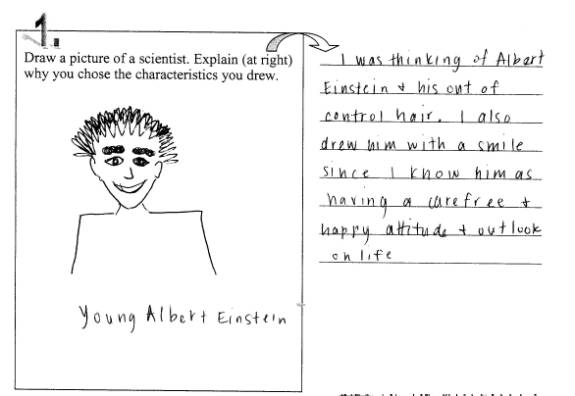
Student #4 said, “I usually think of a scientist as a man because of the famous scientists like Newton and Einstein and because most scientists on TV shows are played by men.”
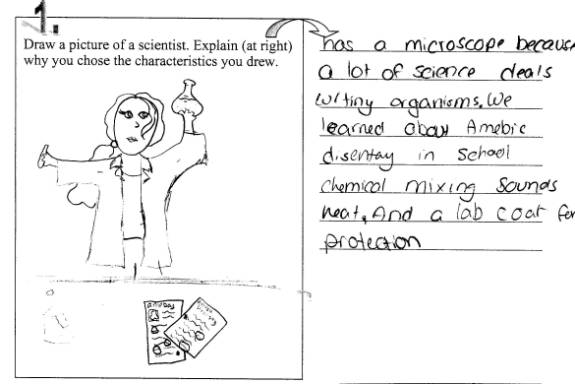
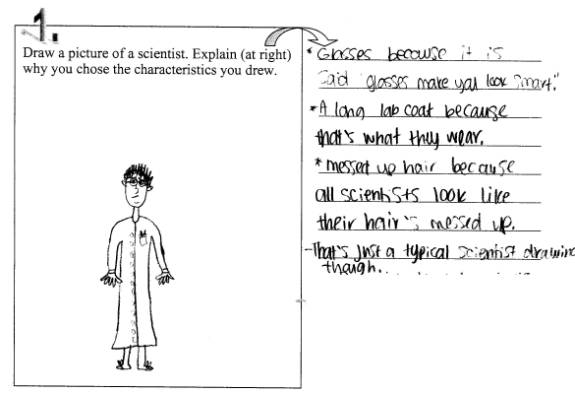
Student # 5 said, “Scientists are usually viewed in male form. Also usually seen as nerds (hence the glasses and pens in pocket)-test tube and lab coat to show “science.”
Student #37 said, “I drew her with goggles and her hair back because of safety reasons-books because scientists are always learning something new.”
Student #19 (who drew a male) said, “I chose these characteristics because I’ve noticed most of my science teachers tend to have glasses, explain a lot of stuff, are nice, and friendly.”
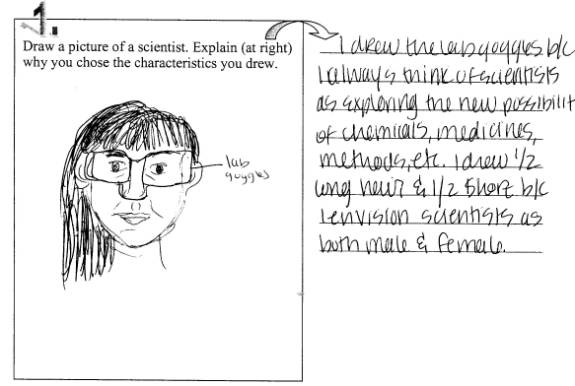
Student #21 said, “I drew the lab goggles because I
always think of scientists as exploring the new possibilities of chemicals,
medicines, methods, etc.” “I drew half long hair and half short hair because
I envision scientists as both male and female.”
Here are some pictures the girls drew.
In addition to having your students draw a scientist, Dr.
Jack Hassard suggests, in his book, Minds on Science, you rank the
pictures too. Here’s his suggested ranking list:
Scoring: (1 point for any of the following: lower score is
a higher rating)
Lab coat
Eyeglasses
Facial hair
Symbols of research - test tubes, flask
Symbols of knowledge - books, filing cabinet
Sign of technology - solutions, machines
Captions - Eureka, I've got it!!!
Male
Signs/labeling - Fire, Danger, Poison
Pencils and pens in pocket protector
Unkempt appearance
Only six girls out of all thirty-seven girls questioned
said they did not have any problems in science. Student #25 said she didn’t
have any problems because she “came in for help.” For the majority (84%),
science was problematic. They listed issues with science labs/write-ups,
formulas, no interest or motivation to study, memorization of lots of new facts,
lectures/teacher talks too fast, tests, comprehending things on own, pronouncing
new words and definitions, math, homework, paying attention, understanding
curriculum, and drawing microscope pictures. I am sure the boys would list a lot
of the same problems. Even with the issues, many girls get very good grades in
their science classes. Twenty-seven of the thirty-seven girls reported a grade
of a B or higher in science class.
|
Grades |
|
|
|
|
|
|
|
|
|
|
|
|
N/A |
A |
A/B |
B |
B/C |
C |
C/D |
D |
D/F |
F |
|
Public
School Girls |
1 |
0 |
9 |
7 |
2 |
3 |
0 |
0 |
1 |
2 |
|
|
|
|
|
|
|
|
|
|
|
|
|
Private
School Girls |
0 |
5 |
4 |
2 |
1 |
0 |
0 |
0 |
0 |
0 |
N/A= No Answer
The last question I asked the girls was, “As a female, do
you feel encouraged to pursue an active role in science class?” I received
some very interesting answers. On the negative side, Student #5 replied, “No;
lots of smart guys always answer first, and the teacher doesn’t always make an
effort to include the girls.” Student #6 wrote, “No; it seems like the guys
have a better grasp of the concepts, and sometimes when a girl speaks up and
asks a question, all of the guys make fun of her.” Student # 20 wrote, No
because I see only men as scientists.” Then, some girls were in the middle.
Student #27 wrote, “Sometimes, but other times I think about how I only see
guys portraying scientists.” Student #31 wrote, “Sometimes because boys
think that they are the only people that can do stuff like that.” On a more
positive note, student # 7 wrote, “Yes; women are smart too.” “They can
also be successful in the field.” Student # 11 wrote, “Yes because some guys
think girls aren’t as smart, but I like to prove them wrong.” Student # 23
wrote, “Yes; I’ve never seen males encouraged over females.” Student #24
wrote, “Yes; I do.” “I don’t think there was ever a time I was
discouraged from participating in science class because I was a girl.”
“There wasn’t a real distinction between boys and girls in classes.”
Discussion
What does all of the information that I found mean? To me,
it means that there are a lot of girls that feel confident in their science
abilities, but there are even more that need support. So many girls said science
was boring and that they just did not care about it. I do not really understand
this because science has so much to offer. I cannot help but think the girls
were turned off by science early because of possible hindrances like
unsupportive teachers that let the boys hog the equipment or answer all of the
questions and concepts that were not taught clearly in the beginning so they
snowballed into a big mass of confusing facts in the end.
Did I answer all of my questions? I do not think I did.
There is still so much more to look at and understand. I did not even begin to
broach the subject of teaching methodology. It would be interesting to find out
what style of teaching reached the most girls, and does an all girls class help
in academic learning? I also did not find out if girls reacted better to male or
female science teachers. The teachers did not seem to think gender mattered, but
I wonder if the girls felt the same way. And what about the boys? What place do
they think women have in science?
What implications do the answers have for your classroom?
When I start teaching, I will try to make sure my classroom is accessible to
both my male and female science students. I want to try out some of the
teacher’s suggestions to see what environment both types of students work best
in. If girls need to work in lab groups that are homogeneously mixed, then that
is what I will do so they can get hands-on experience. I will also try to be the
best role model possible. I think that a female science teacher is in some ways
the only contact some girls have with a scientist, and I want to make science
exciting, inquisitive, and accessible to everyday life so the girls think of
themselves as real scientists! Every teacher in every classroom environment can
use these results in their own classroom. From the girl’s own writings, it is
easy to see they want a classroom where the teacher will listen to them without
making them feel dumb and a classroom where they will not be made fun of by
another student.
Where might you go from here? Is there further research
that can be carried out? Like I said earlier, I could find out what style of
teaching reached the most girls, and does an all girls class help in academic
learning? Plus I could study boy’s ideas on the topic. Do they think girls
should be scientists? Who would they rather have teaching them in science-a male
teacher or a female teacher? This topic has lots of latitude. People have been
studying gender differences for a long time. They study women in science, women
in history, women in math, etc. I just love science, and I am thankful that I
had parents who did not see a son and a daughter and gave us different tasks.
They saw children, and said clean the bathroom and when y’all are done work on
the yard! Not, Jenna clean the bathroom, and Jim work on the yard. Unfortunately
not everyone is there yet, but with more studies over the next years, we will
hopefully see a shift in gender stereotyping.
1. Find out girls thoughts and ideas concerning science.

|
|
When I need help with math or science, I usually
ask... |
|
|
Girls who enjoy science are... |
|
|
Boys who enjoy science are... |
|
|
I want to be
____________________________________________ when I grow up. I will/will
not need math and science. |
|
|
My parents want me to be
____________________________________________ when I grow up. |
|
|
In math classes, teachers expect the boys to |
|
|
In math classes, teachers expect the girls to |
|
|
Draw a picture of a scientist. |

2. Talk to them about famous women in science. For example:
* The world's first computer programmer was a woman. August Ada Lovelace wrote the instructions for a computing machine in the 1800's.
*One of the chief developers of COBOL, a language for programming digital computers for business applications, was a woman, Grace Hopper. She was also the first to coin the term "bug" in referring to a computer error. In 1960, when the computer industry was still in its infancy, 65% of the 2,000 computer operators were women.
* Sally
Ride 1951- Present
After
getting an advanced degree in astrophysics from Stanford University, Sally Ride
joined NASA in 1977 to train as an astronaut. In 1983, she became the first
American woman and the youngest American astronaut ever in space, when she went
up with the shuttle Challenger.
3. Encourage guessing, questioning, and exploration to
reduce girls' anxiety and build their confidence about science.
4. Be a role model. Exhibit science skills like reasoning
and solving a problem though experimentation in every day life.
5. The Math/Science Network at Mills College in Oakland,
California suggests that girls need “more experience, encouragement, and
creative methods of instruction” in the following areas to help them improve
in their math and science abilities.
1. Multiple-step word problems
2. Reasoning ability and applications
3. Spatial visualization
4. Measurement: making linear, area, mass, volume and temperature measurements; reading bar and line graphs; using rulers, balances, calipers, and other measurement tools.
5. Probability and statistics
6. Mechanical reasoning, including
use of tools.
Also, a number of strategies
which could apply to virtually any content area (including those above) have
been suggested by participants in Novato Unified School District workshops.
1. Present open-ended problems with many possible answers.
2. Urge exploration of many ways to solve a problem.
3. Provide opportunities for individualized learning and independent problem solving.
4. Encourage active involvement in decision-making.
5. Structure activities in which everyone can experience some success.
6. Allow for cooperative group work and occasions for students to talk to one another.
7. Create nonthreatening competition.
8. Utilize "hands-on" activities (manipulatives).
9. Consider alternative methods such as strategy games, role-playing, and simulation games.
10. Maintain "realism" in problem-solving examples.
11. Review texts and curriculum materials for relevance to girls' daily experiences.
12. Enlist students' cooperation
in monitoring sex stereotyping.
6. Send them to a girl’s only science camp where they can
be real scientists instead of the person keeping track of the data while the
boys get to do the hands-on stuff. This is a small sample of camps that
Education World suggests:
Camp Kaleidoscope: One of Pacific Science Center's Science
Summer Day Camps, this camp allows girls in grades 6 through 8 to sample a
kaleidoscope of scientific fields, including astronomy, chemistry, criminology,
engineering, and meteorology. Campers meet women who are making a difference in
the scientific community and visit research labs in Seattle to see scientists at
work.
Purdue Computer Science Summer Camps 2000: Held on the
Purdue campus in West Lafayette, Indiana, these boys-only and girls-only
programs in computer science and robotics are sponsored by the K-12 Outreach
Program of Perdue's department of computer sciences, Tellabs, Motorola,
Raytheon, and Abbott Laboratories.
North Carolina Museum of Natural Sciences: Girls in Science
Programs North Carolina's Girls in Science Statewide Project provides
sixth-grade girls with hands-on experience with living things, along with
interaction with female science mentors. In addition, Outdoor Ed-ventures,
six-day residential science camps for seventh-grade girls, provide campers with
canoeing, rafting, camping, and hiking experiences.
The USC Summer Science Program Developed: to engage middle
school girls in hands-on scientific exploration, this program gives students the
opportunity to explore science as they interact with undergraduate and graduate
students in various scientific fields and with women already engaged in careers
in environmental, biological, and physical sciences.
Leslie Bulion. “Summer Science Is for Girls!” Education World®, 2000.
http://www.educationworld.com/a_curr/curr238.shtml
Hassard, Jack. Minds on Science. Atlanta: Georgia State, 2000.
http://scied.gsu.edu/Hassard/mos/chapter_1.html
Kober, Nancy. "What
Special Problems Do Girls Face In Science? What Can Schools
Do?" EDTALK: What We Know
About Science Teaching And Learning. pp. 26-28.
Math/Science Resource
Center Mills College Oakland, California. “Expanding Your
Horizons in Science and
Mathematics” (tm) Packets. Math/Science
Network, Copyright 1986.
NASA Quest http://quest.arc.nasa.gov/women/resources/bib.html
Sturge, Lisa,
ed. “Why girls turn their backs on a science education?” Opportunity
Towards A Balanced Workforce,
March 1986. http://www.lboro.ac.uk/orgs/opp2000/chap2.htm
Tobias, Sheila. The "Problem" of Women in Science: Why Is It So Difficult to Convince
People There Is One?
http://www.enc.org/topics/equity/articles/document.shtm?input=ACQ-111306-1306
