


articles
In july my wife and I went for our first longer sail into the Stockholm archipelago. With about 24 000 islands and rocks, this archipelago is one of the worlds biggest. Close to the mainland, the islands are larger and more lush, the bays and channels wider and year-around residents more numerous. As you travel further out towards the Baltic sea, the scenery becomes more rugged finally ending in sparse windblown islets. During summer, the archipelago is filled with sailboats as many Stockholmers ply the waters. There are 150 inhabited islands, with more than 6000 permanent residents, and no roads to the mainland.
As in the Baltic sea in general, there are no tides to be considered, and it is very easy to find a sheltered bay or cove. We usually moor our boats bow to land with a stern anchor. This makes it possible to lay near enough to the shore to get ashore without using a dingy. Bigger boats of course will have to lay at anchor farther out and use their dingy to get ashore.
By Jens Kuhn
Another thing which made me look for a smaller boat was the fact that it would be nice to get a boat which was easily trailerable and easy to launch and recover. Trailering the boat is for now something I merely plan when I will be able to get a bigger car. However, the Swedish boating season is quite short, only from late april to october, and due to ice we ususally store our boats on shore during the winter.
The weather is usually best in july and august. Winds are normally about 10-20 knots, more than 25 knots is quite rare in the summer. During our trip it was quite hot, about 28-30 degrees centigrade. Fortunately it was raining during a few nights. One night we had a thundestorm, while we were securely moored in a marina.
We lived on the boat for eight days and everything worked just fine. Altough the Alacrity is a bit smaller than the Folkboat we had sailed the previous summer, we actually found it more comfortable. We definitely banged our heads on the cabin roof less often and we slept better.
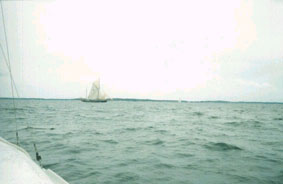
I wonder if a bigger genoa or perhaps a gennaker could make the boat a bit faster in light winds. Maybe something to look into in the future.
One of Discovery's biggest advantages actually turned out to be her size and shallow draugth. In the big marina at Sandhamn, the archipelagos last outpost to the Baltic and starting point of many regattas and offshore trips, we got an nice spot at the far end of the long row of boats, where it was too shallow for everybody else. Even in natural harbours the shallow draught made it possible to find really nice spots away from the somewhat more crowded places.
(This article was previously published in Twin Keeler Newsletter volume 7, issue 4. 2003)
Having looked at a few boats I suddenly found an ad on the Internet. A young guy was selling his Alacrity and when I looked at the picture I decided to have a closer look. The boat seemed to have all the advantages I was looking for. It was easy to rig and sail, it was easy to store on land (the twin keels made the need for a cradle obsolete), and it was, being unusual here, quite cheap.
I drove to the club where the boat was, then still on shore, looked at it and kind of fell in love. It was in quite good shape, and I really liked the mahogany interior and the nice shelves next to the single forward berth.
I decided to purchase the boat. The day after it was launched in mid-april, I and two friends motor-sailed her home. The wind was at least 25 knots right on our nose and after about one hour it began to snow. Then the outboard died. Since I usually never trust motors, I had the main sail with two reefs in ready. We got up the sail and cleared the rocks which where only about 20 meters away. Because of the cold and the snow, which made the deck quite slippery we then decided to make it for a nearby marina and wait for better weather. The next day, with the outboard still not working, we sailed the boat to its new home.
Back to Main Page