
Flight Report number Two (Friday 21 April, 2000)
The Qantas/Sunstate DHC6 "Twin Otter"
This month's report is about the Aircraft pictured below, the DHC6 Twin Otter Short Takeoff/Landing capable aircraft. See below the picture for a full report.
Qantas/Sunstate DHC6 Twin Otter lands on Sydney's runway 16L
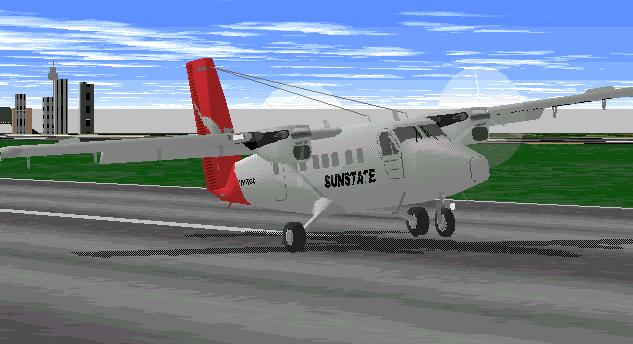
Features of this Model: This aircraft model is a very detailed aircraft visually, and is chockers full of interesting feartues. It includes full moving parts, including moving aerlons, elevators and rudder, and even fully variable flaps. The landing lights on this model are fully working too. The aircraaft performs well in the air and is very stable and very easy to land, Takeoff and cruises perfectly straight without autopilot if trimmed out correctly (when in calm wind of course). The aircraft also performs well on the ground, being a little touchy at times, and with a distinctave bounce when speeding up, slowing down and breaking. When the engines are shut down, a fair amount of "spool down" is evident, which is okay to watch, but could have perhaps been done better... but it is better than I have seen in most cases.
The Model is based on the light jet model rather than the propeller model, I think that this was a wise choice on the makers part, as the Turboprops performance and features resemble those of Jet's closer than that of prop planes such as the Cessna.
Things I liked with this model: I love the high amount of detail done on the visuals of this aircraft. From the radio cables stretching from the cockpit to the tail top, to the ridging on the rudder surface and the little windscreen wipers on the windshield. I also like the bouncing effect when Taxying. It's just like the real thing (which because it's main gear is so close to it's Centre of Gravity (COG), it has a habit of "doing wheelies" if it taxies too fast... so far I havn't been able to replicate this... yet.)
At night, the cabin windows light up.
Things not included with this model: This model has no spoilers and the landing gear does not retract. The real aircraft also lacks these features. For you Virtual Cockpit fans out there, sorry, this model does not include one, although It must be said that there are many flightsimmers out there who don't like the virtual cockpit anyway. Reasons for this pertain mostly to the effect it has on framerates compared to the usability of the VC (which is pretty much nothing but "atmosphere"). The file download does not contain Turboprop sounds or a panel, but there are lots of those available on the net.
Flight Performance
My take on this DHC6 model:
Preparation for flight: The DHC6 can carry 1006 Litres of fuel which will take it 700 Nautical Miles (legaly) which would be about a 4 hour trip or so. It's Service Ceiling is said to be 21,000 ft in the documentation in the aircraft's file, and I would imagine that the average cruise would be 18,000ft or 19,000ft depending on the direction one is travelling according to the flight plan and ATC.
Takeoff: Warning: do not taxi to takeoff position too fast if light, and don't turn above 10kts True speed. or you may find yourself dragging the tail on the tarmac. On takeoff, unless using a really short runway (1000ft or less, say) then have the brakes set off (free) and slowly advance power to about 95% - 98%. don't go above 100% for longer than 2 minutes when using short runways or you may find smoke emitting from the engine cowls! (nb. this feature is not simulated). If using 1 notch flap, then rotate at 60 to 70 knots depending on weight.
Climb: Initially, climb at 1500ft per minute at about 95% power. try to hold between 90 and 100 Knots initially, and increace later by reducing climb rate, to say 1400ft/min passing 3000 ft, holding 95% throuought the climb. Clear the flap as you reach 80 knots, before you get to 90 knots. Turn the Landing lights off at some point above 7000ft.
At 7000 feet, hold a 10 degree nose up attitude, which is about 1200ft/min which will increace the speed to about 120 to 130 knots.
By 9000ft, aim to be climbing at 1000ft/min and moving at 140 to 150 knots indicated speed. Remember, do not exceed 170 knots indicated, which is the highest safe speed of the aircraft.. Expect to be at 9000ft by 15 Nautical Miles from your takeoff point.
Remember to turn on Pitot heat when the outside air temprature drops below 5 degrees, this will occur at about 13000 ft. Climbing to FL190, lower the climb rate at intervals to keep the speed above 140kts.
Cruise: at either FL180, FL190 or FL200. Lower if making a short hop. The aircraft can fly faster at higher altitudes, although must never exceed 170knots Indicated, that will convert to about 230knots true speed at 20,000ft, but is simply 170 knots at sea level. The aircraft can travel 700 nautical miles unrefuled... probably further, but not legally.
Approach and Landing: from FL180, begin decent 60 Nautical miles from your Destination. Decend at 1800 feet per minute, and at 13000ft, shallow the climb to 1000ft/min. Turn Pitot heat off once the outside Temprature is above 10 degrees. Turn Landing lights on at 10,000ft. Remember to adjust power to stay below 170kt. At 4000 ft, above the airfield elevation, Intercept the ILS. you will most likley be below the glideslope. hold altitude untill interception.
If the field you are approaching has no ILS system, then continue decent to 2000 ft at passing 25 miles DME, set up for a visual approach, and have your approach plates ready ;-)
Approach the runway initially at 140 knots. Stay at this speed untill below 2000 ft. Thence as follows;
2000ft above airfield: 120knots, 1 notch flap
1000ft above airfield: 100knots, 2 notches flaps. You must be in line with the runway by now... right?
800ft above runway: all flap. hold 80 knots
300ft above touchdown. slow to 70 knots If you can't see a runway by now, Go Around!
Touchdown at between 60 and 50 knots. Hit the reverse thrust and stop. Remember to take the reversers off before you stop.