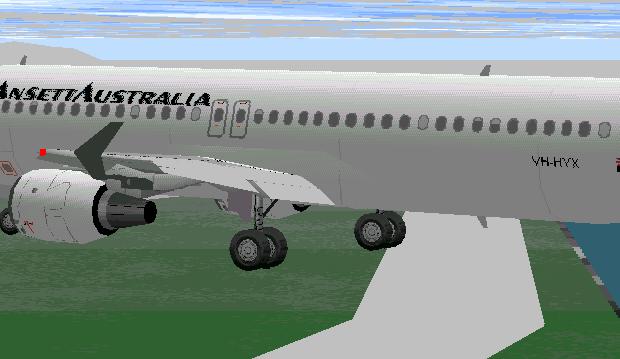
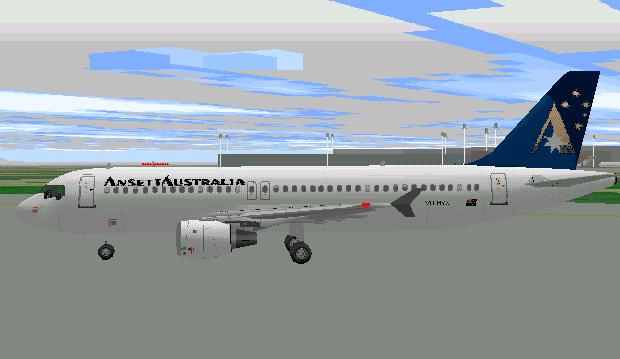
The Ansett Airbus A320 "VH-HYX"
The Model is based on the heavy jet model (737) and uses default 737 sounds and panel. However there are a number of great sounds and panels available at www.flightsim.com and other places. I downloaded some sounds and a most amazing panel for this aircraft for FS98.
Things I liked with this model: I love the high amount of detail done on the visuals of this aircraft. The virtual cockpit which is encluded is reasonably well done, and the textures are quite good for FS98 ones. The aircraft seems to have lots of features which emulate as close as possible systems and effects only found in FS2000. Finaly I'm just stoakd that someone made it in an Australian Livery, usually the only really good things are found in American and European liveries.
Things not included with this model: Not much at all! apart from lack of included panel & sounds in the download. The only thing I would have changed is the landing speed which seems a bit low at 130kts for approach and 120 or so stall speed. The aircraft is larger than the Boeing 737-400, but the medels of the 737's approach at 140kts.
My take on this A320 model:
Preparation for flight: Using the panel I downloaded, startup takes a quite long time (to just get the engines on!) Firstly you must bleed air into the APU and so clicking an various spots on the upper panel, you eventually start the APU, which then spools up with a nice little noise. The APU is then used to start up engine 1 and 2, and is then shut down. This little extra procedure just adds a little more realism to the experience :-)
Takeoff: Takeoff in the A320 is quite easy, especially with the panel I use, as it has a little 'bug' which shows were the spooling up will stop at the current throttle configuration. use one 'stage' of flap (5 degrees) and about 90 - 95% N1 thrust. Rotate at about 125kts, retract the gear and double check gear up! (on the used panel you MUST click on the gear lever on the panel, pressing "G" doesn't work!). In real life, after the tyres leave the runway, pilots hold a 15 degree nose up attitude untill the gear and flaps are coming up.
Climb: Initially, climb at 2000ft per minute at about 95% power. as speed increaces, I usually increace climb rate to stay under 250 knots, rather than reducing power. Above 10,000ft you can once again reduce climb as to exceed 250 knots (now that your above transition altitude) and remember to set QNH to 1013. With my panel, flaps will reduce by themselves to half a stage at 200 knots speed. (to 0 flap, slats extended, or 1 degree flap in a non airbus panel) passing 230 knots, retract the flap fully. (In a real Airbus this happens automaticaly too!)
Cruise: Most Airbus A320's in Australia are employed in routes between Hobart, Melbourne, Adelaide, Sydney, Canberra, Brisbane, Cairns and the like. These relitavly short hops mean that the aircraft usually cruise between 28,000 ft and 35,000ft most of the time. (20,000 for Sydney - Canberra perhaps.) Generaly cruise is between Mach 0.74 and Mach 0.77 in an Airbus A320, although it is not unheard of for an A320 to exceed Mach 0.80 quite happily.
Approach and Landing: I use an FMS during cruise, it also helps during decent. I also use published STAR charts and IAL's to help properly plan the approach, and often connect to SATPAC whereby a controller using Procontroller directs you in. But the general info is at around 100 miles from your destination, think about your decent. by 60 miles from touchdown be decending through 18,000ft at about -2000 to -2500 feet per minute.
Extend one stage of flap at about 200 knots, At about 180 knots extend gear and 2nd stage of flap, which should (without much change in thrust) slow you down to the next and final stage of flap extention, 150 knots. The aircraft model allows approach to be made at about 130 knots.