
Peace Corps and Armenia
 |
 |
 |
 |
| To find out how to become a Peace Corps volunteer, visit the official Peace Corps website. |
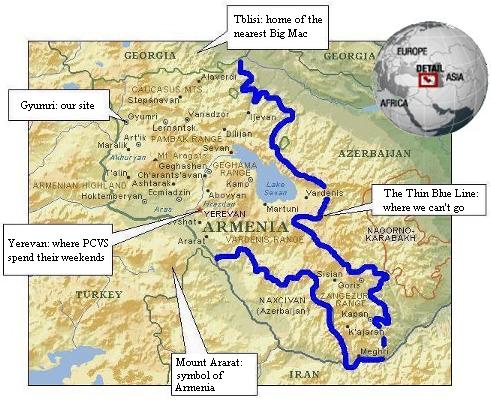
Places of interest for PCVs. |
 |
| Despite the country's relative obscurity, it remains in the news thanks to its geopolitical position. |
| Is Bush Pro-Azeri or Just Pro-Oil? (Baltimore Sun, April 2, 2001) | |
| Armenia's History, Turkey's Dilemma (Washington Post, March 11, 2001) | |
| Foreign Aid Shrinks, but Not For All (Washington Post, January 24, 2001) | |
| Forgotten Land (Dallas Morning News, November 26, 2000) |
 |
 |
 |
|
Background The Republic of Armenia covers 11,506 square miles in the Transcaucasus region of southwetern Asia. It is slightly smaller than Maryland or about the same size as Belgium. Much of Armenia lies on a mountainous plateau. Frequent earthquakes are a reminder of Armenia's volcanic past and position on a major fault line. A devastating 1988 earthquake destroyed Armenia's second largest city, Leninankan (now Gyumri), and killed 35,000 to 55,000 people. History (the short version) The Armenian civilization developed in the 6th century B.C. In following centuries, a series of invaders rolled over Armenia because of its strategic position. During the reign of Tigran the Great (95-55 B.C.), Armenia's borders stretched from the Caspian Sea to the Mediterranean. By A.D. 100, Armenia had lost its independence, and parts or all of the country fell under Persian, Byzantine, and Arab rule in different times. A sovereign Armenian kingdom was not fully restored until the 9th century. During the 15th century, Armenia was divided between the Ottoman Turks and Persians. Persia ruled Eastern Armenia until 1828 when Russia annexed it. Ottoman rulers in Western Armenia began a series of massacres that culminated in a 1915 genocide in which 1.5 million people died. Survivors scattered all over the world or found refuge in Eastern Armenia. Eastern Armenia declared independence from Russia in 1918, but a 1920 invasion of the Red Army established Armenia as a Soviet Socialist Republic. In 1988, Armenia moved to integrate integrate Nagorno-Karabagh (an Armenian-populated area of neighboring Azerbaijani) into Armenia. The movement eventually led to a full-scale war. A cease-fire has remained in place since 1994. The People Ethnic Armenians compose 96% of the republic's 3 million people. More Armenians (5 million worldwide) live outside the country than in. Eastern Armenian is the official language and Russian is also widely used. The language is a subgroup within the Indo-European family. Armenia embraced Christianity in 301 as the state religion. However, society is mostly secular. More than 90% of the population belongs to the Armenian Apostolic Church. Armenians take great pride in their ancient history and epic tales of heroic struggles against oppression or adversity. Despite centuries of domination, war, and even genocide, Armenians have maintained their culture, language and traditions. Armenians value education and believe it is the responsibility of parents to provide their children with the best schooling possible. Armenian values come from both West and East, creating a unique mix of cosmopolitanism and conservatism. Because they lacked sovereignty for so long before 1991, Armenians tend to be very political, constantly questioning and frequently distrusting government authority. Indeed, the average Armenian has little respect for rules and laws even in the new republic. Armenians pay great attention to their clothing and hairstyles. They follow modern European trends that are practical for daily life. Women generally wear long skirts; men wear conservative suits. Parents will dress their children very well, even if they cannot afford equally nice clothing for themselves. Customs and Courtesies When greeting, men shake hands and even kiss some acquaintances on the cheek. Women hug and kiss each other. Armenians tend to be emotional, so they often use their eyes, hands, shoulders and heads to express themselves more clearly. During conversation, eye contact is expected. It is considered improper for women to smoke in public, though men may smoke nearly anywhere. Armenians are social and gregarious. Guests are served dessert or fruit with coffee or tea. Guests arriving near mealtime are invited to share the meal. Unannounced visits are common and accepted. When guests are present, the host and others will propose toasts to anything from the guests to peace to national values. Traditionally, a woman prepares the meals and joins the group only after serving everyone else. She will later insist that guests take second or third helpings. Declining such offers will generally offend the hosts. Lifestyle In urban areas, dating generally begins around 18 and usually leads to marriage. In rural areas, where parents traditionally arrange marriages, dating may occur after the engagement. Traditional weddings take place in the Church, but civil marriages are quite common. After the wedding, the bride moves into the groom's home--many times with his parents--and the newlyweds break plates with their feet before entering. Reading literature is a popular pastime, as is reading the newspaper and discussing politics. Soccer is the most popular sport. Chess and backgammon are especially popular games in Armenia. |