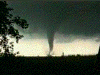
 Thirty Minute Lesson for children K-2:
Jen's Wind and Tornados
Hello, My name is Jennifer and I am elementary education student at Purdue University. I am currently a sophomore, and have already begun field experience, and cannot wait to teach children for the rest of my life. My goal is to teach kindergarten to second grade children at a school in a rural area. If you have ay questions please feel free to contact me at [email protected].
Thirty Minute Lesson for children K-2:
Playing Twister in a Bottle
B) Website used: http://www.crh.noaa.gov/abr/teacher/tornado_bottle.html
C) Purpose of the Activity:
The purpose of this activity is to teach children how tornado is formed and also some conditions to look for, I would also like to teach them the difference between a severe weather watch and a severe weather warning, and where a safe place to is if there is a tornado warning.
D) Reference to the Indiana State Science Proficiencies:
First Grade Proficiencies:
1.1.2 The Nature of Science and Technology – This is met when the student makes their own tornado and learns about how a tornado is formed in the world. They will be asked many questions and be given the opportunity to ask questions and will be actively engaged in the activity.
Second Grade Proficiencies:
2.5.5 Reasoning and Uncertainty – Students will learn that tornados are not always predictable and even though they may come during the same months and have the same weather patterns prior, it may not always mean that a tornado will follow.
E) Educational Objectives:
Cognitive: Students will be asked to think and draw a picture about where the safest place would be for them during a tornado. They will also understand how and when a tornado is formed.
Affective: Students will be motivated to think about what they would do in their own home with their own family.
Psychomotor: Students will work with one another when making the Tornado Tubes, we will also hold a class discussion about what type of room is safe to be in during a tornado.
Equity and Diversity Issues: The issue that I may run into while implementing this lesson would first be the homes that they live in, when drawing a picture of a safe room in their home, I may need to change it to a safe room at school or near by, if they live in many different places or an area that is no where suitable for a safe place from tornados. All of the children should be able to construct a Tornado Tube, because it requires simple motor skills. During our class discussion about Tornados there may be an issue with limited English proficiency. I will make every attempt to accommodate every single student in my class, they all have the right to learn just a much as the student sitting next to them.
F) Materials Needed:
G) Estimated Time Needed:
1 ½ - 2 ½ min. – Pass out nametags and have children write their names on them and put them on.
1-2 min. – Tell children what we will be talking about and doing that day
5-7 min. – Pass paper out to children, show them the example of my safe place, and then have them draw their own safe place of where they will go in their home during a tornado.
2-3 min. – Ask class if they know the difference between a tornado watch and a tornado warning. Explain to them when the need to take shelter and what the real difference is between a watch and a warning.
4-5 min. – Tell children the prime months that tornados occur, and what the weather will be like when there could be a tornado. Also at this time I will pass out picture of other tornados for the class to look at.
8-10 min. – Put the class into groups have them tell their group member about their safe place while I pass out the materials and instructions and have each group make their own tornado tubes.
2-3 min. – Pass out evaluations and have the class fill them out also ask review question to find out what they learned
H) Logistics:
First I will tell the children that I am Miss Felix and I am from Purdue and that I need them to write their name on the nametag, and wear it so that I will know who they are. Then I will tell them my three rules of the classroom, these are, respect, listen, and participate. We will also quickly go over what we will be doing that day.
Next I will ask the student what kind of are they think would be a safe place during a tornado, and where they would go at home and at school. I will pass out a piece of paper with a square and a place for a door drawn on it and tell them to draw a their safe place in or near their home. I will then tell them to hold onto their picture they will use it later. Then I will ask the class if they know the difference between a tornado watch and a tornado warning, I will tell them what the difference is, and will ask them when they go to their safe place.
After this I will ask them if they know what time of year we are most likely to have a tornado, and what kind of weather they think brings on a tornado, they will write their condition predictions on the board. I will eventually tell them what the conditions are like when a tornado occurs.
Now it is time to make their own tornado. I will tell the students to get in groups of two or three and share their picture of their safe place. While they are sharing their pictures I will be passing out the bottles, tornado tube, instruction card and small objects that will go in their bottles. I will go around and help the children read the instruction cards, and will also write them on the board. After they put water in the bottle I will go around and pour some vegetable oil in their bottles. I will tell them to shake their bottle in a circular motion and see what happens. I will ask them what happens with those small objects in the bottle and tell them that these represent houses, cars, etc.
Finally I will pass out the evaluation and have the children fill it out. I will also ask them what they learned and again ask them what the difference is between and watch and a warning.
I) Safety Concerns
I do not think that there are any major safety concerns with my lesson. The only problem that there would be is with the vegetable oil, but as long as I control the dispense of it, there should not be any problems.
J) Student Evaluation
On my evaluation you will find the following:
Should a safe place that you go to during a tornado have lots of rooms?
Do you take shelter during a tornado watch?
Is it more likely that there will be a tornado in April or December?
What was you favorite part of the day?
K) Activity Extensions:
If I need to extent this activity we could try using hot water and cold water in the bottle and see what happens, dish soap can also be put in to the bottle, and students can also see a tornado.
L) Integration into other curricular areas:
Language arts - Children could write stories about tornados.
Art - Children could paint a picture of a tornado using only primary colors.
Reading - Children could find and write a storyboard about a book where tornados occur
 60 minute lesson for children K-2
The Wind that Blew Us All Away
B) Website used: http://atozteacherstuff.com/lessons/Wind.shtml and http://www.angelfire.com/fl/preschoolfunzone/specialdays.html
C) Purpose of Activity:
The purpose of this activity is to teach children that wind blows from many different directions. I will also show them that wind can blow at many different speeds. They will have an apparatus that they can take home and use on their own to see how fast the wind is blowing
D) Reference to the Indiana State Science Proficiencies:
First Grade Proficiencies
1.1.1 Scientific Inquiry – Student will achieve this proficiency when they
learn about the wind as the book is read to them and then they blow the paint and find out for themselves what happens to objects in the wind. They also will be able to observe wind speed when they try out their windmills.
Second Grade Proficiencies
2.3.1 The Earth and the Processes that shape it – Students will observe the
processes that shape the Earth such as the wind, and how it shapes the earth everyday. We will talk about when the wind speed is higher, relating to what is going on in the Earth’s atmosphere.
E) Educational Objectives:
Cognitive: Students will be asked to think about what the wind does to objects in the environment if it the air through a straw blows paint across a plate.
Affective: Students will take their windmills home and use them outside in the wind to see how fast the wind is blowing.
Psychomotor: We will discuss as a class when the wind is the strongest in the atmosphere and how these activities relate to the environment.
Equity and Diversity Issues: The issues that I may run into would be English as a second language students they would have problems interpreting the book I could give them a translation in Spanish, because I know enough Spanish to translate it from English, or a person that doesn’t know Spanish could use www.AltaVistatranslator.com. All the activities are simple enough that all students can do them, although some students might need help assembling the windmill.
F) Needed Materials:
G) Estimated Time needed:
*1-2 min. – passes out nametags and have children put their names on them.
*1-2 min. - tell children that we will be talking about wind and that we are going to create our own wind, read a book about wind, and then we will make a device that shows us if the wind is blowing.
*4-5 min. – pass out paper plates that will already have a paint dot on it, and give each child a straw. Have them blow the paint, to create their own wind.
*1-2 min. – explain to the class how the wind does things like this in the real world.
*5-6 min. – read book and review what occurred
*8-10 min – pass out TP rolls and windmill templates tell children to cut along the dotted lines and then get approval from you the teacher and they will get a brad and can assemble their windmill, make sure their name is on it, they can color them until everyone else is done.
*1-2 min. – pass out paper plates with lines already drawn on them and have them label them N, E, S, and W.
*10-15 min. – assemble rest of device to tell the wind direction
*2-3 min. – Clean up
*10 min. – Depending on weather the class will go outside to test their devices, if weather is not permitting I will bring in a fan or check with the teacher to see if there’s one in the classroom.
*4-5 min - Students will fill out an evaluation for me, regarding how I did and we will discuss what they learned.
H) Logistics
First I will tell the children that I am Miss Felix, I am from Purdue, and I am wearing a nametag so I would like it if they would, so I will pass out name tag and would like them to write their name on it, so I will know who they are. Then I will tell them my three rule of the classroom; respect, listen, and participate. We also quickly go over r the agenda for the 60 minutes.
Next I will ask them if they’ve ever been out side on a windy day and we will create a discussion and lead into what happens to nature on windy days. Then they will blow the paint on paper plates and we will talk about how this relates to what happens in the environment every windy day. This discussion will hopefully lead us into our book that we are going to read. After the book we will talk about what happened in the book, to make sure that all the children understand.
After this the children will make windmills and a device that will tell them the direction we will then take the devices outside and use them. This will show the children that meteorologists actually use these in their everyday work. By taking these outside it will show them how they can use them on their own at home.
At the end the children will fill out the evaluation and we will go over what they learned.
I) Safety Concerns
My only safety concern in this lesson is that the children would suck on the straw instead of blow and ingest the paint, in order to prevent possible poisoning I will use non-toxic paint. I should be prepared for anything though because children are unpredictable and a teacher never knows what types of problems might arise.
J) Student Evaluation
What was the title of the book?
Can wind destroy things in the environment?
What was your favorite part of the wind lesson today?
Did you enjoy having a Purdue student today?
K) Activity Extensions
Children could use the windmills to learn how to measure wind speed. We could also test these devices in different areas outside and see if the wind speed and direction varied in different areas.
L) Integration into other curricular areas
Language Arts: Children could write a story about how the wind blew them away.
Technology: Children could use a weather website to track the wind speed in different areas of the country, on the same day.
Math: Children could find out what the average wind speed was for a week or month, etc.
Art: Children could paint a picture of their windy day.
Links for Teachers to Other Lessons about Wind and Tornados
Task Cards
Links to Information about Wind and Tornados
Fun Links for Kids
Indiana State Education Standards
This many people have visited Jen's Wind and Tornados: