Painted Hills Photo Gallery
The two Painted Hills Photo Galleries contain photos from my Memorial Day weekend trips in 1999 and 2000.
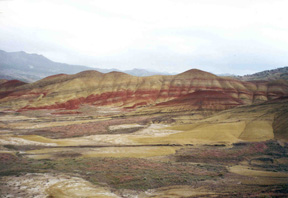
"The Painted Hills are composed mostly of claystone layers, which include ancient soils and lake beds. The surface of the hils have weathered and softened to clay," (Painted Hills Viewpoint. 1999. National Parks Service.).
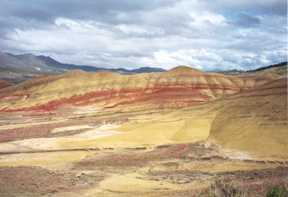
"The claystones were formed by several events and processes. Over 30,000,000 years ago, volcanoes from ancestral Cascade Mountains...slowly deposited layer after layer of cooled ash. Plants and animals churned and tilled the surface, and air oxidized the ash. Ground water flowed, leaching and redestributing minerals," (Painted Hills Viewpoint. 1999 National Parks Service.).
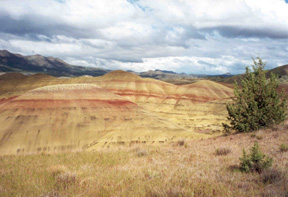
"Over time, the ashfall became soil, later buried under hundreds of feet of deposits. Compaction, cementation, and recrystallization processes occurred. The original ashfalls were thus changed structurally and chemically, resulting in hard and colorful stone," (Painted Hills Viewpoint. 1999. National Parks Service.).
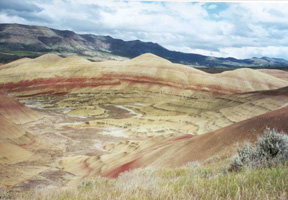
"The original ashfall was probably a very light, buff color, comprised primarily of..." Aluminum, Silicon, Iron, Magnesium, Manganese, Sodium, Calcium, Phosphorous, Titanium, Potatssium, Oxygen, Hydrogen "...These twelve elements, plus traces of seventeen others, were mixed in a variety of ways. The various mixes produce minerals of different colors that make up the hills," (Painted Hills Viewpoint. 1999. National Parks Service.).
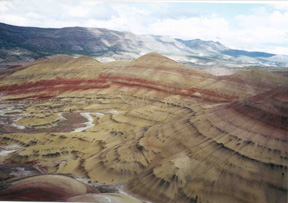
"Sometimes the color of one mineral dominates, such as the rust colored layers, rich in iron oxide. A blend of minerals may create a color differenct from the originals. The yellows are a blend of iron and magnesium oxides. The black "hash-marks" are primarily colored by the manganese oxide. Also, depending on the amount of moisture in and on the hills, light is reflected and absorbed differently. This causes ever-changing tints of red, buff, yellow, and other colors," (Painted Hills Viewpoint. 1999. National Parks Service.).
back to my home page