One Picture.
by John McLaren
Jerry Kilgore
September 29, 2004
Does economic policy make a difference?
The Bush administration turned its back on standard
economic advice early in its term. When the recession began in 2001 following
the burst of the tech-stock bubble, instead of a temporary tax cut targeted
at middle- and low-income households, the administration pushed for long-term
tax cuts heavily favoring the wealthy. This worried mainstream economists,
who were concerned that a tax cut for the wealthy would fail to generate
jobs, and that the return of a long-term deficit would crowd out private
investment, slowing growth. But politics trumped economic analysis, and
the administration hoped it wouldn’t make any difference to the subsequent
economic results.
Jerry Kilgore
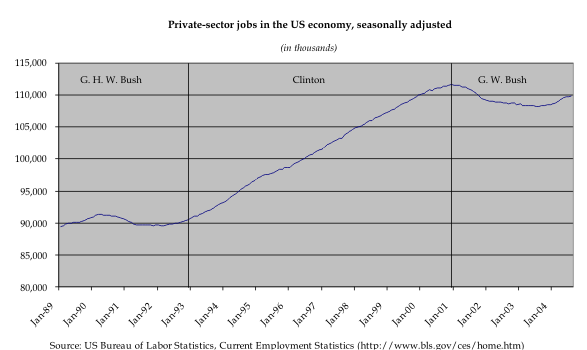
The results are now in. Causality is never really provable in economics, but sometimes the evidence is so overwhelming it cannot be ignored. The story of the Bush economy is shown in the accompanying graphic. It shows the total number of people employed in the private sector of the US economy over the last four presidential cycles. The term of the elder Mr. Bush, from 1988-1992, saw a sharp external shock in the form of an oil price spike during the first Gulf War. A recession and loss of jobs followed, but as the picture shows, normal job growth resumed soon as GDP recovered. The Clinton years saw several external economic shocks: The implosion of the economy of a major trading partner, Japan; the sharp contraction of another major partner, Mexico; and the Asian crisis. However, these caused no ripple in the US jobs picture. This was partly because of nimble economic management, particularly in the case of the Mexican crisis.
The record during the current administration, however, is sharply different. The number of jobs plummeted by five million over two years, and then began a painfully slow recovery, even though the recession was by then over and gone. Under the latest figures, the economy still has one million fewer jobs than it did on inauguration day in 2001.
This is a remarkably poor performance, particularly for an economy that did not suffer any particularly severe economic shocks. It is difficult to avoid giving some blame to the quality of economic policy making. This administration’s demonstrated indifference to real economic analysis, and job creation in particular, in its policy-formation process is well-known (documented, for example, in the recent book by Ron Suskind).
It is worth pointing out, by the way, that John Kerry’s
economic team has a number of key players from the Clinton economic team,
and it is a good bet that if he is elected he will listen to them.
--AZ-01: Rick Renzi
--AZ-05: J.D. Hayworth
--CA-04: John Doolittle
--CA-11: Richard Pombo
--CA-50: Brian Bilbray
--CO-04: Marilyn Musgrave
--CO-05: Doug Lamborn
--CO-07: Rick O'Donnell
--CT-04: Christopher Shays
--FL-13: Vernon Buchanan
--FL-16: Joe Negron
--FL-22: Clay Shaw
--ID-01: Bill Sali
--IL-06: Peter Roskam
--IL-10: Mark Kirk
--IL-14: Dennis Hastert
--IN-02: Chris Chocola
--IN-08: John Hostettler
--IA-01: Mike Whalen
--KS-02: Jim Ryun
--KY-03: Anne Northup
--KY-04: Geoff Davis
--MD-Sen: Michael Steele
--MN-01: Gil Gutknecht
--MN-06: Michele Bachmann
--MO-Sen: Jim Talent
--MT-Sen: Conrad Burns
--NV-03: Jon Porter
--NH-02: Charlie Bass
--NJ-07: Mike Ferguson
--NM-01: Heather Wilson
--NY-03: Peter King
--NY-20: John Sweeney
--NY-26: Tom Reynolds
--NY-29: Randy Kuhl
--NC-08: Robin Hayes
--NC-11: Charles Taylor
--OH-01: Steve Chabot
--OH-02: Jean Schmidt
--OH-15: Deborah Pryce
--OH-18: Joy Padgett
--PA-04: Melissa Hart
--PA-07: Curt Weldon
--PA-08: Mike Fitzpatrick
--PA-10: Don Sherwood
--RI-Sen: Lincoln Chafee
--TN-Sen: Bob Corker
--VA-Sen: George Allen
--VA-10: Frank Wolf
--WA-Sen: Mike McGavick
--WA-08: Dave Reichert