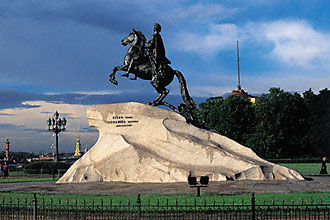
Immortalised by Pushkin in his epic poem, "The Bronze Horseman" has stood guard over the Neva River for centuries. Erected by Catherine the Great to honour the city’s founder, Peter the Great, the statue has come to symbolise St. Petersburg.
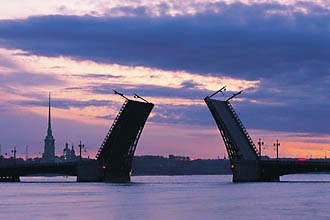
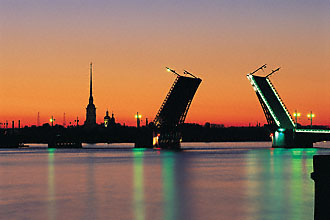
You haven't really seen St.Petersburg, if you haven't seen bridges open at midsummer night allowing ships to go upstream the Neva river. The open Palace bridge with the Sts. Peter and Paul cathedral spire on the background is one of the most distinctive symbols of St.Petersburg.
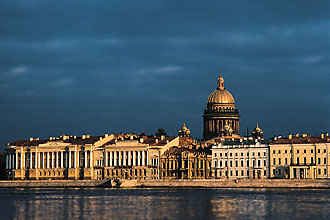
The cupola of St. Isaac’s Cathedral, a familiar landmark to anyone strolling the banks of the Neva River, rises gracefully above the neo-Classical facades of the English Embankment. The largest church in the city, St. Isaac’s commands an impressive view of the city from the gallery in the cupola.
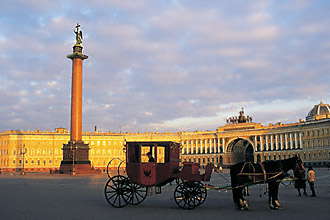
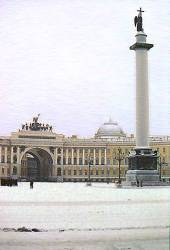
Historic Palace Square, which has seen the birth of revolutions that shook the world, enjoys a quiet mid-afternoon moment free of crowds of tourists and teenagers.
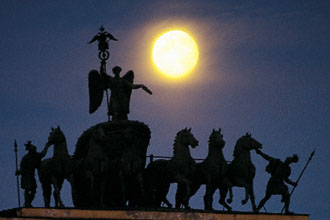
The moon rises dramatically over this powerful symbol of Russian military strength. During St. Petersburg’s days as the Russian capital, this building on Palace Square served as the empire’s central military headquarters.
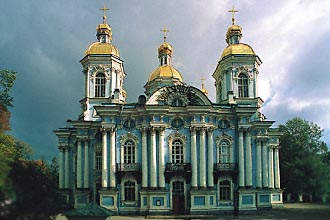
The Cathedral of St. Nicholas has offered succor and spiritual sustenance to sailors throughout its long history, as is witnessed by the rich maritime details of the interior
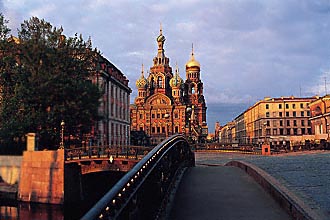
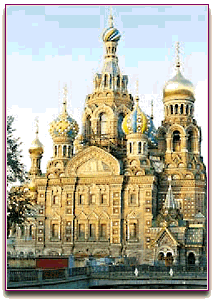
Nicknamed the “Mosaic Church” for its distinctive multi-coloured cupolas, the Church of the Saviour-on-the-Blood was built on the exact spot where Tsar Alexander was assassinated on March 1, 1881
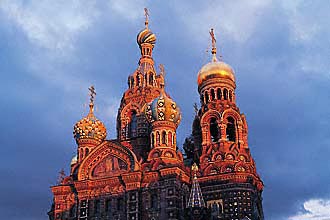
Savior on the Blood" church, St Petersburg, Russia
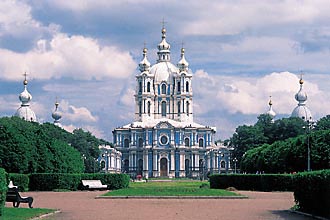
The Smolny Convent owes its striking combination of ornamental Baroque and traditional Russian elements to the long process of its construction. Initially designed in the 18th century by the Italian architect Rastrelli, the convent was completed in 1835 by the Russian Stasov.
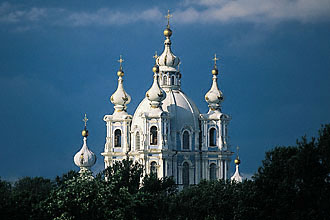
Smolny convent, St Petersburg, Russia
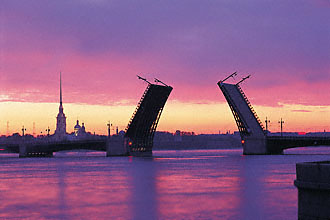
The open Palace bridge with the Sts. Peter and Paul cathedral spire on the background in the early morning and in the deep night
.. Saint Petersburg - the imperial city of golden spires, golden domes, pastel palaces and picturesque canals. With its arrow-straight avenues, leafy parks and lovely architecture, Petersburg is as staggeringly impressive on a horizontal scale as New York is on a vertical one. Take Versailles, multiply it by ten, throw in the Louvre and you have a beginning. Then add stupendous churches, jewel-box theaters, beautiful bridges spanning the Neva and the myriad canals that give the city the sobriquet 'Venice of the North'.
Church of the Spilt Blood
Alexander III built the Church of the Resurrection on the very spot where his father Alexander II was assassinated. It is also called the Church of the Spilt Blood.The twisted onion domes, proliferating mosaics and asymmetry of the Church come as a surprise in this city known for its Baroque curves and classical rigor. The mosaics have just been restored and are magnificent. Alfred Parland, who built the church (1883-1907), won the competition set up by Alexander III, which stipulated that it had to be in the 'purely Russian style of the 17th century'.
The Hermitage
- The collection of the Hermitage was founded by Catherine II in the Winter Palace, built by B.Rastrelli in 1754-1762 for Elizabeth. In 1764 225 paintings intended for Frederick II of Prussia, were sent to Catherine II in payment of a debt. The works of art were placed in two art galleries joined together, a group of selected friends of Catherine II could enjoy them and at that time the place got the name "Hermitage" meaning "a place of solitude". The transition from the palace to museum was a gradual one. Catherine II acquired individual works of art from Western Europe, and also whole collections, besides she commissioned a number of paintings, statues, objects of applied art. The grandsons of Catherine II Alexander I and Nicholas I extended the collection. In 1852 the museum was opened to the public. Russia's first purpose-built art gallery was added. The splendid "New Hermitage" with the porch supported by atlases (1784-1864) and the Old Hermitage (1771-87) were joined to the Small Hermitage (1764-1767), and with it made up the "Imperial Hermitage". The collection grew considerably after the events of 1917 followed by nationalization of private collections. In 1922 the Winter Palace became the part of the art museum.