
Gambel's Quail
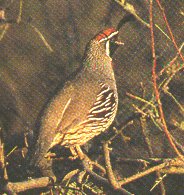
The spectacular Gambel's Quail inhabits the desert regions of the American Southwest, ranging from northern Nevada to southern Colorado and as far south as northern Mexico. A denizen of cactus scrublands and stream-side woodlands, Gambels' Quail is a small land bird characterized by a distinctive black plume. The male is gray with chestnut-colored flanks and contrasting white stripes. Its head is also chestnut, but the face and throat are black. A large black patch on its pale belly is fairly conspicuous, making the bird easy to identify in the field. The female sports a smaller plume, is somewhat duller in color, and lacks the black throat and belly patch.
When courting, the male struts around the female, bobbing its head to make its black plume dance. For the nest, the female scratches out a hollow in the soil beneath a desert shrub or cactus. After the chicks hatch, both parents tend to the young. It is not unusual to see a Gambel's Quail family, led by the male, bobbing along the desert terrain with the female following in the rear. These birds eat dry seeds from weeds and grasses, grasshoppers, ants and other insects, as well as fruits, berries, mesquite and other wild legumes. They're most active during the day when they forage for food. In the evening they move to an area near water, drinking their fill before roosting in nearby trees and desert shrubs.
http://home.att.net/~DanCowell/gambel.html - More information on Gambel's Quail

Animal Life