


Carbon-14 and Pb/U are two of the most used techniques to find the absolute date of something. Because, of this, archaeologists are constantly trying to improve their techniques and find more accurate, and easier methods to date objects.
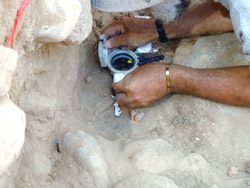
When you use Archaeomagnetism, you are using archaeological material to determining past variation in the earth's magnetic field.
Over a period of several thousand years, the sunrise position changes. Today, it rises slightly east of the position that it rose in prehistoric times. To date items with this technique, the sighting line needs to be marked. Then, markers need to be placed along the line marking different periods of time. By then measuring the alignment of the markers with optical instruments, they were able to calculate the position of the sunrise as it used to be.
ESR is similar to thermoluminescence. ESR is a "trapped charge" dating method, but it is applied to different kinds of samples, and the method of measurement is also different. ESR does not release trapped electrons, but subjects them to electromagnetic radiation in a magnetic field, which causes electrons to create and absorb electromagnetic power. The strength of the creation reflects the number of electrons that have become trapped since the crystals were formed.
The minerals in the sediment grains are sensitive to light, and when exposed to light, electrons leave the grains. This process is known as recombination. To detect the age, a comparison is made between sediment grains with a known amount of added radiation, and sediment grains that were affected naturally. Optical dating was only capable of dating sediments no older than 500,000 years. Also, since the technique is light-sensitive, the sediments must not come into contact with light.
Dendrochronology is the study of tree rings and provide very accurate dates about the tree and artifacts near. A tree produces a series of rings each year, with some rings being thin, and some thick. In dendrochronology, these rings are counted and compared. Typically, the more rings a tree has, the older it is.

This method involves counting microscopic tracks caused by fragments created by fission of uranium-238 in glassy minerals, whether geological or human manufactured.
Potassium-Argon is an ideal dating method for early hominid fossils since they occur in an area that was volcanically active when the fossils were left between one and five million years ago. In the 1950's more tests proved that they were really twice the original estimate of their age.
The OCR dating technique was introduced in 1992 by the Archaeology Consulting Team from Essex, VT. It was developed to measure the rate of biodegradation of carbonized organic matter that resulted from human activity. Even though OCR has the potential to provide archaeologists with a method of finding accurate and precise age estimates, it is still new and in the experimental stage.
Thermoluminescence dating is used to date something based on the last time it was burned or heated. It is typically used to date ceramic samples. To determine the age of ceramic sample, they are heated and energy is released in the form of visible light impulses. The energy is the measure of the radioactive self� and ambient radiation, which affected the ceramic minerals since the last burning. The more of the self� and ambient radiation that has been stored, the older the ceramic is.