Jeffrey Jabson
AUTOMT
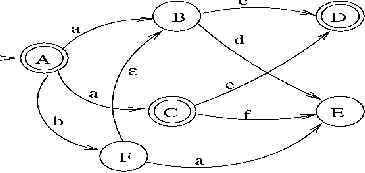
Definition: A Finite State Automaton is a graph determined with a 5-tuple where V is a finite set of vertices (states), E is a finite set of edges, is the labeling function, is the set of initial states, and is the set of terminal states. So every SA is also a finite state automaton by taking I=T=V. We extend to a labeling function where P is the set of all finite paths in the natural way: if is a path in than . As before we consider two functions as the source and the target of an edge. For a finite path we will call s(e1) the source of p and write s(p) and t(ek) will be the target of p and we will write t(p).
A finite state automaton is called deterministic if for every vertex the out-coming edges are labeled distinctly.
In the case of a deterministic finite state automaton we will use the following notations: Let p be a path with v=s(p), w=t(p) and . We will write vx=w and if there is no path starting at v with label x, we will write vx = 0.
A finite-state automaton is a device that can be in one of a finite number of states . In certain conditions, it can switch to another state. This is called a transition . When the automaton starts working (when it is switched on), it can be in one of its initial states. There is also another important subset of states of the automaton: the final states. If the automaton is in a final state when it stops working, it is said to accept its input. The input is a sequence of symbols. The interpretation of the symbols depends on the application; they usually represent events, or can be interpreted as "the event that a particular data became available". The symbols must come from a finite set of symbols, called the alphabet . If a particular symbol in a particular state triggers a transition from that state to another one, that transition is labeled with that symbol. The labels of transitions can contain one particular symbol that is not in the alphabet. A transition is labeled with E (not present in the alphabet) if it can be traversed with no input symbol.
SEMINAR ON NETWORK SECURITY ( 10-12-2002 at AMACC Pasig ) By: Mr. Richard Chan
Details/Summary:
Security Threats [ Hacking Tools ]
Computer Crime & Security Survey – states that every year, the education sector, government, and top 100 corporations are greatly affected and encounter network security problems. [ www.gocsi.com ]
Potential Risks ( from a hack attack )
Security Solutions ( Key Points ):