FOOTLOOSE
IN SEOUL
Preconceptions
Over the years I had heard many
reactions from those who had visited or lived in Seoul, and they were not
enthusiastic, for the most part.
American expatriates who had corporate postings there seemed not to have
enjoyed the time that they spent there.
Not only did they find the language barrier formidable, they also found
Seoul less open and convenient than Hong Kong, and less sophisticated and
fashionable than Tokyo. Among
short-term visitors, some of my Chinese colleagues tended to see it as an
unimpressive amalgam of Chinese and Japanese cultural and architectural
features and felt that the Korean capital had neither the magnificent
monumental palaces of Beijing nor the sleek, high-tech modernity of Tokyo. All of this piqued my curiosity, so when I
had the opportunity in April 1999 to route my flight through Seoul on my way
back to New York from my Bangkok assignment, I decided to stay 2 days.
Re-entering the Developed World
Arriving on a flight from Bangkok
at Seoul airport and emerging from the terminal, I suddenly felt that I was
back again in the developed world. That
does not mean to say that other Asian countries like Thailand or China had not
made tremendous economic strides in recent years. But getting into the city itself was something pleasant,
comfortable and altogether safe. There
was an airport bus that took passengers to major downtown hotels following 4 or
5 different routes (that reminds one of Tokyo airport, but the price here is
only $5 versus $20 in Tokyo.) In
Vientiane, I had to be picked up by the
hotel in an SUV and driven to my hotel over unpaved roads. In Bangkok,
I took a metered taxi from the airport but the driver, as soon as he got
on the highway, turned off the meter and offered me a flat rate, which I had to
accept, because I had no way of getting other transportation on the
highway. So I was grateful this time
for this convenient, modern touch. The
bus, after stopping at a number of hotels on the way, eventually dropped me off
at the Sofitel Ambassador Hotel in the heart of downtown Seoul. I was glad to be finally arriving, and after settling into my cozy and
pleasingly-appointed room, I threw open one of the windows, drank in the cool evening breeze and looked
down at the teeming, neon-lit city below, busy with traffic still.
The Allure of Seoul’s Palaces
There’s no doubt that for any
visitor to the Korean capital, its palaces are the main attraction. So bright and early the next morning, after
a hearty breakfast, I headed straight for the guest relations manager’s desk in
the lobby to get some help on how to reach the palaces. She very helpfully wrote down the name of
Kyongbokkung Palace in Korean on the hotel’s business card, on the reverse side
of which was printed the name of the Sofitel Ambassador in Korean and a small
road map indicating its location.
Armed with this card, I felt invincible and ran out of the hotel
entrance to the taxi stand, where a row of polished black taxis was in
attendance. I handed the card to the
driver, and said “Kyongbokkung Palace, please!” He smiled, repeated the same words approvingly and opened the
door for me. It was a beautiful spring
day. The car glided through busy
downtown, but all around us were trees with tender-green leaves and hosts and
hosts of flowers in bloom and ablaze with color. I was elated and luxuriated in the comfortable upholstered
seats.
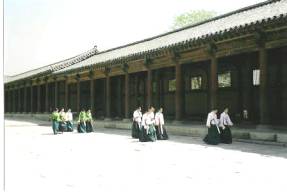 On
entering Kyongbokkung Palace, I was delighted to see about 14 young Korean
women with beautifully-coiffed jet-black hair and in traditional Korean dress, the Hanbok, in this case white
blouses and long dark green skirts and red belts, making their way in groups of
2 or 5 across the courtyard of the main palace building. I had thought that the Hanbok was worn only
on important ceremonial occasions such as weddings and birthdays and formal
parties, and wondered what event was about to take place in the palace.
On
entering Kyongbokkung Palace, I was delighted to see about 14 young Korean
women with beautifully-coiffed jet-black hair and in traditional Korean dress, the Hanbok, in this case white
blouses and long dark green skirts and red belts, making their way in groups of
2 or 5 across the courtyard of the main palace building. I had thought that the Hanbok was worn only
on important ceremonial occasions such as weddings and birthdays and formal
parties, and wondered what event was about to take place in the palace.
Viewing Korean palaces invites
comparisons with Chinese palaces. The
layout of Kyongbokkung palace is on a north-south axis, much like the Forbidden
Palace in Beijing. The word “kung” in
Korean is exactly the same word as in Chinese, meaning simply “palace” and is
even written and pronounced the same way in the two languages. So it would make more sense to say Kyongbok
Palace and omit the “kung” or simply say Kyongbokkung when referring to the
palace.
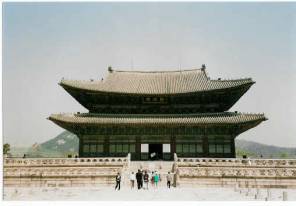 Once inside the palace grounds, there is much
that is reminiscent of the Forbidden City, whether it is the basic
architectural style or the stone animals on the balustrades and the detailed
and fine carvings on the ceremonial ramps leading into the entrances or the
names given, in Chinese characters, to the palace buildings, evincing time-honored
Confucian precepts, e.g. “The Hall of Diligent Administration,” (see photo on
left) or the intricate and varied patterns of palace windows. One distinct feature which seems to set the
Kyongbokkung apart from the Forbidden City is the presence of stone markers in
the ground in front of the main palace building, designating the precise rank
of the official, thereby specifying his precise location in the pecking order
for being received by the Emperor. The
military officials are arrayed on one side of the courtyard, while civilian
officials are arranged on the other. One is struck by how close the palace is to the hills that
surround the city of Seoul, and also by the fact that during these beautiful
spring days, the palaces are favorite haunts of schoolchildren, who come, immaculate
in their uniforms, and in groups supervised by their teachers to see these
proud symbols of their nation’s culture, but also to relax and run around,
enjoy the flowers and bask in the warmth of the sun.
Once inside the palace grounds, there is much
that is reminiscent of the Forbidden City, whether it is the basic
architectural style or the stone animals on the balustrades and the detailed
and fine carvings on the ceremonial ramps leading into the entrances or the
names given, in Chinese characters, to the palace buildings, evincing time-honored
Confucian precepts, e.g. “The Hall of Diligent Administration,” (see photo on
left) or the intricate and varied patterns of palace windows. One distinct feature which seems to set the
Kyongbokkung apart from the Forbidden City is the presence of stone markers in
the ground in front of the main palace building, designating the precise rank
of the official, thereby specifying his precise location in the pecking order
for being received by the Emperor. The
military officials are arrayed on one side of the courtyard, while civilian
officials are arranged on the other. One is struck by how close the palace is to the hills that
surround the city of Seoul, and also by the fact that during these beautiful
spring days, the palaces are favorite haunts of schoolchildren, who come, immaculate
in their uniforms, and in groups supervised by their teachers to see these
proud symbols of their nation’s culture, but also to relax and run around,
enjoy the flowers and bask in the warmth of the sun.
Another interesting
and possibly unique feature of Kyongbok Palace is the Terrace for Measuring the
Wind. This is an ornately carved raised
stone terrace with a hole drilled into it, in which is inserted a flag-pole,
and the flag was used to determine both the direction and the intensity of the
wind. These devices apparently go back
several centuries, and I don’t remember seeing them in China or Japan or
anywhere else in the world.
The Elegant Simplicity of Changdokkung
 Changdokkung
is located east of Kyongbokkung. It is
on the list of UNESCO’s World Heritage Sites and can only be visited by guided
tour. For me, it was a tour within a
tour, since I had joined a half-day city tour run by a commercial operator
which included visiting the Blue House (Presidential Mansion), various city sights
and the highlight - Changdok Palace. Changdok boasts an impressive array of palace buildings, differing
little from the other major palace.
But an intriguing piece of information emerged from the guided tour, which
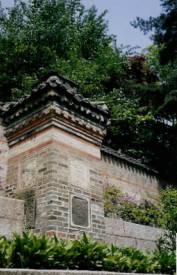
was that, as far back as 400 years ago; Korean palaces were heated by subterranean
coal furnaces which warmed the stone floors evenly and admirably. Moreover, the smoke from the burning coal
was conducted by pipes from underneath the floors out of the buildings and
expelled into the air through free-standing chimneys constructed outside the
main buildings (see left). The chimney
was not an integral part of the building itself, but was often an imposing
brick structure standing alone as a separate architectural feature.
Changdokkung
is located east of Kyongbokkung. It is
on the list of UNESCO’s World Heritage Sites and can only be visited by guided
tour. For me, it was a tour within a
tour, since I had joined a half-day city tour run by a commercial operator
which included visiting the Blue House (Presidential Mansion), various city sights
and the highlight - Changdok Palace. Changdok boasts an impressive array of palace buildings, differing
little from the other major palace.
But an intriguing piece of information emerged from the guided tour, which
was that, as far back as 400 years ago; Korean palaces were heated by subterranean
coal furnaces which warmed the stone floors evenly and admirably. Moreover, the smoke from the burning coal
was conducted by pipes from underneath the floors out of the buildings and
expelled into the air through free-standing chimneys constructed outside the
main buildings (see left). The chimney
was not an integral part of the building itself, but was often an imposing
brick structure standing alone as a separate architectural feature.
 The
other charming aspect of Changdok was that one of the Korean kings who lived
there wanted the experience of living, not like royalty, but like an ordinary
person. So he arranged to have built,
in one corner of the palace grounds, an unostentatious but beautiful nobleman’s
house, made out of wood and paper. The
nobleman’s “humble” abode had wooden beams, elegant windows in circular,
rectangular and octagonal shapes with delicate lattice-work, very much in the
Chinese tradition. Across the top of
the front gate to the mansion was a sign saying, in Chinese characters, “Gate
of Eternal Happiness.” And on the
wooden pillars of the house supporting the roof was a delightful series of
Chinese couplets, extolling the virtues of the Confucian gentleman living in
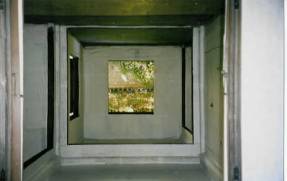
quiet and idyllic seclusion. We peered
into the intriguing rooms (see above left), separated now by a rectangular
door, now by a Chinese moon-gate, with the inside of doors and the interior
lined with beautiful white paper, giving the effect of regal simplicity. In addition, the mansion is set in enchanting
grounds, on the edge of a pond, and luxuriant with trees and shrubbery and
flowers galore. The overall effect was
of one of painstaking and meticulous landscaping, reminiscent of Japanese
gardens. I should not fail to mention
the entrance to the estate - a quaint stone archway which has carved onto the
horizontal part of it three Chinese characters saying “Bu Lao Mun” meaning
“Gate of Eternal Youth.”
The
other charming aspect of Changdok was that one of the Korean kings who lived
there wanted the experience of living, not like royalty, but like an ordinary
person. So he arranged to have built,
in one corner of the palace grounds, an unostentatious but beautiful nobleman’s
house, made out of wood and paper. The
nobleman’s “humble” abode had wooden beams, elegant windows in circular,
rectangular and octagonal shapes with delicate lattice-work, very much in the
Chinese tradition. Across the top of
the front gate to the mansion was a sign saying, in Chinese characters, “Gate
of Eternal Happiness.” And on the
wooden pillars of the house supporting the roof was a delightful series of
Chinese couplets, extolling the virtues of the Confucian gentleman living in
quiet and idyllic seclusion. We peered
into the intriguing rooms (see above left), separated now by a rectangular
door, now by a Chinese moon-gate, with the inside of doors and the interior
lined with beautiful white paper, giving the effect of regal simplicity. In addition, the mansion is set in enchanting
grounds, on the edge of a pond, and luxuriant with trees and shrubbery and
flowers galore. The overall effect was
of one of painstaking and meticulous landscaping, reminiscent of Japanese
gardens. I should not fail to mention
the entrance to the estate - a quaint stone archway which has carved onto the
horizontal part of it three Chinese characters saying “Bu Lao Mun” meaning
“Gate of Eternal Youth.”
 But
it is impossible to speak of the Changdok Palace without any reference to the
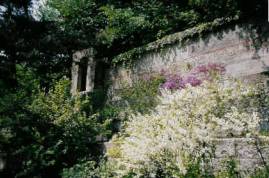
Piwon, or “Secret Garden.” This is a
walled garden adjacent to the Palace covering an area of 32-hectares studded
with ponds and pavilions. The Palace
side of the wall had intricate designs on it, and with peonies and apple
blossoms in bloom at this time of year, it was positively delightful (see left). Inside the Piwon, it was all peacefulness
and tranquility, and one felt far removed from the clamor and hectic pace of a
large city. We saw an endearing little
plum tree which turned out to be 400 years old and a gift from one of the Ming
emperors. Another totally awesome sight
was a 700-year- old cypress tree which was twisted and gnarled in such a way as
to resemble a dragon rising, which is in fact what it is called. One could see how this might have been the
playground of the care-free royalty. As
we followed our guide and penetrated through the layers of mysteries of the
garden (my Korean friend in New York says that the word “Piwon” in Korean also
means “mysterious garden”), suddenly we came upon a whole group of men and
women in traditional Korean attire. The
women looked very much like those we had seen earlier in the Kyongbok Palace
and they now carried large vertical fans, as if they were ladies-in-waiting at
court. In addition, there were footmen
in navy carrying huge yellow parasols and guards in peach-colored costumes
wearing swords in their belts.
Eventually, the king emerged, resplendent in full royal regalia. It turned out that Korean National
Television was making a film about one of the Korean kings. It was my good fortune to have been present
on this rare occasion.
But
it is impossible to speak of the Changdok Palace without any reference to the
Piwon, or “Secret Garden.” This is a
walled garden adjacent to the Palace covering an area of 32-hectares studded
with ponds and pavilions. The Palace
side of the wall had intricate designs on it, and with peonies and apple
blossoms in bloom at this time of year, it was positively delightful (see left). Inside the Piwon, it was all peacefulness
and tranquility, and one felt far removed from the clamor and hectic pace of a
large city. We saw an endearing little
plum tree which turned out to be 400 years old and a gift from one of the Ming
emperors. Another totally awesome sight
was a 700-year- old cypress tree which was twisted and gnarled in such a way as
to resemble a dragon rising, which is in fact what it is called. One could see how this might have been the
playground of the care-free royalty. As
we followed our guide and penetrated through the layers of mysteries of the
garden (my Korean friend in New York says that the word “Piwon” in Korean also
means “mysterious garden”), suddenly we came upon a whole group of men and
women in traditional Korean attire. The
women looked very much like those we had seen earlier in the Kyongbok Palace
and they now carried large vertical fans, as if they were ladies-in-waiting at
court. In addition, there were footmen
in navy carrying huge yellow parasols and guards in peach-colored costumes
wearing swords in their belts.
Eventually, the king emerged, resplendent in full royal regalia. It turned out that Korean National
Television was making a film about one of the Korean kings. It was my good fortune to have been present
on this rare occasion.
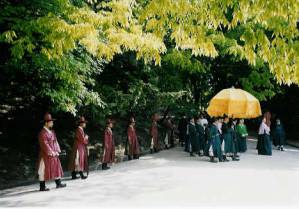
Royal scene being filmed in Changdok
Palace
Insadong
Our tour guide put it this way,
“During the colonial period ( Japanese occupation of Korea, 1910-1945),
noblemen could not make a living, so they started selling their art objects and
precious possessions, and they did so in this district of Insadong, which
eventually evolved to become Seoul’s antique district.” It has a whole street lined with art
galleries and shops mostly selling ceramics, paintings, calligraphy and
different kinds of souvenirs. Some
shops also sell furniture such as Korean clothes chests and medicine cabinets
made out of wood with metal fixtures.
Authenticity and pricing could be problematic in such a touristy
neighborhood. There are also shops
which specialize in brushes, brush-pots, ink-wells and paper for calligraphy
and painting.
In the evening, the neighborhood
comes to life with many restaurants, bars, tea-houses and coffee-shops doing a roaring
trade. My local friend took me to an
old restaurant (dating back 100 years) housed in a charming wooden structure,
containing many private rooms and serving authentic and traditional Korean
cuisine. But most of the establishments
here have a trendy and cosmopolitan appearance and ambience and most Westerners
would feel quite at home here - I also have the impression that more English is
spoken here than in many other parts of Seoul.
After a very fine dinner and a strong cup of coffee in a cafe, my
friend, always brimming with energy, suggested taking a taxi across town to
south of the Han river to meet a friend in a karaoke bar. She told me that the area she wanted to take
me to was more heavily expatriate, with accommodation, entertainment and other
facilities catering to foreigners - I don’t suppose there would be any kind of
a language problem there. Would that be
the Seoul equivalent of Lan Kwai Fong in Hong Kong, I wondered? I was too weary to find out, since, by that
time, my jet-lag was beginning to catch up with me, and I offered my apologies.
Namdaemun
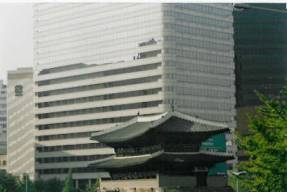 Another
well-traveled tourist destination is Namdaemun Gate, the southern gate to the
city of Seoul. It dates back to the late 14th Century, but like many
structures in this city, has been damaged more than once, most recently during
the Korean War of the 1950's, and subsequently rebuilt. It remains an
impressive sight till this day, with its solid and formidable stone base and
its two-tiered roof supported by numerous beams rising to quite a height above
street level. Alas, the massive
glass-and metal high-rises of corporate Korea now tower over and dwarf this
structure, and endless streams of cars swirl round and round the Namdaemun
almost without abatement. We should
all, however, be glad that it has been preserved and still stands proudly in
its original site. The headlong drive
toward modernization and development in Asia has taken a tremendous toll on the
cultural and architectural heritage of its cities. The Koreans, however, having known centuries of invasion, war and
destruction, have learnt to treasure their national heritage and worked
tirelessly to restore and preserve the relics from their proud past, whether it
is one of their many palaces, the statue of their national hero Admiral Yi, or
Namdaemun.
Another
well-traveled tourist destination is Namdaemun Gate, the southern gate to the
city of Seoul. It dates back to the late 14th Century, but like many
structures in this city, has been damaged more than once, most recently during
the Korean War of the 1950's, and subsequently rebuilt. It remains an
impressive sight till this day, with its solid and formidable stone base and
its two-tiered roof supported by numerous beams rising to quite a height above
street level. Alas, the massive
glass-and metal high-rises of corporate Korea now tower over and dwarf this
structure, and endless streams of cars swirl round and round the Namdaemun
almost without abatement. We should
all, however, be glad that it has been preserved and still stands proudly in
its original site. The headlong drive
toward modernization and development in Asia has taken a tremendous toll on the
cultural and architectural heritage of its cities. The Koreans, however, having known centuries of invasion, war and
destruction, have learnt to treasure their national heritage and worked
tirelessly to restore and preserve the relics from their proud past, whether it
is one of their many palaces, the statue of their national hero Admiral Yi, or
Namdaemun.
Does Seoul have
its distinctive character?
There is no getting away from the
fact that invasion and occupation by the Japanese have left their mark on
Korea’s capital city. The City Hall,
situated right in the heart of downtown, is a copy of the Diet Building in
Tokyo, a product of the Japanese occupation between 1910 and 1945. Seoul Station appears to be a building along
the same lines. Just wandering around
in the affluent and modern downtown area, say, along the premier shopping
street, Myongdong, one senses in the layout of the streets, the design of the
street signs and subway stations, and in the overall conception and appearance
of the urban environment, something powerfully reminiscent of central Tokyo. Equally, the subway system is extensive,
clean and well-run, and a pleasure to use.
And one cannot help thinking that the Japanese influence has something
to do with this. The department store
culture so totally embraced by the Japanese in the tradition of Mitsukoshi or
Matsuya has found faithful expression in Seoul - in the Lotte Department Store
with its full range of services as well as products, and several restaurants
offering cheap food. In a more subtle
way, the care and meticulousness with which, say, the restaurant staff in my
hotel wrap a lunch box , certainly suggest a Japanese kind of
perfectionism. On entering Seoul’s
Shilla Hotel, reputed to be the biggest and the best, I heard someone speaking
through a loud-speaker issuing what seemed to be directions to motorists to
make sure they took the correct driveway into the hotel. That is Japanese-style efficiency and
organization - relatively rare in Asia.
For a Chinese visiting the palaces
and major cultural sights in Seoul, there is a palpable sense of cultural
kinship with things Korean. Seoul’s
palaces have derived much of their layout
and design concepts from Chinese palaces. Moreover, since the ancient Korean writing system was in fact
Chinese, the names of palace buildings and the inscriptions and couplets are
all in Chinese as well, not to mention the fact that the words evoke the same
Confucian concepts of good governance and
moral rectitude shared by East Asian countries for many centuries.
But that is as far as it goes. Kyongbok Palace has several features that
seem to have no antecedents or parallels in China. Changdok Palace’s free-standing chimneys are indeed unique
and the Korean king’s idea of building a non-royal mansion
to experience life as an ordinary person, is not one that appears to have
caught on at any time among emperors in China.
Korean food is certainly
distinct from both Chinese and Japanese food, and one cannot help
noticing that in the streets of Seoul, almost all the cars are made in Korea,
and foreign imports are almost not to be seen, particularly not Japanese
ones, in sharp contrast to the
situation in many other countries in Asia.
As for the writing system, a Korean script, known as Hangul, was
introduced by King Sejong in the 15th Century, and gradually evolved
and took root in Korea to become the modern Korean writing system used
today. One of the most striking and
poignant examples of Korean ingenuity and national resolve was of course the
“turtle ships” invented by Admiral Yi Sun-shin of the 16th Century
who encased his wooden warships in sheets of armor and won important sea
battles against the otherwise militarily superior armadas of Japan’s
Hideyoshi. A bronze statue of Admiral
Yi stands on a major downtown thoroughfare as eloquent testimony to the
patriotism and courage of the Korean people.
In fact, Seoul, as the heart and
soul of the Korean nation, is where we can see most clearly and unmistakably,
the centuries-old struggle by this great people to preserve and assert their
uniqueness and cultural individuality in the face of strong influences from
China and outright aggression by Japan.
J.T.
November 1999