Some of these have enjoyed enormous popularity with visitors and residents alike. The Chinese restaurant on the 8th floor of the Peace Hotel, facing the Bund,has traditional decor, and more important, a commanding view of the bustling Huangpu River. The cheongsam-clad waitresses lead customers straight to a table by the window after greeting them. Highly-recommended dishes there would be lu shui er pian, cold sliced goose in soy sauce (always Rachel’s favorite), san se fu pi juan, vegetables stuffed in bean curd rolls, and he ye xiao pao ya, steamed duck morsels wrapped in little lotus-leaf packets. The Park Hotel on Nanjing Xilu offers an appetizing buffet lunch in its Coffee Shop, which is quite popular with locals. There is an array of delicious cold Shanghai hor d’oeuvres, hot dishes that include sauteed prawns and Peking duck with pancakes, and an endless supply of Shanghai snacks like sheng jian mantou, pan-fried pork buns and steamed dumplings. The Grand Hyatt in Pudong (meaning east of the Huangpu River) has, on its 54th floor, an upscale buffet restaurant, the Grand Cafe, whose breathtaking views of the river and the buildings on the Bund (looking like toys from a distance), are a major selling point. The cold seafood buffet is delicious and varied, and entrees can be ordered a la carte and include steaks and pastas as well as at least one Shanghai specialty like fried crispy fish in sweet-and-sour sauce. The dessert selection is western and enticing. But by far the most enchanting hotel restaurant is the Chinese Restaurant in Building One of the Ruijin Guesthouse on tree-lined Ruijin Er Lu, within the boundaries of what was formerly the French Concession. Before it was open to the public, the hotel used to be a state guesthouse restricted to national leaders and visiting dignitaries. The grounds of the guesthouse are beautiful, with carefully-tended flower-beds and lovely old trees and willows, and a number of small villa-like houses scattered over the whole compound. Building One was once part of the Morriss Estate (the Morriss family owned a major newspaper called the North China Daily News with premises on the Bund) and customers first go through a lobby, still grand with its marble floors and columns and rich wood paneling, and then into a dining room on the left, big enough for no more than five or six tables. One dines in an atmosphere of quiet and discreet intimacy here. At Ruijin, we found the zhang cha ya, camphor-smoked duck ( a Sichuan dish ), qing chao xia ren, fresh sauteed shrimps and huo tui zhu gan si, finely-shredded bean curd and ham cooked in broth, all quite outstanding. Of course, the juicy xie fen xiao long, crab-meat dumplings served in wooden steamers and the only-slightly-sweet he tao su, walnut pastries, were some of the restaurant’s signature offerings.
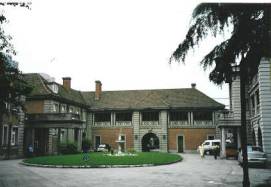
The attractive grounds of Ruijin Guesthouse
Restaurants that are almost Institutions
 A couple of restaurants date
back to the 30's and have so much history and romance associated with them that
they have become permanently woven into the fabric of this great city. Located on Nanjing Xilu, Meilongzhen
is probably one of the most sought-after old restaurants in Shanghai. Founded in 1938, initially it was a
watering-hole for underground Communist Party members, left-wing intellectuals
and personalities from Shanghai’s cultural
world. That cachet continues to attach
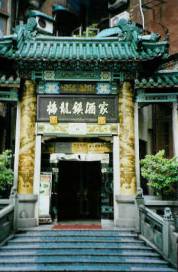
to this house of distinction and reservations must be made far in advance. It occupies a quaint old building on Nanjing
Xilu, with an imposing entrance (see left) and the name of the restaurant
brush-painted by the eminent artist Liu Hai Su. One evening, on my uncle’s
invitation, we dined in the opulent “Hall of
the Dragon and Phoenix.” All around us were festive and
elaborately-painted lanterns, carved wood panels, latticed doorways and
traditional Chinese furniture. The food
certainly lived up to its reputation.
The piece de resistance, you bao shan yu, sizzlingfried
eel, was succulent and tasty. The xiang
su ya, aromatic crispy duck, was expertly cooked - moist and soft inside,
crispy outside. And the dessert, a hot flan
of red-bean puree, dou sha guo bing, was something to die for.
A couple of restaurants date
back to the 30's and have so much history and romance associated with them that
they have become permanently woven into the fabric of this great city. Located on Nanjing Xilu, Meilongzhen
is probably one of the most sought-after old restaurants in Shanghai. Founded in 1938, initially it was a
watering-hole for underground Communist Party members, left-wing intellectuals
and personalities from Shanghai’s cultural
world. That cachet continues to attach
to this house of distinction and reservations must be made far in advance. It occupies a quaint old building on Nanjing
Xilu, with an imposing entrance (see left) and the name of the restaurant
brush-painted by the eminent artist Liu Hai Su. One evening, on my uncle’s
invitation, we dined in the opulent “Hall of
the Dragon and Phoenix.” All around us were festive and
elaborately-painted lanterns, carved wood panels, latticed doorways and
traditional Chinese furniture. The food
certainly lived up to its reputation.
The piece de resistance, you bao shan yu, sizzlingfried
eel, was succulent and tasty. The xiang
su ya, aromatic crispy duck, was expertly cooked - moist and soft inside,
crispy outside. And the dessert, a hot flan
of red-bean puree, dou sha guo bing, was something to die for.
Meilongzhen’s companion restaurant is Green Willow Village, or Luyangcun, also on Nanjing Xilu, and of the same vintage, established 1936. My parents frequented it in their youth when they still lived in Shanghai. Elegant private rooms are available upstairs, and the menu contains many Huaiyang dishes such as shui jing xiao rou, cold cubed ham in aspic and huo ji zhu gan si, shredded dried bean-curd cooked with chicken and ham. But the zao liu yu pian, sliced fresh fish braised in wine sauce, was particularly good, as were the numerous snacks and dumplings that Luyangcun is famous for.
 In quite another part of town,
the oldest part in fact, called Nanshi, and near the beautiful Ming dynasty
mansion and Yuyuan gardens, is the highly-regarded Lubolang, or Gallery
of the Green Waves, appropriately named since it nestles on the shore of a
jade green body of water crossed by a picturesque bridge. The restaurant, which earned the distinction
of being one of the ten best in China (having been officially designated as
such by the Ministry of Internal Trade), occupies a traditional Chinese house
and has been the venue for many banquets in honor of visiting dignitaries and
royalty, including Queen Elizabeth of England.
It offers a variety of interesting snacks and pastries, in addition to
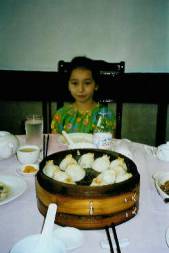
an extensive menu containing dishes to rival any in Shanghai. Other than the steamed crab-meat dumplings
(see picture at left, with my daughter Rachel), which are particularly juicy
here, there is a savory, flaky pastry in the shape of classical curved
eyebrows, called san si mei mao su.
Equally delicious were huo tui lo bo si bing, shredded ham and
turnip pastry, and the less common guo ren jiao yan su bing, a pastry
containing minced cashew nuts, pepper spiced salt and scallions and topped with
sesame seeds. One would not want to
forget mentioning a whimsical snack - jin
tui xiao zong, meat-and-rice
dumplings wrapped in pandanus leaf so tiny and dainty that they’re almost a shame to eat.
In quite another part of town,
the oldest part in fact, called Nanshi, and near the beautiful Ming dynasty
mansion and Yuyuan gardens, is the highly-regarded Lubolang, or Gallery
of the Green Waves, appropriately named since it nestles on the shore of a
jade green body of water crossed by a picturesque bridge. The restaurant, which earned the distinction
of being one of the ten best in China (having been officially designated as
such by the Ministry of Internal Trade), occupies a traditional Chinese house
and has been the venue for many banquets in honor of visiting dignitaries and
royalty, including Queen Elizabeth of England.
It offers a variety of interesting snacks and pastries, in addition to
an extensive menu containing dishes to rival any in Shanghai. Other than the steamed crab-meat dumplings
(see picture at left, with my daughter Rachel), which are particularly juicy
here, there is a savory, flaky pastry in the shape of classical curved
eyebrows, called san si mei mao su.
Equally delicious were huo tui lo bo si bing, shredded ham and
turnip pastry, and the less common guo ren jiao yan su bing, a pastry
containing minced cashew nuts, pepper spiced salt and scallions and topped with
sesame seeds. One would not want to
forget mentioning a whimsical snack - jin
tui xiao zong, meat-and-rice
dumplings wrapped in pandanus leaf so tiny and dainty that they’re almost a shame to eat.
New Restaurants in Old Houses
There is no doubt that a number of old restaurants have stood the test of time, and held their own more than adequately against relentless competition. But in recent years, enterprising restaurateurs have turned to the clever idea of converting lovely old villas or houses into charming restaurants, and nowhere has this been done with greater success and panache than in the former French Concession, now designated as a “ Landmark Historic District “ by the municipal authorities.
Hengshan Lu, the main artery running through this area, is lined with cafes, bars and eateries that evoke the gracious life styles of the past. Yang Jia Chu Fang, or Yang’s Kitchen, is in a house at the end of a narrow, winding alley some distance from the main road, where generally taxi drivers would politely ask you to get off and walk. Its slightly inconvenient location, however, has not detracted from its popularity. The house once belonged to a KMT general, but the ground floor of it has been attractively renovated by its current owner, Mr. Yang to serve as an informal eatery specializing in authentic local dishes. I was pleased that there was a no-smoking section, something rare in China. My favorite dish here was fresh clams braised with mushrooms, ham and bean-curd, very light and drawing on natural flavors.
Wuxing Hua Yuan or Wuxing Garden is another restaurant in a house situated at the corner of Hengshan Lu and Wuxing Lu. This one has a garden, resplendent with blooming flowers and shady trees. Unfortunately, the most coveted tables by the windows facing the garden were not available the evening we went, on account of a wedding party having taken over the best area. However, the five of us were given a cosy private room upstairs that might once have been a maid’s room. We dined on hong shao xiao huang yu, small red-cooked yellow fish, bai ye jie hong shao rou, stewed pork with knotted bundles of bean-curd skin, and shui jing xia ren, crystal shrimps prepared in a special way to retain their translucent appearance and succulent texture. The menu included a number of Hong Kong style dishes such as Cantonese roast duck which we tried and found to be superb. The service was friendly and attentive without being intrusive.
We had made reservations for our last night at the well-known Xi Jia Hua Yuan, or Xi’s Garden Restaurant, on Julu Lu, but we couldn’t make it. From the literature about it, it appears to be one of a group of houses situated in a large garden, which collectively served as accommodation for senior executives of an American oil company during the 30's, reverting to control by the Chinese Government after 1949. This one building has been painstakingly restored, retaining the architectural and decorative features of the house in its original form 60 years ago as much as possible. It is now one of the most fashionable restaurants in Shanghai.
Xujiahui Neighborhood Restaurants
We were staying in Xujiahui, a district on the western edge of the former French Concession, where high-rise apartment buildings and shopping malls are cheek-by-jowl with quiet, leafy streets lined with old houses. Coincidentally, my aunt and cousin live in Xujiahui, so we got to know several neighborhood restaurants quite well. Yuanyuan Restaurant on Wanping Nanlu has bright, cheerful decor and excellent food. I was particularly impressed with the ba bao ya, or Eight Treasure Duck, a whole bird stuffed with glutinous rice combined with a total of eight savory ingredients, such as mushrooms, dried shrimps, diced ham, gingko nuts etc., and braised in a delicious sauce. This dish is suitable for groups of six or seven at least. One example of the kind of unorthodox marketing that is now being resorted to by restaurants in the face of competitive pressures is the way a soup dish is listed on the menu here as pa tiao tang, or “Crawl and Jump Soup.” The ingredients of this highly-appetizing broth help one to understand its name - small crabs, prawns, frogs and clams. Zhang Sheng Ji, on busy Zhaojiabang Lu, specializes in Hangzhou cuisine and is enormously popular--reservations need to be made at least ten days in advance. One of the signature dishes of this relatively new establishment is lao ya bao, or whole duck casserole - a fresh duck is simmered in a large earthenware pot along with choice cuts of ham, tender bamboo shoots and other delicacies to produce a rich and satisfying broth. It’s a meal in itself. And then there’s Liang Xiao (which means perfect evening), on pleasant Tian Ping Lu. It is particularly proud of its shi peng niu rou, or sliced beef cooked over hot, smooth pebbles--tender and exquisitely tasty. The restaurant has won an award from the district council for superior food and service.
A Crab Restaurant
In a slightly run-down part of Tianjin Lu, a little distance from the bustle and glamor of the Bund, is a shabby-looking old building of several stories. This is the site of Xin Guang Restaurant, specializing in crab dishes. Some classmates of mine from high school in Hong Kong had reserved a crab feast here and we were able to join them. The restaurant seemed to have no main dining room, only a number of private rooms on two or three floors. We knew we had come to the right place when we entered through the front door and caught a glimpse, behind screens, of workers engaged in the delicate but tedious task of removing crab meat from its shell with special instruments. What followed was course after course of crab in various combinations: crab claw meat served plain with vinegar, crab braised with bean-curd or with asparagus, crab meat sauteed with crab roe, and finally, noodles with crab sauce. All of this was washed down with warm Shaoxing wine, diligently poured by an attentive and pleasant young waitress.
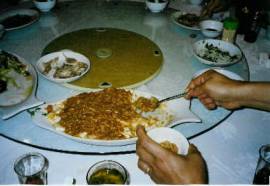
Crab with bean curd at Xin Guang
Only Scratched the Surface
We were well aware of the fact that we had only made a very small dent on the infinite variety of fine restaurants waiting to be discovered in this fascinating metropolis. The idea during our short visit of ten days was to concentrate on the city’s strengths - Shanghai and local food from the adjacent Jiangnan region, such as Yangzhou and Hangzhou. There is so much talent and versatility here that excellent Beijing, Cantonese, Hunanese, Sichuanese, Yunnanese and other regional fare can easily be found. Since Shanghai is a cosmopolitan city, a wide assortment of foreign cuisines of high quality is available: French, Italian, Japanese, Korean, Indian, Thai and Vietnamese, to name but a few. The way things are going, the discerning epicure will find much here to stimulate and delight his palate and to provide an enjoyable total dining experience. My family and I cannot wait to return here at the earliest opportunity. One fact is well-established: in the major centers of this vast country, so well-endowed with fresh fish, fowl and vegetables, the competition among restaurants is fierce - in Nanjing, one restaurant closes while a new one opens every day. It is this harsh reality which will keep standards high.
Grand Hyatt Hotel
177 Lujiazui Lu, Pudong
Grand Cafe, 54th Floor
Tel.: 5049 1234
Liang Xiao
312-314 Tian Ping Lu, Xujiajui
Tel.: 64079733, 64078822
Lubolang (Green Wave Gallery)
131 Yuyuan Lu
Tel.: 6328 0602
Luyangcun (Green Willow Village)
763 Nanjing Xilu
Tel.: 6258 4422
Meilongzhen
1081 Nanjing Xilu
Tel.: 6256 6688
Park Hotel
170 Nanjing Xilu
Tel.: 6327 5225
Peace Hotel
20 Nanjing Donglu
8th floor Chinese Restaurant
Tel.: 6321 6888
Ruijin Guesthouse
118 Ruijin Er Lu, Building One
Tel.: 6472 5222
Wuxing Garden
87 Wuxing Lu (intersects with Hengshan Lu)
Tel.: 64334230, 64312853
Xin Guang
512 Tientsin Lu
Tel.: 63223978, 63616682 after 10 PM
Xi’s Garden
889 Julu Lu, Bldg. 1 (near the Hilton)
Tel.: 64661246
Yang’s Kitchen
9 Hengshan Lu, Lane 3
Tel.: 6415 6800
Yuanyuan
550 Wanping Nanlu, Xujiahui
Tel.: 64381015
Zhang Sheng Ji
446 Zhaojiabang Rd, Xujiahui
Tel.: 6445 5777
Jeffrey Tao
July 2002