
|
 |
 |
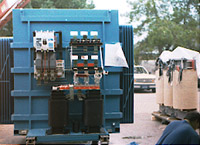
| Bill James Memorial Test Set (BJM) |
| 1500 A CB |
| Star-Point reactor |
| Water Cooled |
| SCRs |
| Contactor |
| Final stage input: 75 KVDC, 10 ADC, 15 APk. |
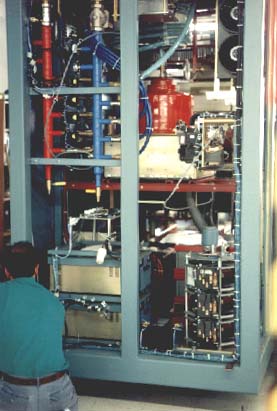 |
| Line Regulator |
| Solenoid Supply |
| 100 KW Tetrode |
| SF6 bell |
| Lytron heat exchangers (Water cooled air) |
| AC Dist. |
| H20 Solenoid Valve | |
| Dole Flow Regulator |
| Proteus flow switches | |
| solenoid current metering/control |
| Bill is still alive. So the name is a misnomer. His tubes are just two feet long. How they'd need this kind of power escapes me. Collector-cooling hoses do reflect major power-dissipation, so it's not a hoax. But the output waveguide is so tiny, it's hard to imagine such huge power-levels getting through without becoming obstructed by multipactoring or arcing. |
| Magna Stangenese had a guy named Cassell doing his star-point controllers. Maybe it was just me: I didn't like the guy. So I went ahead and designed the SCR regulator myself, using an Enerpro 12-pole trigger-pulse generator board. Cassell's board had a CMOS latch for "remembering" whether or not to be "on." His latch consistently forgot which to do (on a previous 14 KV klystron amplifier). My method uses "high-voltage-on" relay-contact closure for enabling the ramp-up/regulate function. A crowbar-fired fiber-optic goes dark enacting the fast inhibit. When asked about how he was dumping the choke energy in a fault, Cassell replied "they'll handle it downline." Being downline, I cried fowl. So he offered to add the traditional zener/SCR combo that shorts the choke at the double-voltage threshold. So he did not hold out on us. But last time I saw it, it was disconnected. I wonder why? Meanwhile Gunnar had finally gotten his way, the Cober cap bank was with us. In review, Steve Mannas took a look at the cap-bank size while characterizing feedback loops. He determined Gunnar was right, ultra-wide pulse-width had finally necessitated massive stored energy. I think I would have tried to remove more of it and go with higher no-load pass-tube anode voltage. This would have also necessitated pi filter reconfiguration in the cap bank. Corr-Rib resistors are in each lead of each cap. Each is rated to withstand a full-bank-dump. The problem is that the DC passes through the series resistances. The fewer the capacitors you have connected, the fewer the resistors remain in paralell to handle the 10 ADC. It probably smells a bit like hot ceramic as it stands. |
| Kurt McMillan was hired amid much hype and fanfare, to head-up BJM. In the end, he was stuck holding the bag on everyone else's designs. He quit afterwards. Our big NAVY contracts were behind us. And ETM was back to delegating everything out. This job was rushed. It was too big for one person to handle. Kurt led the effort and did a good job of ordering long-lead items. But Kurt felt growing frustration; he was left out, bogged down doing beam-box design. Meanwhile our boss had me designing one module after the next. Then I felt left out when Kurt was in the field, testing my designs. I had agreed to doing certain things in response to customer concerns, at the design review. But one by one, my words fell to the red pen, as Kurt ripped out modules and disposed of them. I couldn't test anything when the unit was still at the plant, the raw supply didn't exist yet. One day, I'd like to go back and beat those specifications. Maybe I'll get my chance yet. The Bill James specification was only three pages. Each deleted-module forfeited our chances of meeting one line. Some were important. But it runs fine. That's what counts, I guess. |
| Chuck told Kurt to "reverse-course: upgrade to a 250 KW dissipation-rated beam pass tube." Kurt forgot to change the tube order. But he did change the fillament transformer. So the voltage was way off. I split up a 208 VAC secondary-output into three buck windings. Kurt provided a small three phase, manually-operated, Powerstat-brand Variac. Variac boost-taps extended the reach of the buck windings to minus 15%. Kurt wanted to buy another xfmr despite my success without. Chuck just laughed at him. Poor Kurt. |
| Chuck was coming down with something like Altzheimers. It was the saddest thing. He had not cultivated honesty around himself. Some of the kids he'd hired liked the hanky panky. Chuck had always been quirky about certain things. If he was wrong, it was possible to disprove his premise. He'd learn. But that was over. He could feel control slipping away. This made him bitter. His knee-jerk reaction was to exert more control in an authoritarian manner. But he was clueless about what he'd dictated afterwards. Those who took his commands seriously were bound for trouble. It was too much for me. The sea of voices finally had its way. Common sense lost the war so I vanished too. |
| Bobby |