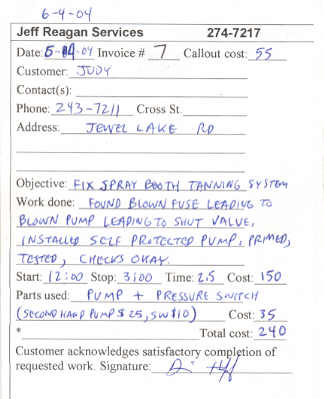
It sounds too easy you say. Maybe--but not so fast--I say: I was confronted with a fairly sophisticated system that I'd never seen before. I had to get up a steep learning curve rapidly. Operators reported a fuse blowing. Replacement proved futile. Suddenly, I found myself looking at a programmable-logic-controller and power-supply (in the box blowing the fuses). Feelings of intimidation might be normal for anyone looking into that box. The wire-harness is two inches thick. In another box, I discover the system is ethernet compatible. That feature goes unused here. But there are no internal controls, indicators, or labels. Okay, you go first, what would you do? So you see, it's not so easy.
I smelled a bad fluorescent-ballast. The odor led the way. Neither of the overhead fixtures smelled bad. And the odor seemed strong. So I started opening assemblies. Everything smelled like Nu-Car-Smell (TM). I kept sniffing around until I found a small pump/motor which appeared to be the source of the odor. It was an RV-style shower-pump assembly. This application uses it for draining a drip-pan, via overhead drain lines. Alas, this was a positive-displacement-pump. And externally, it had been equipped with a ball-valve, in the discharge line. Inevitably, blockage would over-stress something.
It appears the ball-valve had been shut, maybe more than once. The unmarked-fuse was spotted bad and replaced. Positive-displacement-pumping was meeting a dead-head condition. The beleagured operator gave me a play-by-play, by phone, when the first fuse blew. Details were scant. Days later, the pump was blown.
We'd been lulled into a false sense of complacency at Grab a Hex Tan. The facility is "riddled" with fast-blow fuses. Perhaps more than 100 of them are protecting inductive loads. Maybe the ballast-family of loads has "no" inrush-surge. OR maybe SOMEBODY never learned about inrush-surge-related phenomena. When the newfangled contraption blew out, replacing fuses felt natural. Nobody asked what was taking too much current. A straight answer would probably not have been forthcoming anyway.
Luckily, I had a similar pump in stock---one featuring a pressure-switch for interupting motor-power (whenever outlet pressure exceeds 30 PSI). Such a pressure-switch would have saved the original pump. Or maybe this was a software glitch. If so, another few lines of code might fix the problem. I installed my replacement pump, primed it, and ran it through a few cycles. Before leaving, I ran it through a little acceptance test for the customer. It pumped. It stopped pumping when blocked. I felt good about the configuration. |