
|
 |
 |
| Dud Farms |
| Dud farming is a nice way to survey characteristics, failure-modes, and variances; across a range of devices from a given family. The idea is to test the devices in bulk. It is helpful to make these test jigs fashionable, and with a small footprint. This is necessary so that the dud-farm can be placed in a conspicuous place. We want to be able to notice subtlties in passing. |
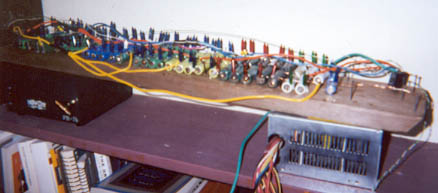
| Below, we see a Nickel-Metal-Hydride-battery dudfarm. Panasonic cells appear to be the stellar performers, in terms of energy storage density. A timer is set to charge the cells from midnight to noon. Then a relay drops out, sending the cells discharging. Each cell connects through an incandescant lamp. The lamp provides for current limiting and endurance indication. Shorted cells are indicated by overly intense charge indication. The best cells keep bulbs glowing well into the night. |
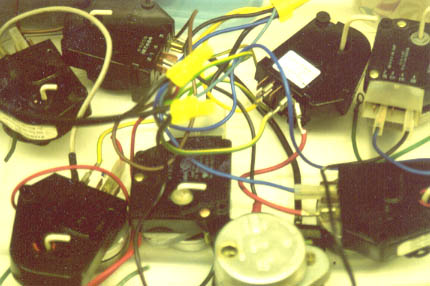
| Below, we see a defrost-timer dud-farm. A bent wire indicates cam-shaft position. Timers with frozen motors are weeded out first. Then some of the timers won't make the complete revolution. This test is performed in the refrigerator, to simulate actual operating conditions. |
| The five-volt high-amperage output of a computer power supply is used to drive charging. Requiring 2.5 volts each, two symmetrical battery-banks are placed in series, with a common midpoint buss. Each bank features a 20-amp relay to select between charging and discharging. The 12 volt relay-coils energize from a 12 volt output on the computer power supply. The timer interrupts primary power. |
| The colored Christmas lights were replaced with clear in the second revision. A vertical format was also adopted, for the reduced footprint. |
| Tip: The sulphur candle flame emits white smoke when ammonia is present (pg. 82, 69). |