


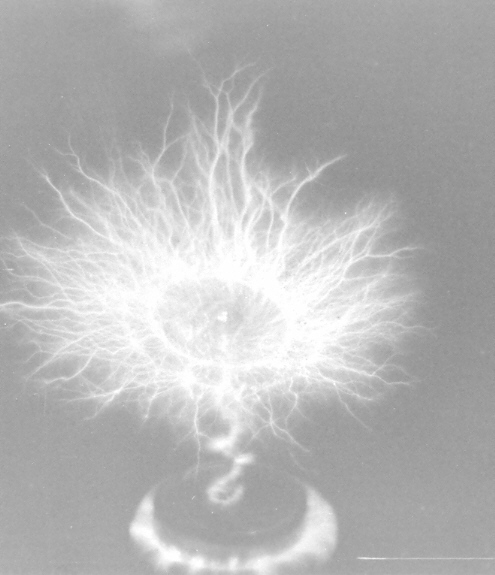
I found a 7.5 KV 120 MA neon transformer and had endless fun with it. I wired an old Bendix radio control-panel so it controlled everything in my room (I had half the garage). My dad insisted on personally unpluging the place each night at bed-time. The panel lit up red. One switch controlled a Jacob's Ladder built into the wall. As the arc arose, it hit a wire leading to a neon "S" which lit momentarily. I'd used Romex for connecting wire. Watched closely, the Romex insulation never failed, which amazed me no end.
Some of the older neighborhood kids discovered capacitors blasted with application of 115 VAC. They fashioned a long cord with clips and put on a show at the local elementary school. My capacitor stash never fully recovered.
One of the guys made a carbon arc that ran off of 115 VAC through a nicrome wire resistor on a porcelain insulator in a jug of water. I did one too, mine had a parabolic reflector given me by my scoutmaster. I could focus it and burn a hole in paper a foot away. That was one beefy spotlight. It was kind of hazardous though.
I had tree-forts in every tree that would hold one up. My dad got me a roll of zip-cord for an intercom connection to Gary Keyes' house three houses down. Later I used the wire to power a spotlight in my back treefort from a transformer in the garage. That was another beefy spotlight.
Someone told me a cool trick to do with TVs. Jeff Murch pioneered the method. Although I never met him
I enjoyed it no end, actually selling them as fast as I made them. Called the wacky-joe it resembles an oscilliscope view of music. All you do is pull the existing yoke off of the picture tube neck while leaving it electrically connected (caution it floats at high voltage RF potential). Then you slip another yoke onto the picture tube neck. This one connects to an adjustable AC source and an audio power amp output. With no music, you see a horizontal line of adjustable width. Cranking up the music makes lissajous figures. I did stereo models too. They were more difficult because the beam needed to be gated off in absence of drive (to prevent discoloration of the phosphor at the center of the screen). They were cooler because they would surprise the unsuspecting with activation of music. I dug further and commandeered the vertical amp in one Zenith to make a roughly self sufficient unit. It lacked the poop needed for good low end response though. I also used the stock video amp for beam-gating on that one. I think I had five units in the field by the end of the fad.
Lasers were my next big fad. I ran one off of a black and white TV anode supply. Then I did a big switching-mode binge. I had everyone in my circle of friends rigged up with one by the end of that fad. The artistic capacity of laser light is stunning. Everyone was doing ad-hoc light shows, even my mom.
Later I aced a TV teck interview by fixing a TV like the one I'd modified extensively. I noticed that the commutating cap in the raw supply doubler had a broken lead inside 30 seconds; to be hired on the spot.