 |
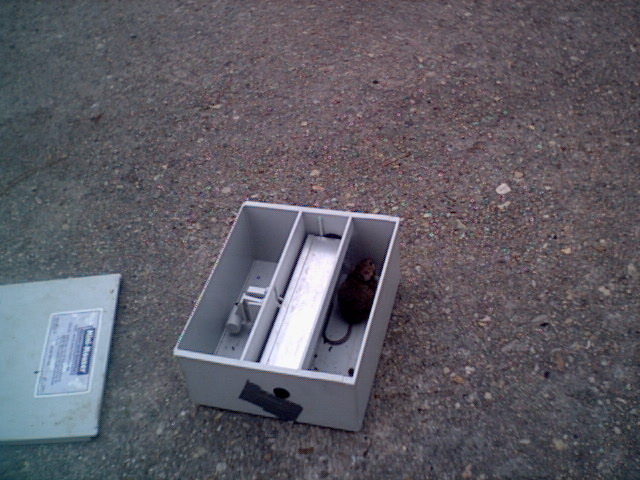
| This photo shows a mouse that I caught in a special trap that catches mice alive. |
| photo by Jeff Opal, taken in May of 2002 |
| This trap is one that bought from a company Kness MFG Co. Inc, located in Albia, Iowa, USA. I keep it under the sink in my kitchen. There are two entrance-holes mice can crawl into. The dark piece of tape visible is covering one of the two entrance holes. I cover up one so that I can put a small bit of tasty food (serving as bait -- usually a pellet of dry dog food) inside the trap (by dropping it in) so that it will rest near the taped-over door. Mice then can reach the pellet only by entering the other door, and crossing over to the taped-over door. When they do that, they inevitably step on a pad that triggers the 3-bladed paddle to turn 1/3rd of a turn. When the paddle thus turns, the mouse is gently wacked into the holding area (where this terrified mouse is). When the paddle-blade mechanism is fully wound-up, the paddle is capable of around nine "swats". I release the mice around 30 meters away from my apartment. Children love to watch me do this! The company literature says that it was founded by a man who was a janitor for an elementary school that was infested with mice. He made a live-catch trap, and it worked so well he patented it's design and began making them and selling them. The trap cost me around $20, and I had to get it via snail-mail (as far as I know, no stores near me carry any live-catch mouse traps). Why do I catch them alive? Because it seems to be to be the right thing to do, given that I might have been born a mouse rather than a human being. That is, I believe that the reincarnation theory of the afterlife is true, and, that I can't say for certain that my now being a human being wasn't due to pure luck. I believe that we humans should regard the enormous advantages provided to us by our powerful brains as a gift we did little or nothing to deserve. We shouldn't misuse our great brain powers, apparently provided by luck, in ways that cause unnecessary suffering to other creatures capable of feeling pain. |
| To-date I've been catching mice with this trap for around 20 months. Out of curiosity, I've maintained a written list, on my kitchen wall, of every catch, giving the date, the size of the mouse, how many were in the trap (around once out of 20 catches more than one has been caught). So far the list shows that I've caught 62 mice. Sometimes the mouse is dead. This is always caused by the mouse being caught part way inside the opened entrance. I'm unsure about why this happens. It doesn't make sense that it would happen because I can see no way that the trigger-pad could be pressed when the mouse is partly inside the open-entrance. Perhaps it happens when another, much smaller mouse is fully inside the open-entrance, while a bigger one is only partly inside. The smaller one then steps on the trigger pad, which causes the bigger one to be wedged-caught. The smaller one is so small that it is a able to escape through the entrance that is partly-blocked by the larger, less-fortunate one. This would explain both how the trigger-pad gets pressed, and why I find only one mouse rather than two. SometimesI find that a mouse is wedged between a blade and and edge of the open-entrance, and that the mouse is still alive. I've discovered that I can easily free such a mouse simply by wiggling the paddle-blade gently for around 30 seconds. The mouse then can struggle free. Recently I was amazed to see how one of these mice (one released this awkward way) behaved after it pulled itself out. It stood in the holding bay and calmly began grooming itself !! Apparently, it sensed that I wished to help it, and to not harm it in any way, so it felt safe grooming itself. I've had to be careful to release the mice when no cats are nearby. Once I forgot to look for a cat, and when the mouse jumped out and ran for cover it was quickly caught and eaten by the cat! Almost always I don't have to peek inside the trap to see whether or not a mouse is inside. Almost always, all I have to do is walk near the trap. Any mouse in the trap is usually so frightened that when they hear my footsteps they panic and frantically try to escape out of the trap (usually by nibbling away some of the trap's plastic). I then can hear the noise the terrified mouse is making. Then I peek inside the trap, to make sure one is really inside. When I find one, I usually wait until some children are around to see me release it. |