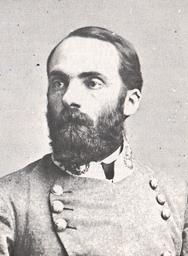
� � � Date of Birth: Sept. 10, 1836.
� � � Birthplace: Augusta, Ga..
� � � U.S. Military Academy: Class of 1859 (19/22) Dragoons-Mounted Rifles.
� � � Pre-War Experience: frontier duty, resigned from the U.S. Army on April 22, 1861.
� � � Rank: 1st Lieutenant Colonel, Colonel - 19th Alabama, Brig. General, Major General.
� � � Major Battles and Campaigns: Shiloh (19th Alabama); numerous cavalry raids, Perryville, Stones River, Knoxville, Chattanooga, Atlanta Campaign, "March to the Sea," Carolinas Campaign (commanded the cavalry of the Army of Tennessee from July 1862 until replaced by W. Hampton during the Carolinas Campaign), captured in May 1865.
� � � Post-War achievements: merchant, U.S. Congressman from Alabama (elected eight times), Major General of U.S. Volunteers in Spanish-American War, writer.
� � � Date of death: Jan. 25, 1906.
� � � Place of burial: Arlington National Cemetery.
Joseph Wheeler (1836-1906), an 1859 graduate of the U.S. Military Academy, resigned from the Army to join the Confederate forces in 1861 and rose rapidly to the rank of lieutenant general. Nicknamed "Fighting Joe," Wheeler was considered by General Robert E. Lee to be one of the two most outstanding Confederate cavalry leaders and saw action in many campaigns, including the opposition to Sherman's advance on Atlanta. During the Civil War he was in more than 500 skirmishes, commanded in 127 full-scale battles, had 18 horses shot from under him, and lost 36 staff officers from his side.
 After the war he became a planter and a lawyer. He served in the U.S. House of Representatives during 1881-1882, 1883, and 1885-1900; there he strove to heal the breach between the North and the South and championed economic policies that would help the South.
Wheeler was the only Confederate general to attain the same rank later in the United States Army. Three decades after he commanded Confederate cavalry forces, he volunteered at
the outbreak of the Spanish-American War. Wheeler was appointed major general of volunteers by President McKinley, saw action as a cavalry commander in Cuba, and was a senior member of the peace commission. He later commanded a brigade in the Philippine Insurrection in 1899-1900, where he was commissioned a brigadier general in the U.S. Regular Army.
Wheeler was also the author of several books on military history and strategy and civil subjects. He died on January 25, 1906, and is buried in Arlington National Cemetery.
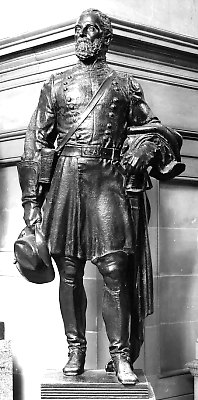
Alabama honored its beloved fighting man by placing his bust in Statuary Hall, Washington, D.C. The nation honored him in 1937 by naming the dam across the Tennessee River at Muscle Shoals for "the South's fightingest general."
Wheeler led 8,500 men during the Atlanta campaign, and had headed the Army of Tennessee's cavalry since the fall of 1862. He was energetic, aggressive, and resourceful; unfortunately, he also (like most Civil War cavalry leaders) was unable to exercise effective control over units not under his personal supervision and had a penchant for exaggerating his successes and minimizing or concealing his failures. Nevertheless he gave Johnston's army what Sherman's lacked - a capable, experienced commander for its horsemen, who throughout the campaign would more than hold their own against the Union troopers.