|
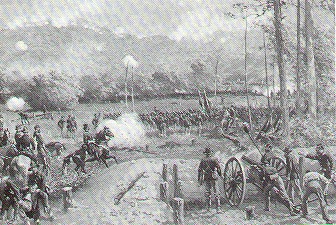
While Lieutenant General Ulysses S. Grant was trying to destroy Lee's army in the war's Eastern theater in 1864, Sherman was trying to destroy General Joseph E. Johnston's in Georgia and capture Atlanta. Beginning in May, Sherman tried several flanking movements before he became entangled in battles northwest of Atlanta, at Dallas, New Hope Church, and Pickett's Mill. Shifting northeast to Acworth, he eventually found Johnston's men entrenched along the Kennesaw Mountain line, which consisted of Kennesaw Mountain, Little Kennesaw Mountain, and Pigeon Hill. Perhaps impatient with his lack of progress against his enemy, or believing his men needed the battle discipline of an attacking maneuver, Sherman decided on a massive frontal assault on the entrenched enemy, rarely a successful tactic. Sherman believed Johnston's line was thin and vulnerable, so he planned several diversionary tactics at all three points along the Kennesaw Mountain line. His main thrust targeted the center of the line at a salient later called Cheatham Hill, or the "Dead Angle." On the morning of June 27, after the Union army's artillery blasted away at the Confederate entrenchments, Sherman sent his men into battle. The fiercest fighting was on Cheatham Hill, where 8,000 men from two infantry divisions, formed close-packed "human battering rams" to puncture the Confederate line. The Union men faced destructive, deadly fire as they made their way to the salient, only to fall back and attack again. They were defeated in hand-to-hand combat in front of the Confederate trenches. As the day ended, Sherman had the worst defeat of the Atlanta Campaign on his hands, with 3,000 casualties compared to 500 on the Confederate side. A diversionary tactic that allowed the Union army to flank the Confederate left was "all the real gain of the day," Sherman later wrote. He resumed his flanking maneuvers, and Johnston was forced to fall back from the Kennesaw Mountain line. To tour this historic ground, go first to the visitor center, which will orient you to the park with an audiovisual program, exhibits, and maps. A bookstore has several good guidebooks, including one prepared by the Kennesaw Mountain Historical Association. The visitor center is located on part of the battlefield where the 66th Illinois Infantry swept across a field and engaged the 26th and 1st Alabama in the woods at the foot of the mountain. From here, you can choose to hike one of several trails on the battlefield ranging from 2 to 16 miles roundtrip. (Local athletes use park trails to train for road races and triathlons.) A one-mile trail behind the center takes you to the top of Kennesaw Mountain, where on a clear day you can see Atlanta and much of the terrain of this part of the Atlanta Campaign. Climbing to the top, you can only imagine what it must have been like to wear a uniform and carry a heavy gun up the steep slopes on a hot, humid Georgia day. The park frequently has excellent living history demonstrations. Ask for a schedule at the visitor center. The last time I walked the trail up the mountain, I was halfway up and lost in my thoughts when living history interpreters fired a lound cannon, nearly causing me to jump off the trail into some historic entrenchments. I can barely imagine what it must have been like for Confederate Major General Samuel G. French, whose division defended Little Kennesaw and Pigeon Hill, when he witnessed the Union attack from near the top of the mountain: "We sat there perhaps an hour, enjoying a birds-eye view of one of the most magnificent sights ever allotted to man, to look down upon a hundred and fifty thousand men arrayed in the strife of battle below. 'Twere worth ten years of peaceful life, one glance at their array!" You can hike the trail to Pigeon Hill, approximately one mile from the summit, view entrenchments there, and continue two more miles to Cheatham Hill, the scene of the fiercest fighting. You can also drive to Cheatham Hill with directions from the visitor center. If you tour the park, Cheatham Hill is a must-see stop. Here you find the Illinois Monument, dedicated by Union survivors exactly 50 years after the battle, at the spot where they faced off with Tennesseeans under Major General Benjamin Franklin Cheatham and lost. In 30 minutes of fighting, the Federals sustained 1,800 casualties in what veterans called the toughest single battle they fought in the entire Civil War. Cheatham Hill also has some excellently preserved entrenchments and a tunnel monument preserving the entrance where Union infantry, trapped in a blind spot for six days, attempted to dig under earthworks to blow up their enemy with a mine. The monument is to the left of the Illinois Monument's stone steps. A footpath leads downhill and across the field where the Union troops charged the Confederates. Walking this path may help you imagine what it must have been like to attack an entrenched enemy on high ground. A short drive from Cheatham Hill is Kolb's Farm, an 1836 log house that witnessed Confederate Lieutenant General John Bell Hood's ill-conceived attack on the men and artillery of Union Major Generals Joseph Hooker and John Schofield on June 22, 1864. The cabin is closed to the public, but historical markers nearby explain the action and significance of what happened here. A few miles from the Kennesaw Mountain National Battlefield Park, near downtown Marietta, is the Marietta Welcome Center, located in a train depot built after the Civil War. Available here is an excellent driving tour of Marietta, with 52 sites, including some antebellum homes used as officers' headquarters during the Civil War...Next door to the welcome center is the historic Kennesaw House, the spot where Union spy James Andrews and his 24 raiders plotted to steal the locomotive General, thus beginning the legendary "Great Locomotive Chase." Today the building houses a restaurant and offices. Using the welcome center map, you can find in Marietta two of the three largest Civil War cemeteries in Georgia, including the beautiful 24-acre Marietta National Cemetery, which contains the remains of 10,000 Union soldiers who lost their lives in Georgia battles south of Resaca. The land was donated by a local man who wanted to integrate and honor Union and Confederate soldiers in one cemetery. Locals decided instead to bury the Confederate dead--3,000 soldiers from 14 states--in a separate cemetery less than a mile away. A cannon on the Confederate cemetery grounds was used by cadets at the Georgia Military Institute, across Powder Springs Road. Confederates had used the college campus for training, so Sherman's troops burned it. The cannon, which the cadets used against the Federals, was seized when Savannah fell. Sherman sent it north as a trophy of war, but it was returned in 1910. Approximately 10 miles from Marietta is a state-run site well worth your time: Pickett's Mill State Historic Park. Considered by some experts to be one of the best-preserved Civil War battlefields in the country, the 765-acre Pickett's Mill park tells the story of another Confederate victory during the Atlanta Campaign. On May 27, 1864, approximately 14,000 Federal troops tried to flank the Confederate line here, a maneuver anticipated and squashed by 10,000 troops under Confederate Major General Patrick R. Cleburne. In ill-timed and poorly directed attacks, the Federals got confused in the dense forests and deep ravines of the battlefield. The Confederates, on top of a ravine, poured murderous fire on advancing Yankees, with deadly results. A Confederate captain reported that he witnessed "50 dead men within 30 feet of me. A great number of them have their skulls bursted open and their brains running out." The Union lost 1,600 men, the Confederates, 500. Sherman neglected to mention the battle in his official report and memoirs, perhaps out of embarrassment. But stung by this defeat and another at New Hope Church, he moved his army back to the railroad at Acworth, setting the stage for the Battle of Kennesaw Mountain. Pickett's Mill is a favorite among local Civil War enthusiasts. You have a choice of three self-guided tours of various length through the battlefield, which is superbly intact, even lacking the battlefield monuments that dot many Civil War parks. You can view entrenchments from the battle and quickly understand a soldier's confusion in the terrain and the terror of being forced to charge up a steep ravine while "Rebel fire swept the ground like a hailstorm." An excellent museum and visitor center features a 17-minute video explaining the battle to novices. Don't miss the interactive computer simulation, which tests your skills in the heat of battle... For a taste of genuine Civil War Georgia, take Highway 120 east from Marietta to Roswell, which bills itself as "The Real Old South." In historic downtown Roswell, find the visitor center, where there are maps to several attractions preserved since the Civil War, when Roswell was a New England-style village centered around the textile mills of the Roswell Manufacturing Company. The most important is Bulloch Hall, one of the most significant houses in Georgia. This Greek Revival mansion, built in 1840 and home of President Theodore Roosevelt's mother, Mittie Bulloch, has the Gone With the Wind feel that many visitors seem to be looking for when they visit the state. (Author Margaret Mitchell, working as a reporter for the Atlanta Constitution, wrote about the house in 1923.) Roosevelt's parents were married in the house. Mittie Bulloch's other son was the father of Eleanor Roosevelt, who married her fifth cousin, President Franklin D. Roosevelt. Built with beautiful heart of pine, the foursquare house is one of the South's few examples of true temple-form architecture, with full pedimented portico, and features 11 fireplaces and a complete kitchen with a beehive oven. On the second floor is a one-room Civil War museum and a gift shop. Bulloch Hall was occupied by Union troops during Sherman's military "tour of homes" in Georgia in 1864. After Confederates retreated from Kennesaw Mountain, they occupied a line in front of the Chattahoochee River. Sherman sought a way to cross the Chattahoochee around Johnston and sent cavalry to Roswell on July 5, 1864. They occupied the town and fought a short battle at the river. Eventually, some 36,000 Union troops under Major General James B. McPherson, on their way to the Battle of Atlanta, crossed on bridges built by Union engineers. Our next stop is the finest Civil War exhibit in Georgia: the Atlanta History Center. The center consists of several attractions on 33 acres, including the new 30,000-square-foot Atlanta History Museum, the Tullie Smith Farm House, the Swan House and McElreath Hall, which contains a research library and archives. At the Museum, a new 9,200-square-foot Civil War exhibit titled "Turning Point: The American Civil War" is opening June 22 (1996), featuring a wide variety of fine artifacts from Georgia and other areas touched by the Civil War. More than 1,200 items will be on display, including the Confederate flag that flew over Atlanta when Federal forces captured the city... The next two attractions I'm recommending are well-known to Civil War buffs, but worth a second look if you've toured the state previously. Stone Mountain, east of Atlanta on Highway 78, features the world's largest carving (yes, larger than Mount Rushmore), a memorial to three heroes of the Confederacy: President Jefferson Davis, General Robert E. Lee, and Lieutenant General Thomas J. "Stonewall" Jackson. From conception to finishing touches, it took three main carvers 57 years to complete it. Originally the plan ambitiously called for a carving to circle the entire 825-foot granite mountain. At Stone Mountain's 3,200-acre park, you can tour the newly renovated Memorial Hall...The museum contains a fine collection of Civil War artifacts and exhibits. You also can visit Confederate Hall, where a large diorama identifies the sites of military events in Georgia. Exhibits and statues highlight other historical events. From here, you can hike up the mountain and get a great view of Atlanta. An authentic antebellum plantation complex consisting of 19 restored buildings open to visitors encapsulates the agricultural history of Georgia. Stone Mountain is also the site of $20 million of new construction for Olympic tennis, archery, and cycling facilities. Located near downtown Atlanta in Grant Park is the Atlanta Cyclorama, which houses what is considered the world's largest painting, at 9,000 pounds, 42 feet high, and 358 feet long. It is one of two intact cycloramas in the world (the other is at Gettysburg National Military Park). The painting depicts the pivotal Battle of Atlanta, which raged a few miles away from Grant Park in an area that has been converted by development. Set in a circular auditorium and supplemented with three-dimensional figures, the painting is the focus of a sound-and-light program that aptly tells the story of the battle. The two-story museum that houses the painting features many excellent exhibits. In February 1996, an anonymous donor gave $1 million to the Cyclorama to fund renovation work that will be completed before the Olympics. The bookstore has an excellent collection of Civil War books. Outside the Cyclorama, a short walk to the southeastern corner of the park at Boulevard and Atlanta Avenue will take you to the earthen remains of Fort Walker, one of the few remaining portions of the earthworks that encircled Atlanta. The fort marked the southeastern corner of the fortifications built by the park's namesake, Lemuel Grant. Though Atlanta's developmentminded civic leaders have razed and bulldozed much of the city's history, these protected sites remain to remind us of the value of historic preservation. Much more remain in jeopardy as Atlanta and Georgia continue to boom, bringing jobs to the New South, but endangering the historical resources that have made the region so distinctive, fascinating, and attractive in the first place.
| |||||||