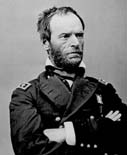
Date of birth: Feb. 8, 1820.
Birthplace: Lancaster, Ohio.
U.S. Military Academy: Class of 1840 (6/42) Artillery.
Pre-war experience: routine frontier and garrison duty, resigned from U.S. Army in 1853, banker, lawyer, school superintendent.
Rank: Colonel - 13th U.S. Infantry, Brig. General, Major General.
Major Battles and Campaigns: First Manassas (3rd Brigade); Shiloh - wounded (5th Division, Army of the Tennessee); Chickasaw Bluffs, Arkansas Post; Vicksburg (XV Corps), Chattanooga (Department of the Tennessee); Atlanta Campaign, "March to the Sea," Carolinas Campaign, surrender of J.E. Johnston (Military Division of the Mississippi).
Post-war achievements: Commander-in-Chief of the Army 1869-1883, speaker.
Date of death: Feb. 14, 1891.
Place of burial: Calvary Cemetery, St. Louis, Missouri.
� � � If the question was asked, "Who was and still is the most hated and despised man in the history of Georgia" the response would be William Tecumseh Sherman. From the onset of hostilities in the Atlanta Campaign in May, 1864 and the March to the Sea ending two days before Christmas 1864 with him capturing Savannah, no one created more destruction. As a result of his successful campaign in Georgia, the Confederacy was split in two and deprived of much needed supplies, ending the war quickly with a Union victory. (ng)
� � � To conduct the campaign against Johnston and Atlanta, Ulysses S. Grant--newly appointed on March 9, 1864, in command of all Union armies-- chose Major General William Tecumseh Sherman. His choice was based on friendship, not on Sherman's generalship. So far than had not been impressive. Early in the war, while commanding in Kentucky and Missouri, Sherman has so greatly exaggerated the strength of and danger from the enemy that he had suffered a nervous breakdown and had to be relieved. Returned to duty, he went to the opposite extreme by denying that the Confederates posed any threat at all, with the result that he was primarily to blame for the surprise and near destruction of Grant's army at Shiloh. In December 1862 his assault at Chickasaw Bluffs in Mississippi failed terribly, and during the subsequent Vicksburg campaign, although he ably did all that Grant told him to do, in truth he did not have to do very much. Assigned by Grant the starring role in the Battle of Chattanooga, his performance was so inept that only an impromptu attack by the troops of Major General George H. Thomas's Army of the Cumberland saved Grant from defeat and gave him victory. (Castel 5)
� � � In the spring of 1864, Sherman was made supreme commander of the armies in the West and was ordered by Grant to "create havoc and destruction of all resources that would be beneficial to the enemy." With a grand aggregate of 98,797 troops and 254 cannons, on May 4, 1864, Sherman began the Atlanta Campaign. (ng)
� � � Despite his lackluster record, Grant deemed Sherman to be the best man to command in the West while he himself commanded in the East. He admired Sherman's brilliant intellect, boundless energy, and persistent enterprise. Above all he knew that Sherman was totally devoted to him personally and so could be trusted to make every effort to assist him in defeating the Confederacy in 1864. (Castel 5,6)
� � � The red-haired Ohioan found fierce resistance from the Confederate troops under Joe Johnston. Johnston held off the troops of McPherson at Resaca, but then had to withdraw after the battle when federal troops were endangering his position by outflanking him, a tactic often used by Sherman. The strength of the Union army and the ability to supply themselves was too much for Johnston's struggling forces. Johnston defeated Sherman's armies at the battle of Kennesaw Mountain on June 27, 1864, but once again had to move his troops back southward to Smyrna due to the numbers of troops at Sherman's disposal. (ng)
� � � Jefferson Davis, President of the Confederacy, had little faith in Johnston's ability to oppose Sherman and on July 17, 1864, Davis relieves Johnston of his command and replaced him with the aggressive John B. Hood. Hood was even more unsuccessful in stopping Sherman's armies. Finally on September 1, 1864, Sherman's troops captured the city of Atlanta, but not before Hood destroyed the railroad yards. (ng)
� � � Sherman declared Atlanta to be a military encampment and ordered the civilians to leave the city. He made arrangements with Hood for safe passage of these civilians, that because of where they lived, no matter if they had Confederate or Union sympathies, they could not remain in their homes if they were within the city of Atlanta. From September to November, Sherman's forces were on the defensive guarding the city. Hood tried several unsuccessful attacks but his efforts were futile. Hood then began marching northward, hoping to destroy Sherman's supply line. Sherman made the statement, "If he continues to march North, all the way to the Ohio, I will supply him with rations." (ng)
� � � In November 1864, Sherman began his infamous March to the Sea. Prior to leaving Atlanta, he set fire to munitions factories, railroad yards, clothing mills, and other targets that could be resourceful to the Confederacy. Sherman never intended to burn the whole city, but the fire got out of hand and spread throughout the city. With the four Corps in two columns, Sherman cut a swath 60 miles wide marching towards Savannah, destroying anything that could aid or be resourceful to the enemy. On December 23, 1864, Sherman sent a telegram to Lincoln stating that he was presenting him the city of Savannah as a Christmas gift. (ng)
� � � Following his victory at Savannah, Sherman's troops battled the troops of General Joe Johnston through South Carolina and North Carolina. Lee surrendered to Grant on April 9, 1865 and General Joe Johnston surrendered to Sherman on April 17, 1865 at Raleigh, North Carolina. (ng)
� � � After the war, Sherman was commissioned Lieutenant General in the regular army, and after Grant was elected was promoted to the grade of full general and given command of the entire U. S Army. He retired in 1883. (ng)