"FLANKING IS PLAYED OUT"
Sherman tries to take Kennesaw
So it was that Sherman, declaring that "flanking is played out," on June 25 ordered Thomas and McPherson to "break through" Johnston's line with frontal assaults. Although both generals doubted that the attacks could succeed, both dutifully proceeded to carry them out. (Castel 28)
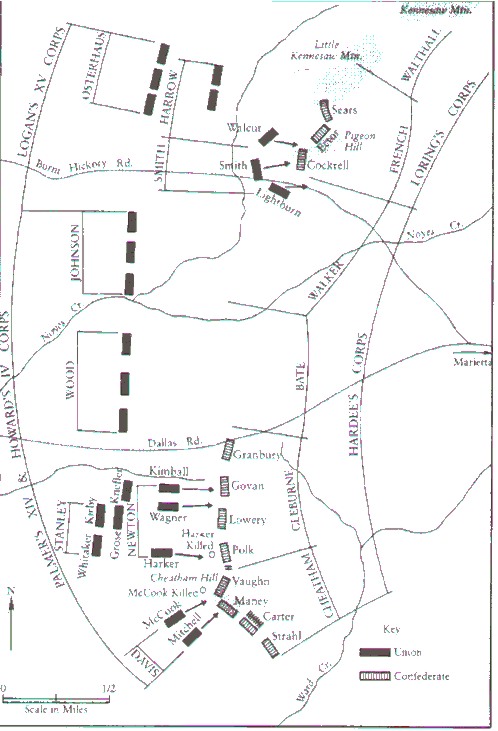 On the morning of June 27, following a furious but ineffective artillery bombardment, Brigadier General Morgan L. Smith's division of the XV Corps, which by now had been shifted to the west of Kennesaw, assailed the Confederate positions around Pigeon Hill while further to the south Brigadier General John C. Newton's division of the IV Corps and Brigadier General Jefferson C. Davis's division of the XIV Corps did the same against what had become Johnston's center. (Castel 28)
Smith's and Newton's troops, despite a determined effort, failed even to reach the Rebel works, and although a few of Davis's men, thanks to favorable terrain, managed to scale the enemy ramparts on what henceforth would be known as Cheatham's Hill (named after the commander of the Confederate troops who held the hill, Major General Benjamin F. Cheatham), they either were killed or captured and their surviving comrades forced to take cover just below the crest of the hill. (Castel 28-29)
It was all over in less than an hour, during which the Federals suffered nearly 3,000 casualties whereas the Confederate loss came to no more than 700 men, most of them pickets overrun in the initial Union rush. Such were the results of Sherman doing what he had told Halleck he would not do--"run head on" against fortifications. (Castel 29)
Sherman's first reaction to the repulse, which he attributed to his troops attacking with insufficient "vigor," was to ask Thomas, "Can you break any part of the enemy line today?" Politely but firmly Thomas answered in the negative. The only way, he added, that the Confederate works could be taken would be by a regular siege-style operation. Sherman, as Thomas doubtlessly expected, rejected this approach for it would prolong the stalemate indefinitely. (Castel 29)
 Thus Sherman found himself left with only one alternative--another flanking maneuver. But where? The answer came late that afternoon in a message from Schofield: Cox's division, working its way southward, had reached a point where it appeared that the Confederate line terminated. After requesting and receiving confirmation of this intelligence from Schofield, Sherman asked Thomas if he was willing to risk a large-scale attempt to turn Johnston's left. Thomas's reply was both prompt and blunt: "I think it decidedly better than butting against breastworks twelve feet thick and strongly abatized." ("Abatized" referred to abatis-sharpened stakes affixed in a crisscross fashion to logs which served the same defensive function as modern-day barbed wire.) (Castel 29)
Because Schofield's corps was too small and Thomas's forces already stretched to their safe limit, Sherman also had no choice except to employ McPherson's three corps for the turning movement, even though that would mean abandoning a direct connection with the railroad. (Ironically, when Thomas on June 23 proposed taking advantage of Hood's shift to the Confederates' left by having McPherson swing around their right, Sherman refused on the grounds that it would expose the railroad and his forward supply bases to enemy seizure. Had such a move been made, almost surely it would have led to Johnston's immediate retreat, as only a thin screen of infantry and Wheeler's cavalry guarded Kennesaw and Marietta from a Union thrust from the east.) (Castel 29-30)
Early on the morning of July 2 Morgan Smith's division of the XV corps left its trenches west of Pigeon Hill and headed down the Sandtown road, to be followed during the night by the rest of the XV Corps and XVI and XVII Corps. That same night Johnston, who long had anticipated precisely this movement and saw no way of countering it, evacuated his lines on and around Kennesaw and retreated southward through Marietta. At long last the way was open for Sherman's men to "swarm" along the Chattahoochee. (Castel 30)
Sherman in his official report stated �Failure as it was, and for which I assume the entire responsibility, I yet claim it produced good fruits, as it demonstrated to General Johnston that I would assault, and that boldly.� (ng)
Sources
� � � National Park Service
� � � Castel, Albert. "The Campaign for Atlanta," National Park Civil War Series,' published by Eastern National Park & Monument Association. 1996.
� � � ngeorgia.com