C.S.A. President Davis Reluctantly Appoints Johnston
If the South was to prevent losing, there were two places where it was absolutely essential to deny the North victory: Virginia and Georgia. Confederate President Jefferson Davis was confident that Lee could hold the Yankees at bay in Virginia, preventing them from taking Richmond, the capital of the Confederacy and the symbol of its independence. (Castel 3)
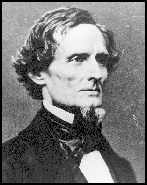 He lacked the same confidence in General Joseph E. Johnston, commander of the Confederate Army of Tennessee in north Georgia. He considered Johnston to be vain and selfish as a man and as a general more inclined to retreat than to fight, to defend rather than to attack, and so recalcitrant in implementing the wishes of the government with regard to military operations as to border on the insubordinate. Therefore, he had appointed Johnston to command the Army of Tennessee, following its debacle at Chattanooga in November 1863, most reluctantly and solely because no other general of the requisite rank was available who could be depended on to do better or even as well. He could only hope that Johnston, now that the fate of the Confederacy hung in the balance, would be more cooperative, more aggressive, and above all more successful that he hitherto had been. (Castel 3)
It would be a vain hope. Johnston's dislike and distrust of Davis matched, indeed exceeded, the president's dislike and distrust of the general. Johnston knew, too, that Davis had named him to head the Army of Tennessee out of necessity, not preference, and suspected that Davis would not be altogether unhappy should he fail in that post. Accordingly, although he would do his best, by his lights, to defend Georgia, as always he would take while doing so to preserve his public reputation for high military skill, a reputation that literally was more precious to him than life itself. (Castel 3)
How difficult it was for Davis and Johnston to work in harmony became evident from the start. Soon after Johnston took command of the Army of Tennessee at Dalton, Georgia, on December 27, 1863, he received a letter from the president urging him to attack and defeat the Federal army at Chattanooga, thereby forestalling an invasion of Georgia by delivering what in effect would be a pre-emptive strike. In theory it was a good plan but in fact utterly impracticable. As Johnston promptly and correctly pointed out in reply, the Army of Tennessee lacked the strength, supplies and transport to conduct a successful offensive. The only way it could reasonably hope to do so, Johnston argued, was to repel the Federals when they attacked, then launch a counterattack. To that end he asked that he be reinforced by Lieutenant General Leonidas Polk's army in Mississippi and Alabama. (Castel 3)
Davis, who had received contrary information from other sources, refused to believe Johnston's assessment of the Army of Tennessee's offensive capability. To him it seemed that Johnston was being his usual uncooperative and unaggressive self. Hence for the next four months he endeavored to persuade Johnston to go after the Yankees before the Yankees came after him. Just as persistently Johnston refused to do anything of the kind. Since Davis, for political reasons, dared not remove Johnston or order him to attack, by default Johnston's strategy for meeting and defeating the Union invasion of Georgia became the Confederate strategy. (Castel 3, 5)
Sources
� � � National Park Service
� � � Castel, Albert. "The Campaign for Atlanta," National Park Civil War Series,' published by Eastern National Park & Monument Association. 1996.