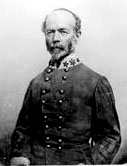
Date of birth: Feb. 3, 1807.
Birthplace: Farmville, Virginia.
U.S. Military Academy: Class of 1829 (13/46) Artillery.
Pre-war experience: Black Hawk and Seminole Wars, resigned from U.S. Army in 1837, civil engineer, re-enlisted as 1st Lt. in 1838, Mexican War - wounded five times, frontier duty in Texas and Kansas with engineers and cavalry, Utah Expedition, resigned from U.S. Army on April 22, 1861.
Rank: Brig. General, Full General.
Major Battles and Campaigns: First Manassas (Commander); Peninsular Campaign, Seven Pines - severely wounded (commanded Army of Northern Virginia, replaced by R.E. Lee); November 1862 named commander Department of the West - subordinates fought at Stones River, Vicksburg, Chickamauga and Chattanooga; Atlanta Campaign (commanded Army of Tennessee from December 1863-July 1864 until replaced by J.B. Hood); Carolinas Campaign (commanded the Army of Tennessee), surrendered to Sherman on April 26, 1865.
Post-war achievements: .Insurance businessman, U.S. Congressman from Virginia, railroad commissioner, writer
Date of death: March 21, 1891.
Place of burial: Green Mount Cemetery, Baltimore, Maryland.
Confederate general who never suffered a direct defeat during the American Civil War (1861-65). His military effectiveness, though, was hindered by a long-standing feud with Jefferson Davis.
A graduate of the U.S. Military Academy, West Point, N.Y.
(1829), Johnston resigned his commission at the outbreak of the
Civil War to offer his services to his native state of Virginia. Given the rank of brigadier general in the Confederate Army of the Shenandoah (May 1861), he was credited in July with the first
important Southern victory at the First Battle of Bull Run
(Manassas). He was promoted to general, but his dissatisfaction
with his seniority was the start of his lengthy differences with Davis, president of the Confederacy. When the Peninsular Campaign
began in April 1862, Johnston withdrew to defend the capital at
Richmond. Although objecting to the strategy prescribed by Davis,
he fought well against the Union forces. Severely wounded at the
Battle of Fair Oaks (Seven Pines) in May, he was replaced by
General Robert E. Lee.
A year later Johnston assumed control of Confederate forces in
Mississippi threatened by the Federal advance on Vicksburg. He
warned General John C. Pemberton to evacuate the city, but
President Davis counterordered Pemberton to hold it at all costs.
Lacking sufficient troops, Johnston could not relieve Pemberton,
and Vicksburg fell on July 4, 1863. Bitterly criticized, he nonetheless took command of the Army of the Tennessee in December as the combined armies of the North advanced toward Atlanta, Ga.
Subsequent events demonstrated the soundness of Johnston's
strategy of planned withdrawal to avoid a defeat by superior forces and the disintegration of the Confederate Army; nevertheless, Davis, dissatisfied with his failure to defeat the invaders, replaced him in July.
Restored to duty in February 1865, Johnston took command of his
old army, now in North Carolina, and succeeded in delaying the
advance of General William T. Sherman at Bentonville, in March.
But lack of men and supplies forced Johnston to order continued
withdrawal, and he surrendered to Sherman at Durham Station,
N.C., on April 26.
After the war, Johnston engaged in business ventures, wrote his
memoirs, served in the U.S. House of Representatives (1879-81),
and was named U.S. commissioner of railroads in 1885.