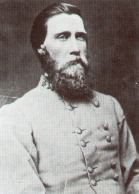
Date of birth: June 1, 1831.
Birthplace: Owingsville, Ky.
U.S. Military Academy: Class of 1853 (44/52) Infantry.
Pre-war experience: garrison and frontier duty, wounded in Indian fighting, resigned from U.S. Army on April 17, 1861.
Rank: 1st Lieutenant to Brig. General, Major General, Lt. General, Full General (temporary rank).
Major Battles and Campaigns: Peninsular Campaign , Second Manassas, Antietam (Texas Brigade); Fredericksburg, Gettysburg - wounded (Division, Longstreet's Corps); Chickamauga - wounded (commanded Longstreet's Corps plus three divisions); Atlanta Campaign, Franklin, Nashville (commanded Corps until July 1864 when he succeeded J.E. Johnston to command of the Army of the Tennessee); surrendered at Natchez, Mississippi in May 1865.
Post-war achievements: merchant.
Date of death: Aug. 30, 1879.
Place of burial: Metairie Cemetery, New Orleans, Louisiana.
Hood, who was only 32, compiled a brilliant combat record as a brigade and division commander in Lee's Army of Northern Virginia, and at Chickamauga his de facto corps's exploitation of a gap in the Union front produced the Confederate victory. (Castel 8)
His military success, however, had come at a high personal cost: at Gettysburg shrapnel paralyzed his left arm, at Chickamauga a bullet shattered his right thigh bone, necessitating amputation near the hip. As a result, he could not, despite an artificial leg, walk without the aid of crutches, and to ride he had to be strapped to his horse. Even so, his fighting spirit remained intact, and Johnston sought and welcomed his assignment to a corps command in the Army of Tennessee, calling it "my greatest comfort." He did not know that Hood had written Davis on April 13, 1864, deploring Johnston's failure to take the offensive: "When we are to be in a better condition to drive the enemy from out country I am not able to comprehend." (Castel 8)
Appointed to West Point by his congressman uncle. Hood reported on July 1,1849. He graduated forty-fifth in a class of fifty-five and was sent to the Fourth Infantry Regiment, stationed in California. Assigned to the Second Cavalry Regiment in Texas in 1855 with Lee and George Thomas. (AMC)
On April 16, 1861 Hood resigned from the Union Army and four days later was commissioned First Lieutenant in Confederate cavalry. He reported to Lee in Virginia who promoted him to Major. In October of the same year he was promoted to Colonel and given command of the Fourth Texas Regiment, Army of Northern Virginia. He was known for being aggressive in battle and again promoted to Brigadier General in March 1862 in command of the Texas Brigade. In October 1862 he received a promotion to Major General and given division command under Longstreet. (AMC)
Promoted to Lieutenant General by Davis February 2, 1864 with date of rank from September 20, 1863, the date he fell at Chickamauga. He reported later in the month to the to take command of Second Corps, Army of Tennessee and served under Johnston. (AMC)
In spite of General Robert E. Lee's objections and Braxton Bragg's less than flowing praise, Davis promoted Hood to Commander of the Army of the Tennessee on July 17, 1864. He attacked at Ezra Church, Lickskillet, Peachtree Creek, Legett's Mill, and Utoy Creek losing every battle and a third of his men. Moving his army north he began the disastrous Nashville Campaign with random attacks in North Georgia including an attack on Allatoona Pass. He lost major battles and numerous generals at Franklin and Nashville. In January of 1865 he requested to be relieved of duty. (ng)
His policy was taking the offensive at any cost; Hood brought his reduced army before the defenses of Nashville, where it was repulsed by General George H. Thomas on December 15-16 1864, in the most complete victory of the war. (AMC)
Although born in Kentucky, Hood had been greatly impressed by the Texans. During the war he was in command of a corps from
Texas. The song "Yellow Rose of Texas" was re-written by Hood's corps (Yellow Rose was a young lady of mixed ancestry who kept General Santa Anna "occupied" in his tent immediately before the battle of San Jacinto in the war for Texas Independence in 1836). The new words to the song were "The gallant Hood of Texas played hell in Tennessee." (ng)
After the war Hood took up residence in New Orleans where he failed in attempts to earn a living in the cotton and insurance industries. He visited Washington where he tried to sell his war stories; also unsuccessful. He married Anna Marie Hennen in April 1868. The couple had 13 children (three sets of twins) in eleven years of marriage. (AMC)
General John B. Hood died of Yellow Fever August 30, 1879.