 |
 |
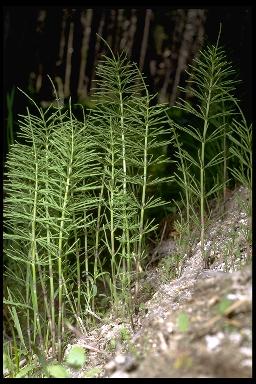
| Horsetails |
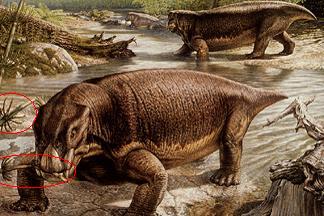
| Lystrosaurus with Horsetails (circled in red) |
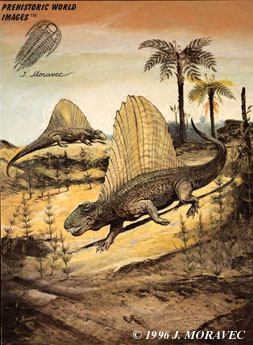
| Dimetrodon with Horsetails |
| Horsetails, This family of plants would grow above 10 meters, as tall as trees, during the Carboniferous period. There are about 35 known species of Horsetails in the world. These perennials (reoccuring year after year) are related to ferns. Synonyms: shavegrass, pewterwort, bottlebrush, horsetail rush, paddock-pipes, Dutch rushes, mare's tail Classification, Class: Equisetopsida Order: Equisetales, Family: Equisetaceae. Genus: Equisetum Ancestry, Flourishing on earth 200 million years ago, a fern-like plant growing into tall six foot leafless stalks, resembling Bamboo, was the prehistoric ancestor of Horsetail. |
 |
| A Horsetail is made of three basic parts: Fertile part ('flower' figurative), Sterile part (leaves), Rhizomes (roots). The Horsetail you see is like the tip of an iceberg, much of it lies below the surface. Fertile (reproductive) Resembling a thin asparagus shoot Appears in early Spring Whitish to light-brown �stalks� about 0.3 meters tall Yellowish to brownish cone (called a strobilus), 0.5 to 1.25 inch long (up to 4 mm) on top Cone bears yellow or pale-green spores (seeds), dies after spores have been produced Unbranched, hollow, cylindrical, jointed, and15-30 mm (6 to 12 inches) long. Each stem section (joint) is ridged, rough textured and surrounded by a short papery sheath (modified leaves) Sterile (after fertile) (vegetative) Can range from 15-60 mm (6 to 24 inches) tall Green shoots bearing whorls of pine-needle like branches Composed of slender, grooved, hollow joints. The middle and upper joints have 6 to 12 needle-like branches that are 5-10 mm (2 to 4 inches) long, jointed but not hollow. The leaves are modified into toothed sheaths that encircle the �stems� at the joints. Rhizomes Extensive tuber-bearing creeping root system The rhizomes are dark brown or blackish, 3-5 mm (1 to 2 inches) thick and covered with brownish hairs that give them a felt-like feel. The space between �shoots� is approximately 10-13 mm (4 to 5 inches) apart. Rhizomes spread many meters horizontally and descending to a depth of one meter or more in suitable soils. The �stems� of a sprawling tropical American species (E. giganteum) grows to more than 30 ft (9.1 m) in length. The horizontal rhizomes branch freely, produce numerous shoots and form rounded tubers about 1 mm (0.5 inch) in diameter either singly or in pairs. Tubers are primarily food storage organs but develop into new plants if removed from the rhizome. |
| Sterile Fertile |
 |
| back to Primeval Plants |
 |
| H. Vannoy Davis � California Academy of Science |