"Mattel Wheels"
New Hot Wheels packages are identified by the name "Mattel Wheels". Mattel merged with Tyco in April 1997, putting their Matchbox and Tyco radio-controlled toys under the name as well.
"It’s an umbrella name, but the cars will retain their brand names," Allison Duffy, production manager at Mattel Canada’s Mississauga office explains. "Matchbox will be authentic, detailed replicas, the kind of cars you’d seen on the street, and construction vehicles. Hot Wheels is about speed, attitude and performance." They’re still and inexpensive collectable. Originally priced at 59 cents in 1968, single cars sell for around a dollar today. "The original intent was to produce toys for children," Duffy says. "The children grew up and became collectors. Most people say that they started collecting four or five years ago. It’s nostalgia for the toys they had when they were young."
Jeep owners have another incentive to collect toy vehicles. Any jeep owner will tell you that they wish they could own one of every Jeep model - from Bantam to Dakar. As most people do not have the unlimited parking space or funds, one or two real size Jeeps is usually all they can own. Due to the many models of toy Jeeps available and the low starting price, collecting toy Jeeps allows for the expansion of the "Jeep Hobby" and creates a legitimate reason for driving a Jeep to the Mall. Unfortunately, finding authentically detailed Jeep toys is not as easy as it once used to be.
When American Motors was running the show, their marketing department knew full well the benefits of getting model Jeeps into the hands of America’s youth. To that end, they made it as simple as possible for companies such as Ravell to produce and market detailed replicas of Jeep vehicles. On several occasions, vehicles were given to the model company for use as patterns for model kits. When Chrysler took over the manufacture of Jeeps, they hired Hamilton Projects to handle the licensing of Jeep products and placed prohibitive royalty requirements on the production of any toy bearing the Jeep name. Companies must submit the product for approval, including prototypes, advertising, promotional, and business plans. What’s worse, is that they also require proof of product liability insurance, covering any such models.
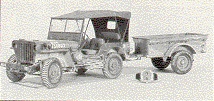
The above was well illustrated when Gary Kohs decided to market a highly detailed model of a WWII Jeep. Kohs sent a memo to the head office at Chrysler informing them of his plans to produce a limited production run of 250 units. Chrysler’s response: a cease and desist letter from their attorney! That is unless Kohs wanted to pay them a hefty royalty fee on each model sold – about 20-25% of the retail price! Kohs said, "OK, I’ll call it a GPW and the Jeep name won’t realize the exposure." Chrysler said they own the trademark for the grille design with the seven slats. Kohs said, "Fine, I’ll use the original WWII jeep grille which was in fact designed by Ford." As yet Chrysler’s attorney haven’t figured out how to swing at that curve ball. Automotive toys in general and models specifically present a very positive image, promote brand identity, and most importantly are one of the finest educational tools available. As far as the OEM is concerned, these models amount to a wealth of free advertising. As far as Kohs’ model is concerned, the finely crafted vehicle went on sale bearing the Ford nameplate.
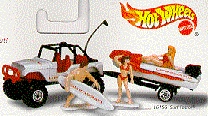
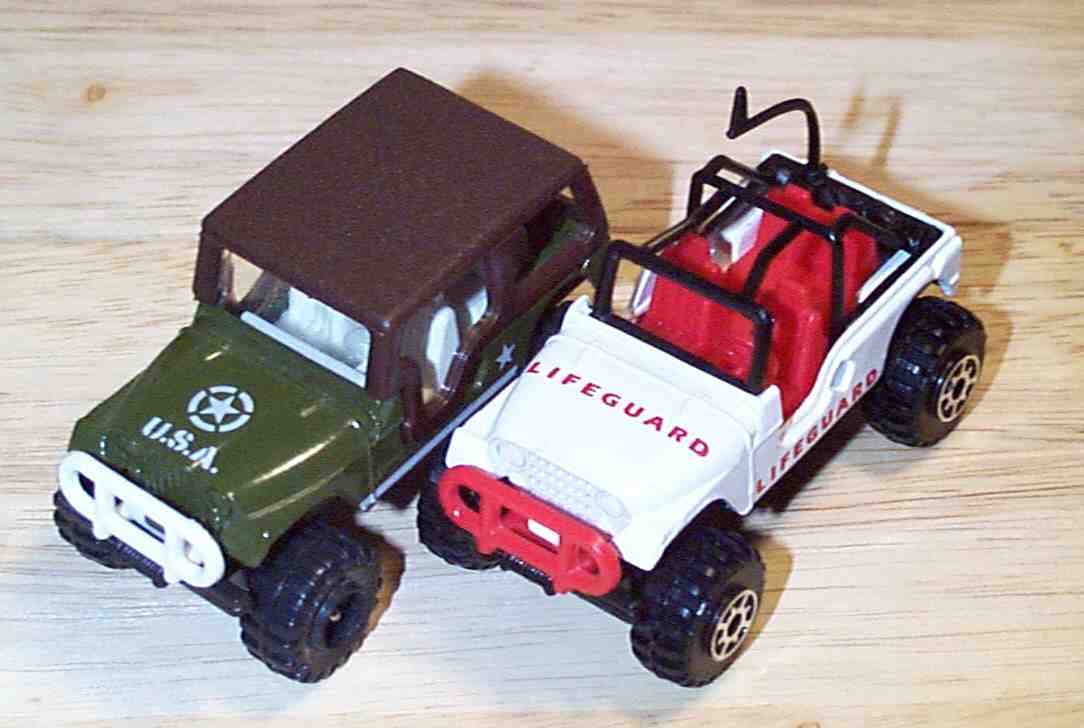
Another recent example of failed Chrysler marketing is the Hot Wheels "Surf Patrol" action set. With the purchase of Corgi, Mattel acquired the casting for the 1/64 scale CJ6 that was being produced at the time. As an aside, Corgi employees bought back the manufacturing of 1/32 scale models and continue to market a Jeep CJ5 in Golden Eagle trim. The CJ6 casting evolved from a regular wheeled hard topped model to a lifted, roll caged off-roader. As the photo on the back of the package shows (shown on left), Hot Wheels planned to produce the "Surf Patrol" set with the Jeep as they do not currently have an authentic Jeep in their lineup. When the set was finally released, it came with the Jeep, but the "Jeep" letters were removed from the body and the grille was hatched to remove resemblance to the trademarked Jeep slats (see photo on right).
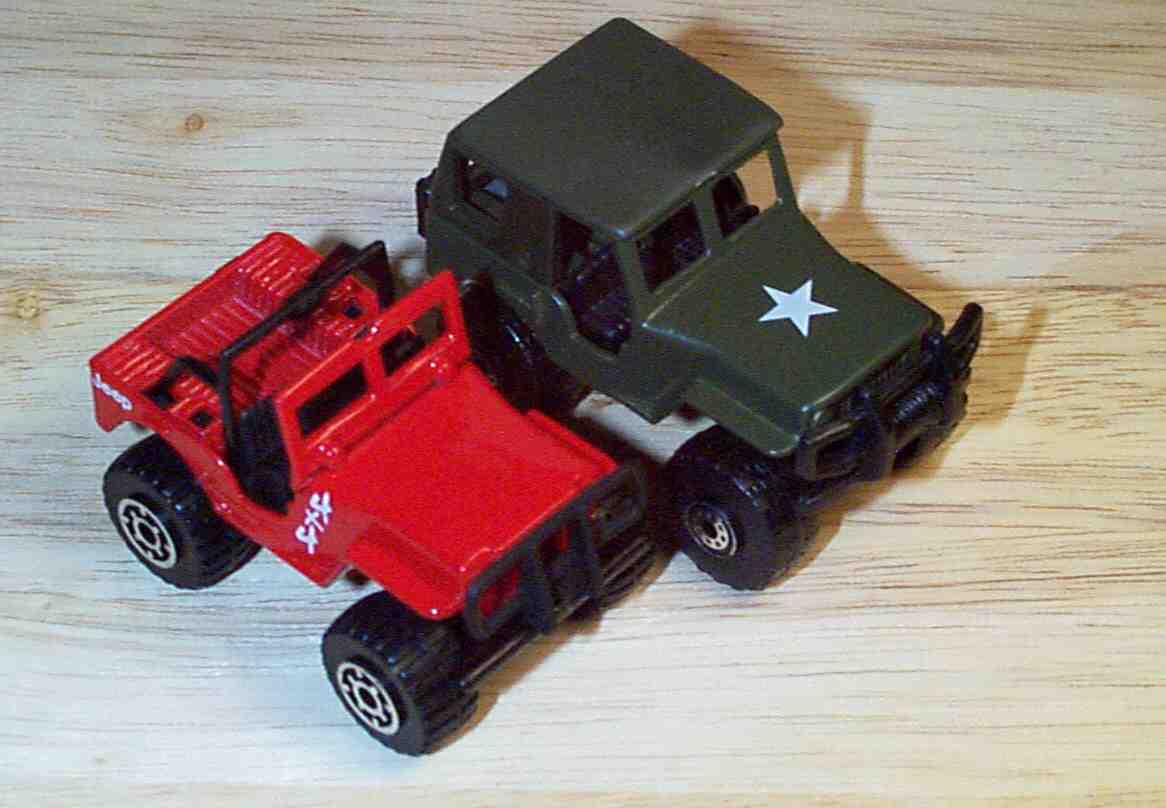
As Mattel incorporates its corporate strategy into the model lineup, Matchbox remains as a manufacturer of authentic 1/64 scale Jeep vehicles. The new models that are being released as "Mattel Wheels" are now starting to even have Chrysler’s name on the underside (red MB on left). Matchbox deserves a lot of credit for not abandoning the Jeep name hassles and releasing the models as "Fords", similar to what Maisto has done with their very similar casting, called a GP (green Jeep on right of photo). One can only guess that the "W" was dropped from GPW to remove any reference to Willys, the company that became the first owner of the Jeep trademark, after a battle with Ford and Bantam.
Thanks to Patrick Pellowski for locating the "Surf Patrol" set for me.
With information from "A License to Jeep" - Open Road, Spring 1996; "I'm a Jeep dealer, and I'm mad." - 4 Wheel Drive, July 1992; "Hot Wheels celebrates 30th anniversary of small-scale fun" - Toronto Star June 20, 1998.