Can't
Happen To Me?
That's What We Thought
The information on this web site has been substantiated by fact and independent Expert Witness evidence in an Australian Court of Law on the 22nd & 23rd of Sept 2005.
On the 31st March 2003, I was towing our caravan (motor home) with a 2001 XJ model Jeep Cherokee travelling East along the South Eastern Fwy in the Adelaide Hills, South Australia. The road and weather conditions were perfect and I estimate my speed was approximately 90kph (55mph) which is my normal towing practice.
Without warning, the vehicle appeared to pitch to the right followed by the caravan swaying violently. My attempts to stabilise the caravan using recommended corrective action had no effect. In the next sequence of events the Jeep suddenly veered to the left and it was then that I realised I had lost control of the situation. At this point of time, with the vehicle already in low gear, I applied the vehicle brakes and made the decision to aim the vehicle at the Armcor Safety Barrier adjacent to the left hand lane.
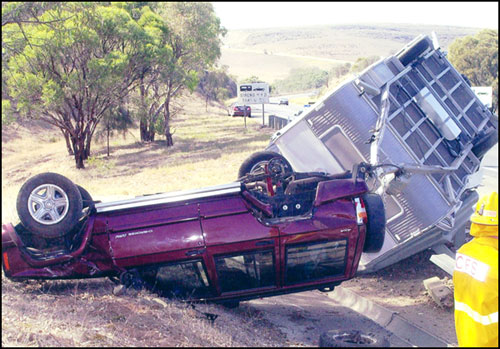
While in a sideways slide with forward momentum, the Jeep impacted the barrier and continued through a 180º roll to finish up on its roof. The caravan was whipped, side-on, into the safety barrier (as shown in the photo) with the rear of the caravan facing in the direction of original travel while the Jeep came to rest at 90º to this line.
Important Note: The detached wheel shown in this photo, was placed where it is shown by one of our rescuers who retrieved the wheel along with other brake component debris from the road.
The 1650kg mass of the loaded caravan was well within the maximum towing limit of 2268kg specified by the Jeep manual. At the time of purchase, my authorised Jeep Dealer prepared the vehicle for towing by replacing the differential oil with a synthetic lubricant, by fitting an approved heavy duty tow hitch, and by fitting a caravan electric brake controller. An after market 250kg rated Hayman Reece weight distribution kit completed the towing setup.
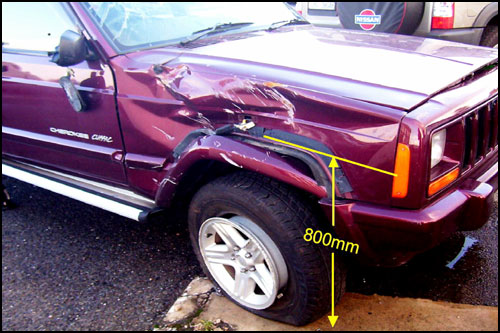
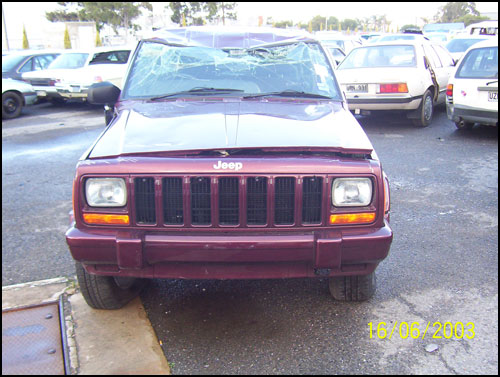
The relatively light damage to the Jeep Cherokee, clearly seen in these photos, plus the fact that the two air bags did not deploy, all confirm that the force of impact was not great. The closing speed at impact has been estmated as approximately 40 kph. The South Australian Police who attended the accident scene found no evidence of driver error or negligence. After assessing the damage, the attending Police suggested that the impact speed may have been even lower than first estimated.
Based on the physical and photographic evidence at the accident scene and my own extensive engineering experience, I had little doubt that the accident was most likely the consequence of an in-service failure of the rear axle. Subsequently, I compiled a detailed incident report which included all of the physical, photographic and expert witness evidence I had at the time. Given my very real concerns about potential issues of public safety, my report was sent, without prejudice or ill will, to Daimler Chrysler Australia/Pacific as a matter of urgency. The Daimler Chrysler response was to deny any liability for the axle failure.
Daimler Chrysler’s Evidence - As The Respondent:
Without ever having visited the accident scene Daimler Chrysler Australia/Pacific have simply ignored the physical and photographic evidence which was provided them and, without any dialogue asserted that: And I quote
verbatim.
"It is highly likely that the rear wheel of the Jeep impacted the concrete kerb or culvert which are normally present next to Armcor barriers around these locations, and this would have provided sufficient force to bend and fracture the axle "
"If the offset of the force on the wheel is assumed to be around 250mm, then the estimated force to cause permanent deformation and fracture for this material is in the order of 65kN…."
Ignoring all of the physical and photographic evidence of the crash scene, Daimler Chrysler’s highly credentialed professional Expert Witness concluded that, his engineering inspections, his engineering calculations and his laboratory testing all confirmed his hypothesis that side impactwas the most probable cause of the damage the axle suffered.
My Evidence-As The Applicant:
Evidence presented to the Court by my expert witnesses and me challenged the veracity and credibility of Daimler Chrysler’s "side impact" hypothesis.
All of the physical and photographic evidence recorded at the accident scene clearly showed that, given the line of action at the time of impact, any suggestion that the right hand side rear wheel side impacted with the kerb or culvert was physically impossible. Daimler Chrysler made no attempt to challenge this evidence.
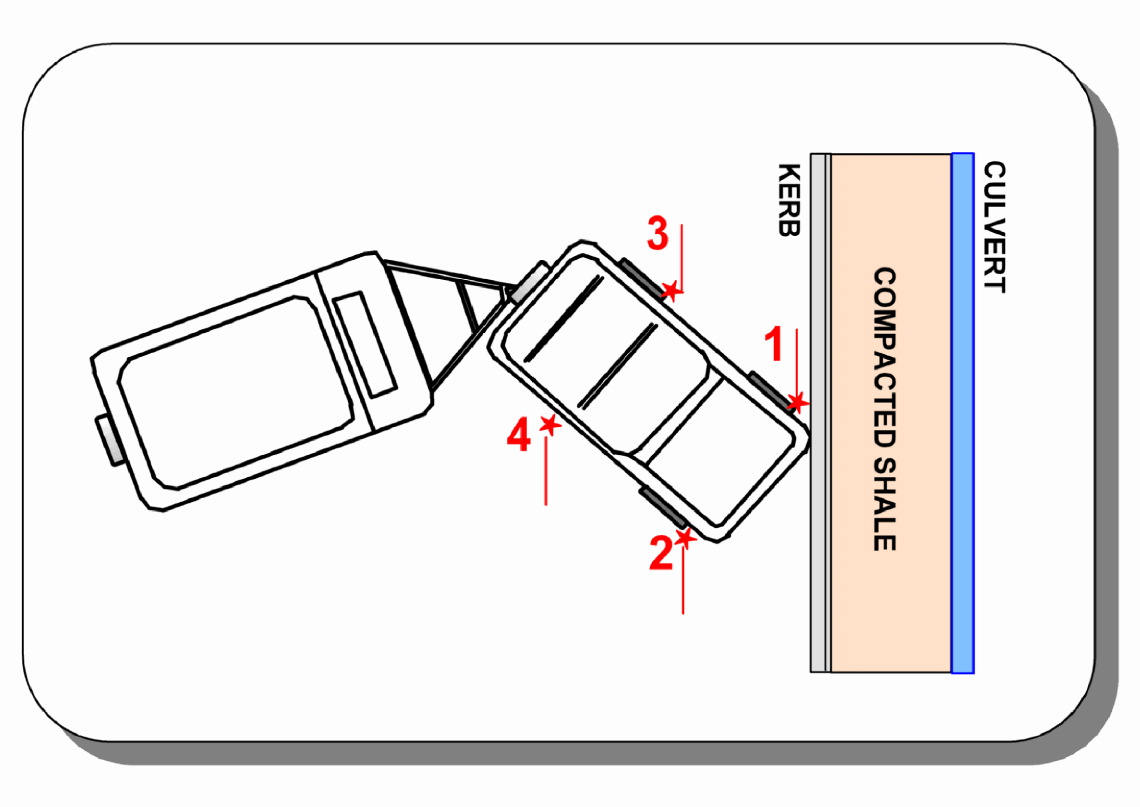
This diagram is an accurate reconstruction based on the
photographic evidence of both vehicle impact and tyre skid marks
Evidence was also presnted to the Court which showed that, while Daimler Chrysler Aust/Pacific actively promoted the XJ Jeep Cherokee as an excellent towing vehicle, Daimler Chrysler had done little, if anything, to redress issues critical to safe towing practice.
My Expert Witness Evidence:
My Engineering Expert Witness, Dr A. Kotousov, (PhD in Fracture Mechanics) a Senior Research Fellow and lecturer in Mechanical Engineering at the University of Adelaide School of Mechanical Engineering concluded his detailed evidence by stating;
" Consequently, the design strength of the axle is not enough to ensure the integrity of the axle and the safety of the vehicle under conditions similar to that which took place during the incident. "
" .....my professional qualifications and experience lead me to the conclusion that the axle failure of the Jeep Cherokee in question was likely to be an in-service failure and could occur well before the vehicle, or any part there of, impacted with external objects. ….”"
Australian NDT Services, a highly accredited company specialising in the investigation of component failures was engaged to conduct a series of Metallurgical investigations on the failed axle to establish a probable cause of failure. Mr Robert Burns, a very experienced and highly credentialed forensic metallurgist concluded his evidence by stating:
"The longitudinal surface indications detected during magnetic particle inspection were consistent with quench cracking or material seam. Both are considered undesirable metallurgical defects, which can contribute to failures."
"Possible contributing factors to the instantaneous fracture are overloading of the axle in-service or inadequate axle shaft design or specification. Large case depth on a small diameter part (as found on the failed axle) and the resultant high residual stress is an example of inadequate axle shaft design or specification."
During the course of the court hearing Dr Kotousov and I were able to convincingly expose much of the evidence offered by the Daimler Chrysler expert witness as being:
- In conflict with the physical and photographic evidence recorded at the accident scene.
- As being embellished by unsubstantiated assumptions,
- As being based on totally inappropriate scientific formulae.
- As being based on calculations made in error using input data proven to be incorrect.
- As being based on questionable, inappropriate and often incorrect engineering testing procedures.
As a result of cross examination during the course of court proceedings, Daimler Chrysler Australia Pacific had sought leave to withdraw two of the reports they had tendered as evidence.
The Court Ruling:
A court ruling was made on the 11th of October 2005. Given the complexity of some aspects of the hearing, I do not believe that this web site is an appropriate forum to discuss all of the issues presented in the Court’s determination. However, with regards to the issue of when and how the axle fractured, I am able to state that the Presiding Member determined,And I quote verbatim.
I ultimately formed the view that the claim may indeed never have been made had it not been for the fairly offhand way in which the Respondent dismissed the initial concerns of the Applicant and attempted to write them off in what I found to be a brief and ill prepared report dated 20 May 2003 authored by Mr xxxx xxxxxxxx. He concludes “it is therefore reasonable to assume that the impact to the o/r/s of the vehicle may have contributed to the axle failure.” The Applicant, himself possessing an extensive background in mechanical engineering took exception to the methodology and findings of the report and so began an endeavour to prove the Respondent wrong. The Respondent, having in my opinion erred in the presentation of the initial report to the Applicant, attempted it would appear for some time to support the decision to do so without further endeavour until it became clear that the Applicant was not going away.” ."
" The Applicant did through his witnesses and cross-examination of the Respondent’s witness satisfy me that the rear axle damage was not sustained upon impact with kerb or culvert.."
And What About Justice?
Given that my position has been one of exposing Daimler Chrysler’s simplistic arguments and, the way in which they dealt with my concerns, I clearly lost sight that the “Law” , in this case at least, was all about quantum: in other words compensation.
Notwithstanding that I had clearly proved that the vehicle’s rear axle did, in fact, fracture well before any impact with a solid body at the accident scene, my case was totally unprepared to argue the issue of quantum. Subsequently, I was unable to prove the very moderate sum I had asked as compensation. In fairness to the Court and to the Presiding Member, I was, quite simply:
Faced with such arguments the Presiding Member ruled that:
And I quote verbatim
“However, the emphasis of the Applicant continued to focus on the refutation of the suggestion that the rear axle damage was sustained upon impact with the kerb as first suggested by the Respondent. The Applicant lost sight of the basis of his claim before the Tribunal, namely to show that he had a cause of action against the named Respondent under the “Fair Trading Act “ 1999 for an identifiable loss.
““For the above reasons I order that the proceeding is dismissed.”
What can I say? Am I bitter? I am certainly not bitter because I have proved what I had set out to prove.
Government and Public Agencies: Contacting the Australian Department of Transport and Regional Services (DoTaRS) was without doubt an overwhelmingly disappointing waste of time, effort and cost. Contacting Australian Automotive Organizations resulted in expected scepticism along with the obligatory “ please let us know how you get on in court.” The Australian print media were not interested. Both my Insurance companies were the big losers but only one showed any interest, again this was subject to my winning the case. The Victorian Dept. of Consumer Affairs, though very helpful, could do nothing and consequently referred me to the Court. And what of the court? Quite frankly the way in which the Presiding Member conducted the hearing was nothing short of brilliant however, notwithstanding this, the experience still leaves me wondering how terms such as Justice and the Law could in anyway be related.
Don't Be Bluffed: What happened to my 2001 XJ Jeep Cherokee is NOT a one-off isolated incident as there is internet evidence of other XJ model Jeep Cherokee vehicles manufactured between 1996 and 2001 also experiencing catastrophic Dana 35c rear axle failures. In my home state of Victoria alone, there have been other known incidents of XJ Jeep Cherokee rear axle fractures in recent years. The most recent of these incidents involved an identical model Jeep Cherokee Classic to mine. That axle failure happened while towing a trailer just three months after my incident. John Szymanski
Email: