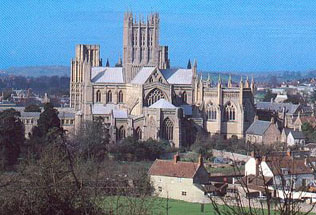
After getting all our mundane Saturday morning chores done, the three of us set off for Wells. Wells gets its name from the many springs in the area, which in the Middle Ages, were thought to have curative powers. The town was originally a Roman settlement but only became important under the Saxons when King Ine of Wessex founded a minster church here in AD 704.
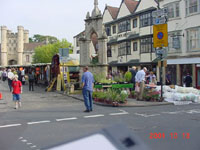
I can't imagine a lovelier, more historic setting for a market than at Wells. For 800 years the market has stood on almost the same site in the ancient market place, overlooked by the splendour of the ancient cathedral. Wells holds twice weekly markets in the market place (Saturday's and Wednesdays). You can buy a wide range of goods from clothes and jewellery to organic vegetables, plants and olives.
It was in the Wells market place in 1695, that the quaker, William Penn the founder of Pennsylvania preached to a huge crowd. He was arrested for unlawful assembly, only to return some weeks later to continue his crusade.
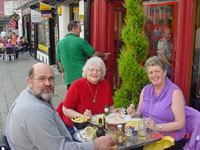 After a very nice lunch at an Italian Bistro type cafe called Ricardo's, seated outside on the sidewalk and being entertained by a pan piper who was playing from a doorway across the street, we briefly joined the shoppers.
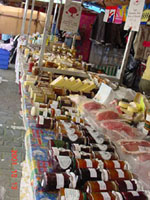 There were wonderful cheeses, and home made chutneys, relishes and jams for sale, needle work stalls that sold both supplies and completed craft projects, the proverbial jewelry, CD's, Video stalls and one stall that sold only boot laces. More lengths, colors, widths than I ever imagined existed. Apparently there is a great demand for bootlaces in Somerset. And last, but not least, at least 6 used bookstalls. I am ashamed to admit this but I was so fascinated by the cathedral and itching to go inside so I spared hardly a glance at the bookstalls. This has to be some kind of a first for me.
The cathedral was just awesome. It is, in my opinion the most beautiful cathedral in Britain and one of it's best kept secrets. The structure as it stands today was started in 1180 by Bishop Reginald de Bolun who pulled down the old Cathedral (circa 705!) and began building the current one. He was only responsible for the transepts, parts of the choir and nave and the north porch. His successors completed the project which took 250 years. Before 705 A shrine of some sort existed here long before Christianity came. Over the years it has been built up, torn down, and partially blown up (1552 during the Reformation). It has survived throughout the years dignity intact. As soon as you walk inside you know you are in a place of worship. It is one of the few cathedrals that has resisted being comercialized and turned into a tourist attraction like Salisbury.
Bob opted to sit on a bench in the very lovely and peaceful garden behind the cathedral. The garden was very much a place where people just came to relax. There was one lady napping on a bench, a couple on the other side was having a very quiet row, (that's an argument to us) and two ladies with toddlers who were visiting with each other while the tots played. So peaceful and beautiful.
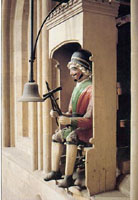 Inside Jenny and I wandered, mouths almost hanging open at all the sheer splendor. We read inscriptions of some of the dignitary's buried under the floor, peeked into all the small chapels that ring the nave and stopped and watched the clock in the north transept ring the hour. A figure of a bearded man in red (Jack Blandiver, whoever he was) sitting above and to
the right of the clock, rings the clock's bells with hands hammering and feet kicking. A mini-castle is immediately over the dial. Four mounted knights come out. Two move to the left, the other two go right. They revolve and at each revolution one knight is knocked backwards on his horse. This happens several times and then the tournament is over for another quarter of an hour. According to one of the guides, this has happened without interruption every fifteen minutes for the last 650 years.
Inside Jenny and I wandered, mouths almost hanging open at all the sheer splendor. We read inscriptions of some of the dignitary's buried under the floor, peeked into all the small chapels that ring the nave and stopped and watched the clock in the north transept ring the hour. A figure of a bearded man in red (Jack Blandiver, whoever he was) sitting above and to
the right of the clock, rings the clock's bells with hands hammering and feet kicking. A mini-castle is immediately over the dial. Four mounted knights come out. Two move to the left, the other two go right. They revolve and at each revolution one knight is knocked backwards on his horse. This happens several times and then the tournament is over for another quarter of an hour. According to one of the guides, this has happened without interruption every fifteen minutes for the last 650 years.
 Outside and to the right was the ruins of the old Bishops Palace which are still ringed by a real, honest to goodness moat, complete with swans.
After we exhausted ourselves drinking in all the splendor we had a brief cup of tea. Under one of the archway's leading into the cathedral there is a sign that read "poor arch". Since the building of the cathedral this is a spot has been set aside for beggars. A Busker (street performer) was playing his guitar and singing much to everyone's dismay. He was so awful it's impossible to describe. We quickly drank our tea and moved on.
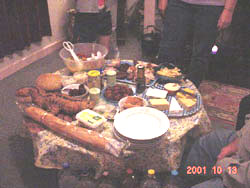
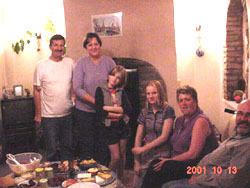 When we left Wells we drove to the Parish of East Pennard, about 7 miles outside of Shepton Mallett, where Bob's uncle lives. This uncle is a much younger brother of his Dad so Phil is not all that much older than Bob and his wife is probably younger, although naturally, I didn't ask. This is a delightful place to visit. Ann served a delicious cold meat, salads and cheeses dinner (among the cheeses was a particularly nice Stilton) topped off with Apple Pie and Double Cream. I mention all this so that Kathy wouldn't think I had given up on rhapsodizing about the food. (more later about food).
 They live in a charming Victorian cottage. That means the house is relatively new, having been built around 1897. I know that because I did ask the age of the house. The atmosphere is very homely and comfortable; overflowing bookcases and musical instruments in almost every room. They are a very musical family. Both girls, Alice age 13 and Amelia age 11 play the cello and Alice and her Dad also play the organ. Alice told me that they are looking around for a small used piano as well. When I mentioned to Ann how comfortable the house felt she said that it sat directly on top of a Ley Line and was part of the Glastonbury Zodiac. Since I had never heard of either Ley Lines or the Glastonbury Zodiac I looked them up on the web. This is what I found.
"Power centers are places where ley lines begin. A power center is created by the presence of both ley energy and underground water. The combination of the two creates a power that has the capability to not only affect consciousness, but also to retain the feelings of people who have visited the site. Power centers can save feelings and emotions in the same way a computer disk holds programs or a battery holds energy."
Glastonbury Zodiac - "The Glastonbury Giants or Zodiac is a great landscape configuration, a circle 10 miles across. The 12 zodiac signs appear in their right order, formed by hills, outlined by roads and rivers. Katherine Maltwood who rediscovered this great circle in the 1930's claimed it as the original Round Table in Avalon with Arthur, Guinevere, Merlin and the Chief Knights still seated about it as the signs of the Zodiac and the seasons of the year. A great hound five miles long, the Girt Dog of Langport, guards this star temple. Several local legends and about 100 place-names, like Wagg on the Dog's tail, Earlake Moor on his ear, hint that these effigies were once well known. You will find Aries at Street, the Phoenix of Aquarius rises from Glastonbury Tor, and the circle continues around the Isle of Avalon."
I can kind of buy into the Ley Lines, but that Glastonbury Zodiac is a little airy fairy for me.
The next day, after a late start (it's hard to drag yourself away from that house) we returned to Bristol. I am going back to their house on Wednesday evening, Oct 31 and the next day Ann, the girls and I are going to spend all day in Glastonbury. I am going to climb the Tor if I have to crawl up the dang thing.
Sunday night we decided to get all gussied up and go out for a really good meal. I'm including this because I was so impressed with the Inn where we ate. It was originally built in 1146 but has only been licensed as an Inn since 1550. I just can't help it, this kind of stuff really does impress me. The food was excellent, I again indulged myself with steak, this time with a really wonderful Port sauce. Yummmmmmm.
Tomorrow I will probably go to Cardiff and next weekend we are going to the Isle of Jersey. I've managed to stay busy

