Edinburgh
Edinburgh, last stop in the tour. The Hotel was easily the nicest hotel we stayed in during the entire tour. The only drawback was that it was not in easy walking distance to the Princess St. shops and The Royal Mile so the cabs did a brisk business ferrying our group back and forth. Because I had visited Edinburgh many times before I felt comfortable riding the bus but I can understand the reluctance of people who were abroad for the first time in their lives. On my first trip to Edinburgh I would have been the same way.
The first afternoon in Edinburgh I made a rather quick trip down to the Waverley shopping mall and spent a couple of hours browsing through James Thin’s Bookstore and checked out the Celtic jewelry in some of the shops. I arrived back at the hotel a little early for dinner and stopped into the bar and had a drink. The barmaid was chatting with another patron about playing Rugby for the Edinburgh Ackees. I asked her if she knew Nicky, who was playing for the West of Scotland at that time. She knew who Nicky was, but was not personally acquainted with her. But it did open the way for a friendly conversation about the state of Women’s Rugby Football in Scotland.
The grapevine has apparently been humming with news of this group's spending prowess because both here in Edinburgh and in Sterling city officials were on hand to welcome us to their cities. I have been constantly amazed at some of the things that these ladies bought. Aside from buying up every tatty souvenier in sight, there have also been some really mind boggling purchases. The lady I shared a room with spent a considerable amount of time in Sterling trying to figure out how to fit the Claymore that she had purchased into her bags. She ended up taking it back to the shop she bought it from and having them ship it home for her.
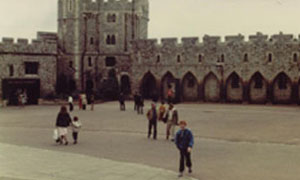 The next day the tour bus deposited everyone at the Edinburgh Castle. It would be very easy to spend an entire day wandering through the castle. The neatest thing about the castle is that upon entering, you can get a headphone set from a kiosk, and have your very own guided tour of the castle. Throughout the castle there are plaques drawing visitors to the most significant areas of the castle, and each one is numbered, giving quick info- then the headphone set gives a much more detailed account of that particular spot. Thanks to this, I am now a virtual fountain of knowledge about Edinburgh Castle. The castle itself sits upon an extinct volcano, and has been occupied, according to archaeological experts, since prehistoric times. The rock is approx 90 meters high, and oval-shaped. The oldest standing building is St. Margaret's Chapel which was built sometime during the reign of David I (1124-1153).
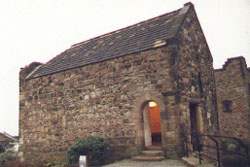 Saint Margaret was David's mother, and died at the castle in 1093.It is a very small chapel, it doesn't hold more than about twenty people, and it's very old, and it's very lovely. It is the oldest building in Edinburgh, and one of the loveliest examples of Norman architecture in Britain. It is very small and simple in design.
Until recently, it was thought to have been the very chapel where Queen Margaret worshipped, but it is now believed to have been built by her son King David at the beginning of the 12th century. When the Earl of Moray captured the castle in 1314, the chapel was the only building that was not destroyed, and, Robert the Bruce is said to have ordered, on his deathbed, that it be repaired.
The chapel has had many uses over the years, and was even a gunpowder store in the 16th century. In 1853, it was restored by Sir Daniel Wilson, who filled in the five small windows with stained glass, which were replaced in the early 1920s
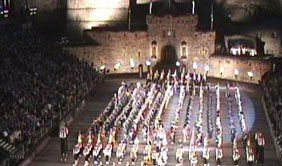 There are too many buildings within the castle to name and describe them all here, so I will just mention a few...The Royal Palace can be seen from the parking lot or Esplanade- an 18th century parade ground where the Edinburgh Tattoo is now held. The word Tattoo is derived from the Dutch word "Tap-toe" which means quite literally "turn off the taps". The signal which indicated that soldiers should return to their quarters and that the beer in the taverns should be turned off was transmitted by drum beat each evening. Eventually this developed into a ceremonial performance of military music by massed bands.
The Palace dates back to the reign of James I. and was the residence of the later Stewart Kings and Queens. It has undergone many alterations and additions over the centuries. Two rooms within the palace are of special interest. The first room is a small chamber where Mary Queen of Scots (1542-67) gave birth to James VI on June 19, 1566 who later became James I of England. The second room houses the Scottish Royal Regalia which were actually walled up in this room in 1707 and then rediscovered and put on display in 1818.
The other building I found of interest was Scotland's National War Museum which reopened earlier this year after a major 4.5 million pound refurbishment. The first gallery is named A Nation In Arms and offers an overview of the last four centuries of Scottish military history from the formation of professional armies through the instability and rebellions of the period following the union with England. It explains Scotland's strategic importance as a military location. Exhibits on display include a Scottish army field gun dating back to 1642 and a Lion Rampant flag lost by a New Zealand regiment during the German invasion of Crete in 1941.
The next section - A Grand Life For A Scotsman - turns the focus firmly back on the individual service man or woman with a look at life in the armed services and the business of recruitment and training. A display of recruiting posters down through the years demonstrates the different approaches used to encourage people to join up. Some of the more unsavory methods of enforcing military rules are also on display including a "Cat O' Nine Tails" used for flogging unfortunate military miscreants!
Weapons employed against the enemy can be found downstairs in Tools of the Trade - the third of six galleries. Highland Broadswords and dirks can be seen alongside muskets, Lee Enfield rifles and the modern day standard issue rifle and machine gun, the SA80. Equipment to protect troops from attack and items necessary for living in extreme environments is also on show in this section as are insights into the symbolic meaning of ceremonial dress and equipment.
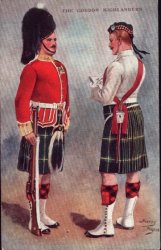 The significance of Highland dress and culture is evident in the fourth gallery which is devoted to the Highland Soldier. It tells the story of the history of the Highland Regiments from their use in policing the often rebellious Highlands on behalf of the British state to their prominent role in overseas battles and campaigns. One of the exhibits on display highlights the reputation Scottish soldiers gained through their military skills and bravery in other parts of the world. A German First World War propaganda medal shows the figure of Death as a Scottish piper - a reputation also revealed by the "ladies from hell" label given by German soldiers to their kilted enemy.
Gallery Five was named In Defense and looks at the role of volunteer Defense units through the centuries as well as the impact of mass conscription and volunteering in the early 20th century while the last section - Active Service - deals with the demands of war and the strategies employed by troops to endure the experience of battle. A life-jacket worn by a naval officer during the Falklands War of 1982 and a Victoria Cross won by RAF Flight Sergeant George Thomson, who died trying to save his comrades in 1945, are just two items given to the museum for display.
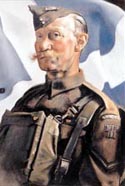 Other exhibits in the museum include a death mask of Earl Haig, protective clothing and riot equipment used in Ireland during the Troubles, a field surgery kit and a collection of letters written by soldiers on active service, many of whom never made it back home.
Given that more than 11 percent of the Scottish population served in World War One alone, the impact of military service on Scotland has been considerable and the new museum stands as a monument to the experiences of all servicemen and women and the wider Scottish community over the past 400 years. As you can see I spent a great deal of my time here.
Since I was planning on staying behind in Edinburgh for another day or so after the tour left, I did a quick stroll down The Royal Mile to the Waverley Shopping Center where I caught a taxi back to the hotel. I was extremely tired and not a little claustrophobic after spending so much time in crowds of people. I made the very unfortunate decision to skip the dinner that featured Dorothy Dunnett as guest speaker. At the time of this tour I had not ever heard of her or her books before, and decided that I would get more out of an early night so I would be rested up for the Riverdance performance the next evening. I now know who Dorothy Dunnett is and have read her Lymond Chronicles and King Hereafter. I deeply regret not attending that dinner.
The next morning I waved the tour goodby as they loaded up and headed for the Airport in Glasgow. I took a taxi to the B&B that Jenny had booked for us, deposited my luggage and set off for the National Scottish Portrait Gallery. I browsed around for a couple of hours and then walked down to Rose Street where I had lunch in one of the Irish Pubs and then on down to Princess Street where I just window shopped and then walked across the street to the park where I sat and watched the world go by.
About 4 pm I walked back to the B&B and met Jenny who had driven over from Helensburgh. We had made dinner reservations at The Witchery, a lovely little restaurant just down from Edinburgh Castle. We arrived a little early so we stepped into a tartan shop across the street and I purchased a lovely lambs wool stole that I have worn every winter since then. It’s my favorite winter wrap. We then went into the bar and had a before dinner drink and at 6 pm we went into the restaurant and had dinner. I remember that I had Lamb and it was delicious.
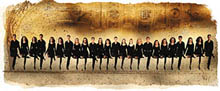 We then walked from the Restaurant all the way down to the theatre which was just around the corner from the Waverley Center. The performance was electrifying. When I could tear my eyes from the dancers I watched the band which was putting on a performance of its own. This was just after Michael Flatley had left the troupe and Colin Dunne was dancing the lead along with Jean Butler. I think that Dunne is a better dancer than Michael Flatley, but he doesn’t have the same stage presence.
After the performance we took a taxi back to the B&B and the next morning, after doing a little shopping along Princess Street, we drove back to Helensburgh and got ready to drive down to England.
HOME
PREVIOUS JOURNAL